

Key takeaways
Recurring payments allow you to automatically charge clients on a set schedule with prior authorization.
They improve cash flow predictability and reduce time spent chasing invoices.
Different recurring payment models (retainers, subscriptions, installment plans) fit different service structures.
With the right payment processor, you can take recurring payments online securely and automate billing, reminders, and reporting.
Few things disrupt a professional services firm faster than an unpaid invoice. Late payments create administrative work, strain client relationships, and make it harder to forecast revenue.
That’s why more firms now accept recurring payments as part of their standard billing process. Instead of sending reminders and following up on overdue invoices, you can set up recurring payments that run automatically on an agreed schedule.
In this guide, we’ll explain how recurring payments work, why they benefit professional services firms, and how to accept recurring payments online in 2026 using a secure, modern payment solution.
What is a recurring payment?
A recurring payment is a preauthorized charge that automatically bills a client’s saved payment method on a scheduled basis.
After a client provides consent and submits their payment details, your payment processor securely stores that information and charges the agreed amount at defined intervals—such as weekly, monthly, or annually. Payments may continue indefinitely, stop after a certain number of installments, or end once a set dollar amount is reached.
Recurring payments can be structured as fixed (the same amount each time) or variable (amounts change based on usage, hours, or milestones).
Benefits of recurring payments
If you’re wondering whether it’s worth shifting from manual invoicing to recurring payments, consider the operational and financial advantages:
Improve your cash flow: Recurring billing creates predictable revenue. When payments are scheduled in advance, forecasting becomes easier and overhead expenses are covered more reliably. Many businesses struggle with cash flow management, and consistent billing helps stabilize operations.
Speed up payment: Automated billing eliminates delays caused by mailed checks, forgotten invoices, or manual processing. Payments run on schedule, reducing the need for follow-ups and administrative time.
Improve client experience: Clients increasingly expect digital payment options. Automated billing allows them to budget more easily and avoid missed due dates. Clear notifications and reminders increase transparency and trust.
Focus on your work, not collections: When you set up recurring payments, your system automatically tracks charges, confirmations, and reporting. That means fewer manual tasks and more time spent serving clients.
Types of recurring payment models
Not all recurring billing structures are the same. The right model depends on your services, pricing, and client relationships.
Fixed recurring payments: A set amount is charged on a consistent schedule. Best for: Ongoing retainers or advisory services with predictable monthly fees.
Variable recurring payments: The amount fluctuates based on usage, time, or deliverables. Best for: Hourly billing arrangements or projects where workload changes month to month.
Subscription model: Clients pay a recurring fee for continued access to services or membership benefits. Best for: Compliance services, consulting subscriptions, or ongoing advisory access.
Installment/payment plan model: A total fee is divided into scheduled payments over a defined period. Best for: Large projects, fixed-fee engagements, or upfront costs that clients prefer to spread out.
Usage-based model: Clients are billed based on measurable consumption (hours, transactions, units). Best for: Firms with scalable services tied to measurable outputs.
Hybrid model: Combines a base recurring fee with variable or usage-based charges. Best for: Firms that want predictable baseline revenue plus flexibility.
Choosing the right structure depends on revenue predictability, scope clarity, and the complexity of your billing arrangements.
If you’re ready to accept recurring payments online, the process is straightforward when broken into clear steps.
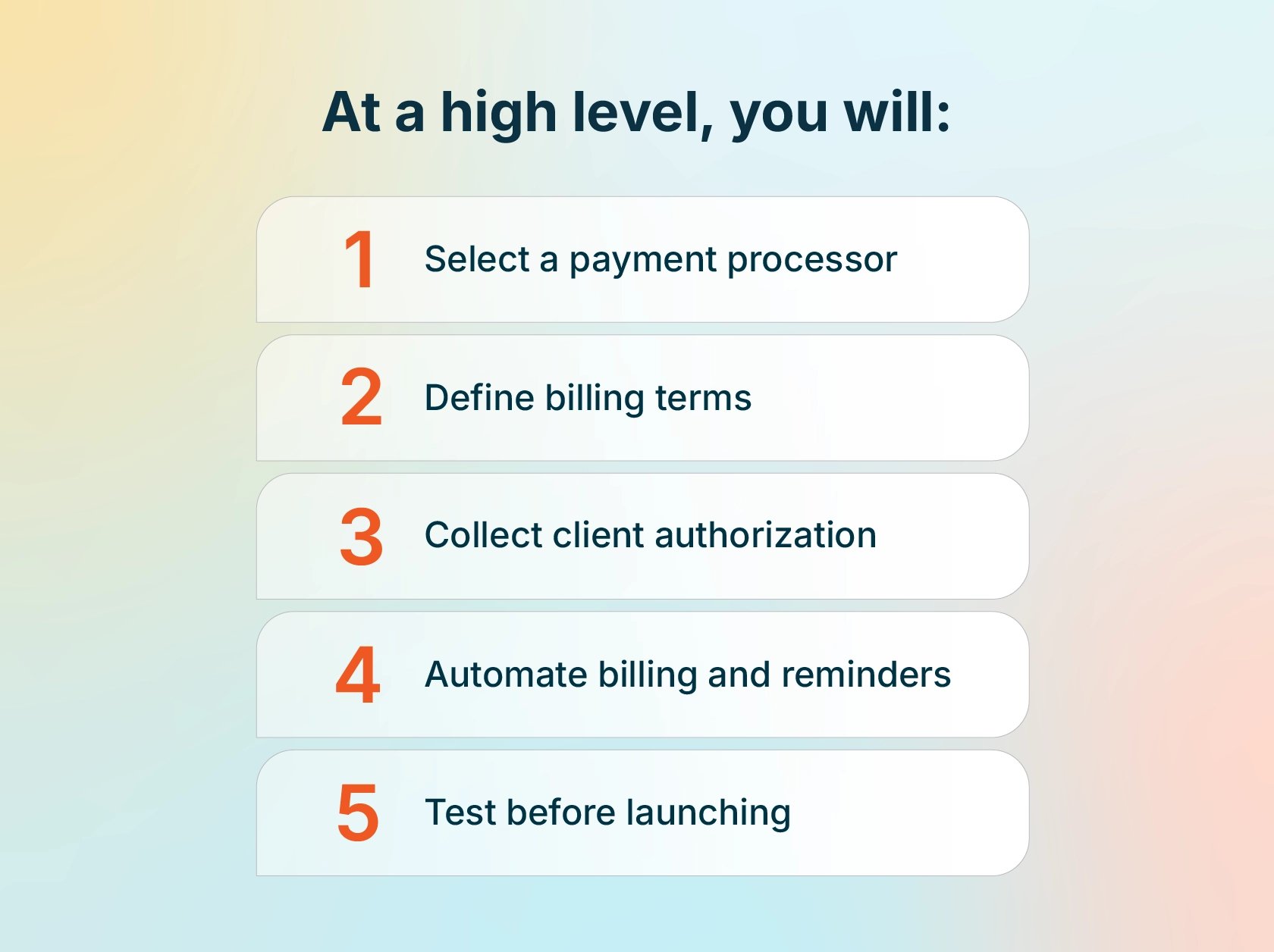
1. Choose a recurring payment processor
The foundation of any recurring billing program is your payment processor. The right platform should make it simple to set up recurring payments while protecting your firm and your clients.
Look for a secure, reputable provider that:
Supports automated recurring billing with flexible scheduling options
Accepts both credit/debit cards and ACH payments
Provides encrypted storage of payment data and PCI-compliant security
Sends automatic payment confirmations and reminder notifications
Integrates with your accounting, case management, or practice management software
Industry-specific solutions like 8am™ LawPay (legal), 8am CPACharge (accounting), and 8am ClientPay (broader professional services) are designed around the compliance, trust accounting, and workflow needs unique to professional firms. Choosing a platform built for your industry can reduce risk and simplify implementation.
2. Set your pricing and billing schedule
Once you’ve selected a processor, the next step is defining how you’ll structure your recurring charges. Your billing model should reflect the way you deliver services and how your clients expect to pay.
Consider:
Will billing be fixed (same amount each cycle) or variable (changes based on time or usage)?
Should payments run weekly, monthly, quarterly, or on a custom schedule?
Will the billing profile continue indefinitely, or end after a defined dollar amount or date?
Are you structuring the arrangement as a retainer, subscription, or installment plan?
Your billing schedule should align clearly with your engagement agreement. When expectations are set upfront, clients are more comfortable authorizing automatic payments—and you avoid confusion later.
3. Collect customer authorization and payment details
Clear authorization is one of the most important parts of setting up recurring payments. It protects both your business and your client by ensuring everyone understands the terms.
Best practices include:
Obtaining written consent that outlines the billing schedule, amounts, and start date
Clearly explaining cancellation, modification, and refund policies
Securely collecting payment information through encrypted, PCI-compliant forms
Retaining documentation of authorization for compliance and dispute resolution purposes
Taking the time to formalize this step significantly reduces the risk of chargebacks, misunderstandings, and billing disputes.
4. Automate billing and payment reminders
After authorization is secured, automation does the heavy lifting.
Within your payment system, you should:
Set the billing interval and start date
Enable automatic receipts for each successful charge
Activate reminder emails before the scheduled payment process
Configure alerts for failed or declined transactions
Automating both charges and communications reduces late payments, limits administrative work, and keeps clients informed without manual follow-up.
5. Test and launch your recurring payment system
Before rolling out recurring billing to clients, take time to test your setup internally. A short testing phase helps you identify small issues before they become larger problems.
Be sure to:
Run internal test transactions to confirm processing works correctly
Verify that notification and reminder emails trigger as expected
Confirm the deposits route to the correct bank account
Review reports to ensure transactions are recorded accurately
Once these checks are complete, you can confidently launch your recurring payment system knowing that payments, schedules, and communications will run smoothly from day one.
How do recurring payments work in different industries?
Recurring billing looks slightly different depending on your field, service structure, and client expectations. While the core concept—automated, preauthorized payments—stays the same, the way firms apply it varies by industry.
Law firms often use recurring payments for monthly retainers, installment plans tied to flat-fee matters, or subscription-style advisory services. For example, an immigration or family law matter may involve an upfront fee broken into scheduled payments, while general counsel or compliance support may be billed monthly. Recurring billing helps law firms maintain steady cash flow while giving clients manageable payment options. Learn more about LawPay’s recurring billing solutions.
Accounting firms and tax professionals commonly use recurring payments for ongoing bookkeeping services, payroll processing, or quarterly tax planning retainers. Larger tax preparation or audit engagements may also be divided into installment plans. Because accounting work is often cyclical or continuous throughout the year, recurring billing creates consistency for both the firm and the client.
Architecture, engineering, and construction (AEC) firms frequently rely on progress-based installment billing tied to project phases or milestones. Some also implement fixed monthly retainers for advisory or consulting work. Recurring payment schedules aligned with project timelines help reduce delays and keep projects moving without financial interruptions.
Across industries, the benefits are similar: more predictable revenue, fewer manual collection efforts, and a smoother client payment experience.
Implement recurring billing with 8am payment solutions
8am provides payment technology tailored to professional services firms, with solutions designed around the specific compliance, workflow, and billing needs of each industry.
LawPay: Designed specifically for law firms, LawPay includes compliance-focused features and built-in scheduled payments functionality. It supports trust and operating account separation and helps firms manage recurring retainers and installment plans with confidence.
CPACharge: Built for accounting and financial professionals, CPACharge supports recurring billing for bookkeeping, tax planning, and advisory services. It enables secure client payments while aligning with the way accounting firms structure ongoing engagements.
ClientPay: A flexible payment solution for a wide range of professional services firms—including AEC, consulting, and other advisory businesses—ClientPay makes it easy to take recurring payments online and manage billing in one place.
Each platform allows you to set up recurring payments quickly, automate billing schedules, send reminders and confirmations, accept both card and ACH payments, and track reporting from a centralized dashboard—helping your firm reduce administrative work while improving payment consistency.
To learn more about implementing recurring payments in your firm, contact 8am.