

Key takeaways
Accounting firm profitability depends on four core drivers: pricing strategy, service mix, staffing leverage, and operational efficiency.
Margins may decline due to underpriced services, delayed payments, and manual administrative work.
Tracking key performance metrics like utilization rate, realization rate, and average revenue per client helps firms identify profit leaks.
Digital billing and payment systems can improve cash flow by reducing administrative work and accelerating collections.
Many accounting firms are busy year-round but still struggle with profitability. Revenue often spikes during tax season, yet unclear pricing, slow payments, and heavy administrative workloads can make it difficult to maintain strong margins year-round.
Another challenge is that many firm owners lack a clear standard for what “good” profitability looks like. Because industry benchmarks vary by firm size, service mix, and operational efficiency, it can be challenging for firms to maintain healthy margins as they grow and financial conditions change.
When margins fall short, the cause is often a mix of underpriced services, inefficient workflows, and inconsistent cash flow. These issues can be easy to miss when a firm is focused on delivering client work day to day.
Accounting practices that track key business metrics, refine pricing strategies, expand high-value services, and improve billing and payment processes are better positioned to maintain strong margins and predictable revenue.
This guide explores the key factors influencing accounting firm profitability and outlines seven practical steps to improve margins and strengthen long-term financial stability.
What is accounting firm profitability?
Accounting firm profitability refers to a firm's ability to generate consistent profit after accounting for all operational expenses, staffing costs, and overhead.
In simple terms, profitability measures how efficiently a firm converts its revenue into profit. Several factors influence profitability for accounting firms, including:
Pricing structure for services
Mix of high-margin vs. low-margin services
Staff utilization and workload distribution
Operational efficiency and technology adoption
Payment speed and collections processes
Firms that actively manage these areas tend to achieve higher margins and more predictable revenue throughout the year.
Common challenges with accounting firm profitability
Even successful accounting firms face operational challenges that can quietly limit profitability. Issues such as outdated pricing models, inefficient internal processes, and delayed payments may not seem significant individually, but together they can steadily erode margins and make revenue less predictable.
Underpricing services: Many firms rely on outdated hourly pricing or hesitate to raise fees. As service scope grows, pricing often fails to reflect the true value delivered, which reduces margins.
Inefficient workflows and manual processes: Administrative work such as billing, payment tracking, and data entry consumes valuable staff time. These tasks reduce billable capacity and limit the overall productivity of the accounting firm.
Delayed payments and inconsistent cash flow: Slow collections and delayed billing can create gaps between when work is completed and when revenue is received.
Seasonal revenue fluctuations: Many accounting firms experience large revenue spikes during tax season, followed by slower periods throughout the year. Without recurring revenue or structured billing practices, this seasonal pattern can make profitability unpredictable.
Key profitability metrics and benchmarks for accounting firms
Tracking performance metrics helps firm owners understand where profitability may be leaking.
Below are several metrics every accounting firm should monitor:
Profit margin: The percentage of revenue remaining after expenses. Higher margins generally indicate efficient operations and effective pricing.
Utilization rate: Utilization rate measures how much of a staff member’s time is spent on billable work versus administrative tasks. Improving utilization often increases revenue without increasing staffing.
Realization rate: The percentage of billed work that is actually collected. Discounts, write-downs, and unpaid invoices reduce realization.
Average revenue per client: This metric measures the revenue each client generates. Firms that bundle services or offer advisory support often increase revenue per client.
Client acquisition cost (CAC): The cost of acquiring a new client through marketing and sales activities.
Payment method mix: Tracking how clients pay—whether by credit card, ACH, or check—can reveal opportunities to accelerate collections.
Client concentration: This metric measures how evenly revenue is spread across a firm’s client base, helping avoid overreliance on a small number of clients.
Accounts receivable (AR) days: The average time it takes to collect payment after an invoice is issued.
Firm size | Profit margin benchmark | Utilization rate benchmark | Realization rate benchmark |
Small firm (< $2M revenue) | 20–30% | 65–75% | 90–93% |
Mid-size firm ($2M–$20M) | 25–35% | 70–80% | 88–92% |
Large firm ($20M+) | 30–40% | 75–85% | 85–90% |
Source: The 2025 AICPA PCPS/CPA.com National Management of an Accounting Practice (MAP) Survey
Steps to make your accounting firm more profitable
Improving profitability often requires adjustments across a firm’s operations. Pricing strategy, service mix, staffing leverage, and operational efficiency are four areas that tend to have the biggest impact on accounting firm margins.
Strong pricing strategies raise revenue without adding more work; an optimal service mix increases average client value; smarter staffing improves capacity; and efficient systems reduce time spent on low-value administrative tasks.
Firms that make progress in even one or two of these areas can improve revenue quality and minimize operational friction that quietly eats into profit.
Step 1: Audit your firm's profitability drivers
The first step toward improving accounting firm profitability is identifying where revenue may be leaking. A profitability audit should review pricing, utilization, collections, and client fit—not just top-line revenue.
The 2025 MAP Survey shows median total net client fees increased 6.7% year over year, but growth alone does not guarantee strong margins. The survey defines top-performing firms as the top 25% based on net remaining per partner, highlighting that the most profitable firms are not always the busiest.
Start by reviewing pricing models and realization. Evaluate whether fixed-fee work is still priced appropriately, whether staff are writing off time, and whether scope creep is affecting recurring engagements. Then assess staff utilization and capacity.
According to the 2025 MAP Survey, firmwide utilization ranges from about 48% in smaller firms to roughly 58–61% in mid-sized firms, suggesting many firms still have room to improve how work is assigned and managed.
Client profitability should also be part of the review. Many firms use an ABC framework to group clients based on value and fit, helping identify where to focus or adjust engagements:
A clients: High-value clients who benefit from advisory services and pay reliably
B clients: Stable clients with growth potential and consistent engagement patterns
C clients: Lower-value or high-maintenance clients who may require repricing, scope adjustments, or referral
This type of segmentation is increasingly common: 56% of firms in the 2025 MAP Survey reported culling clients in 2024 to improve profitability and focus on better-fit engagements.
A strong audit should also evaluate internal workflows. The 2025 Thomson Reuters State of Tax Professionals report found that improving efficiency through technology remains the top priority for firms. Yet automation adoption remains uneven: 18% of firms report no automation, and nearly half say only 1–25% of their tax workflows are automated. That gap highlights a significant opportunity to reduce manual work across billing, data collection, and administrative tasks.
Step 2: Align with clients' needs and goals
Once you understand where profit is leaking, the next step is ensuring your services align with what clients actually need. Firms that stay close to client goals are better positioned to retain business, cross-sell services, and adjust pricing confidently.
According to the 2025 Thomson Reuters State of Tax Professionals report, three-quarters of firms say clients are seeking more tax and business advice beyond basic tax preparation. This demand creates opportunities to expand beyond compliance work and deliver higher-value advisory services.
Client segmentation helps firms tailor services and pricing based on value and fit. A clients often benefit from premium, advisory-focused packages; B clients align well with standardized offerings; and C clients may require repricing, scope adjustments, or referral if they no longer fit the firm’s ideal profile.
Specialization can further strengthen this approach. The 2024 CPA.com Client Advisory Services (CAS) Benchmark Survey found that firms generating at least half of their CAS revenue from defined niches often perform better, and top-performing firms typically focus on four to six industries. Concentrating on specific niches allows firms to standardize processes, deepen expertise, and deliver more strategic advisory services.
Step 3: Embrace upskilling and expand services
As your firm grows, pricing and service offerings should evolve to reflect the value you deliver. Many accounting firms unintentionally underprice their work because fees remain tied to outdated hourly models or haven’t been reviewed in years. Regular pricing reviews help ensure your firm is compensated appropriately while maintaining healthy profit margins.
Start by evaluating the true cost and value of your services. Review the time required to complete each engagement, the resources involved, and the outcomes delivered to the client. This type of analysis can reveal underpriced work and highlight opportunities to restructure services or adjust pricing.
Many firms are also moving away from strictly hourly billing toward fixed-fee or bundled pricing models. Packaging services together can make costs more predictable for clients while ensuring the firm captures the full value of the work performed.
Expanding into higher-value services can further increase accounting firm profitability. As client needs evolve, firms that broaden their offerings can generate more revenue per client while strengthening long-term relationships. Examples of higher-value services include:
CFO or financial advisory services
Industry-specific consulting packages
Technology implementation and process improvement guidance
Firms can also increase profitability by cross-selling additional services to existing clients. Service bundles, periodic financial reviews, and structured add-on offerings make it easier to introduce new services while delivering greater value to clients. Over time, this approach increases average revenue per client while positioning the firm as a strategic partner rather than just a compliance provider.
Step 4: Optimize staffing leverage and capacity
Staffing leverage plays a key role in accounting firm profitability. As firms grow, aligning the workloads of partners, managers, and staff helps teams deliver more work efficiently while protecting margins. When senior professionals spend too much time on tasks that could be delegated, firms lose opportunities to scale.
Many firms follow a staffing pyramid model, where a smaller number of partners oversee a larger team of managers and staff. In this structure, partners focus on client relationships and strategic guidance, managers coordinate projects, and staff handle much of the day-to-day work.
A typical staffing pyramid may look like:
1 partner
2 managers
5–6 staff members
Capacity planning is just as important. Firms should regularly review workloads, utilization rates, and staffing needs to ensure teams are neither overloaded nor underused. A well-balanced staffing structure allows firms to take on more work while maintaining strong margins and consistent service quality.
Step 5: Implement strategic pricing models
Strategic pricing can significantly improve accounting firm profitability when it accurately reflects the value and scope of the work being delivered. Many firms still price recurring services too conservatively or rely on hourly billing longer than necessary.
Industry data shows that pricing models are shifting quickly. The 2024 CPA.com CAS Benchmark Survey found that reliance on hourly billing dropped from 53% in 2018 to just 10% in 2024, while 84% of firms now use fixed-fee pricing billed monthly, quarterly, or annually.
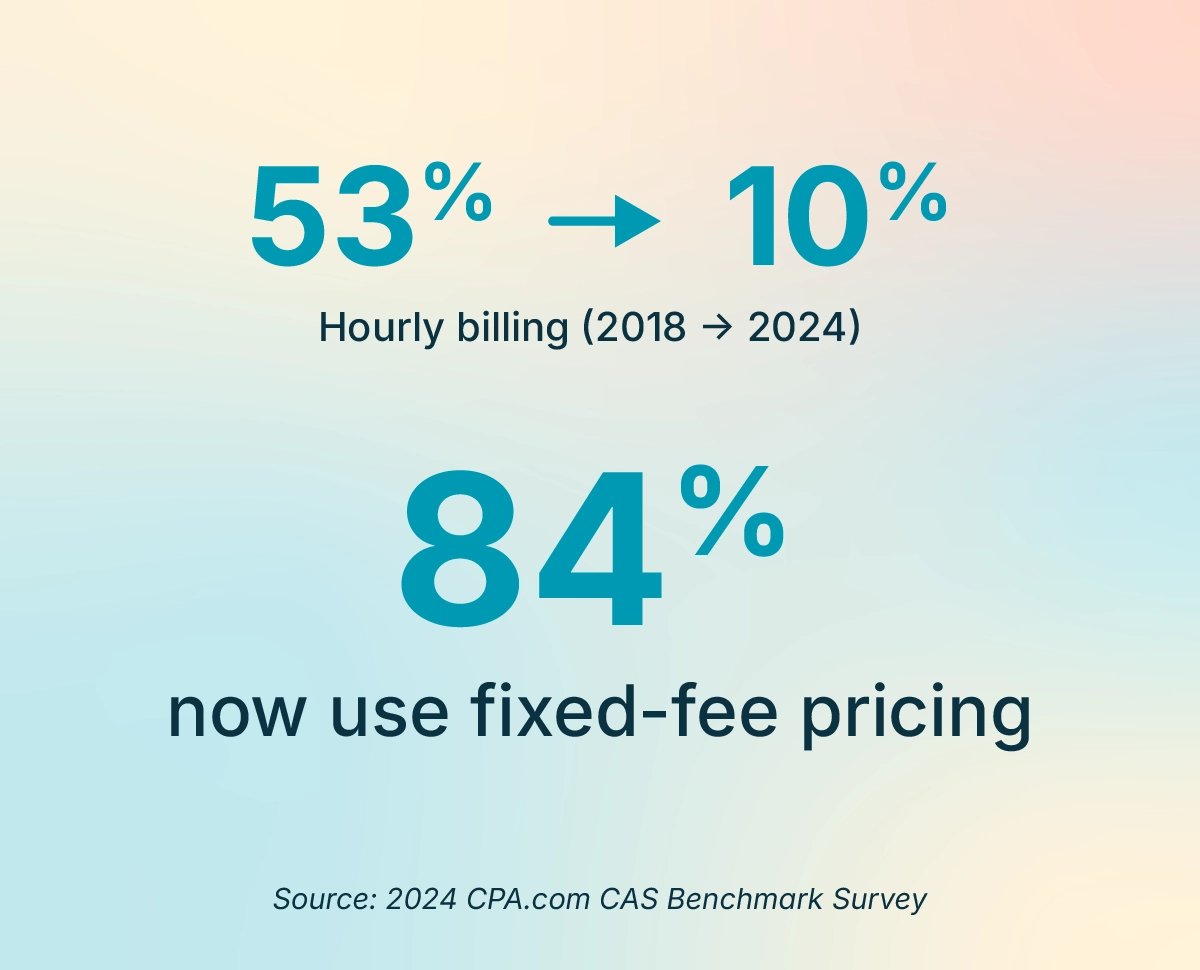
Fixed-fee and subscription pricing improve revenue predictability and encourage clearer service scopes. CPA.com also notes that firms using fixed-fee models should regularly reassess pricing and track out-of-scope work to prevent scope creep from eroding margins.
Regular pricing reviews are increasingly common across the profession. The 2025 MAP Survey reported median net client fee growth of 6.7% year over year, following 9.1% growth in the prior survey, reflecting ongoing pricing adjustments across firms.
Instead of relying on one pricing model, many firms use a mix depending on the type of work:
Pricing model | Best for | Strength | Considerations |
Hourly | One-off or unpredictable projects | Familiar and flexible | Less predictable revenue; easier to underbill |
Fixed-fee | Recurring compliance work | Predictable revenue and simpler billing | Requires a clear scope and periodic price review |
Value-based | Advisory and strategic consulting | Aligns pricing with client outcomes | Requires strong positioning and communication |
Retainer/subscription | Ongoing advisory or CAS services | Consistent cash flow and long-term relationships | Requires disciplined packaging and scope management |
Across the profession, fixed-fee and subscription pricing are becoming the default for CAS, while traditional time-and-materials billing continues to decline.
Step 6: Master collections and cash flow
Profitability depends not only on how much work your firm completes, but also on how quickly you get paid. Clear accounts receivable (AR) policies help reduce payment delays and keep cash flow predictable.
Start by setting clear payment terms in engagement letters so clients understand when and how payment is due. Other best practices include offering autopay with stored payment methods, applying late fees for overdue invoices, and establishing stop-work policies for delinquent accounts.
Firms should also plan for seasonal revenue swings. Recurring billing for advisory services can create a steady monthly income, while installment plans for tax work allow clients to spread payments across the year. Faster payment processing—such as online payments, automated invoices, and reminders—can further reduce delays and improve revenue predictability.
Step 7: Modernize billing and payment processes
Modernizing billing and payment processes can significantly improve cash flow and reduce administrative workload. Many accounting firms still rely on manual invoicing or paper checks, which can slow collections and create extra work for staff. Digital invoicing and online payment options make it easier for clients to pay quickly and help firms receive funds sooner.
Automated billing tools can also reduce time spent on routine tasks. Features such as recurring invoices, automated payment reminders, and integrated payment processing help firms manage billing more efficiently while minimizing follow-up work. Integrated reporting tools also make it easier to track payments and identify overdue accounts.
Adopting modern billing systems not only speeds up collections but also improves the client experience. Providing convenient payment options and clear, automated invoicing helps firms maintain steady cash flow while freeing staff to focus on higher-value work.
Make your firm more profitable with 8am™ CPACharge
Improving accounting firm profitability requires visibility into key performance metrics, consistent pricing strategies, and efficient billing and collection processes. Technology can play an important role in supporting these efforts by reducing administrative work and helping firms collect payments faster.
Built specifically for accounting professionals, CPACharge helps firms manage billing, payments, and financial reporting in one solution. With the right systems in place, firms can spend less time chasing invoices and more time focusing on client work.
CPACharge helps firms improve cash flow and operational efficiency through tools designed for modern accounting practices, including:
Professional billing and invoicing tools that allow firms to send invoices quickly and manage client billing in one place
Secure payment processing that enables clients to pay online using credit cards or ACH, helping firms get paid faster
Built-in reporting tools that give firms visibility into payments, collections, and revenue performance
These capabilities help firms reduce payment delays, improve revenue predictability, and maintain better insight into financial performance.
Learn more about how CPACharge supports accounting firms, or see how it works firsthand by scheduling a demo.
If you’re ready to get started now, sign up for CPACharge.