

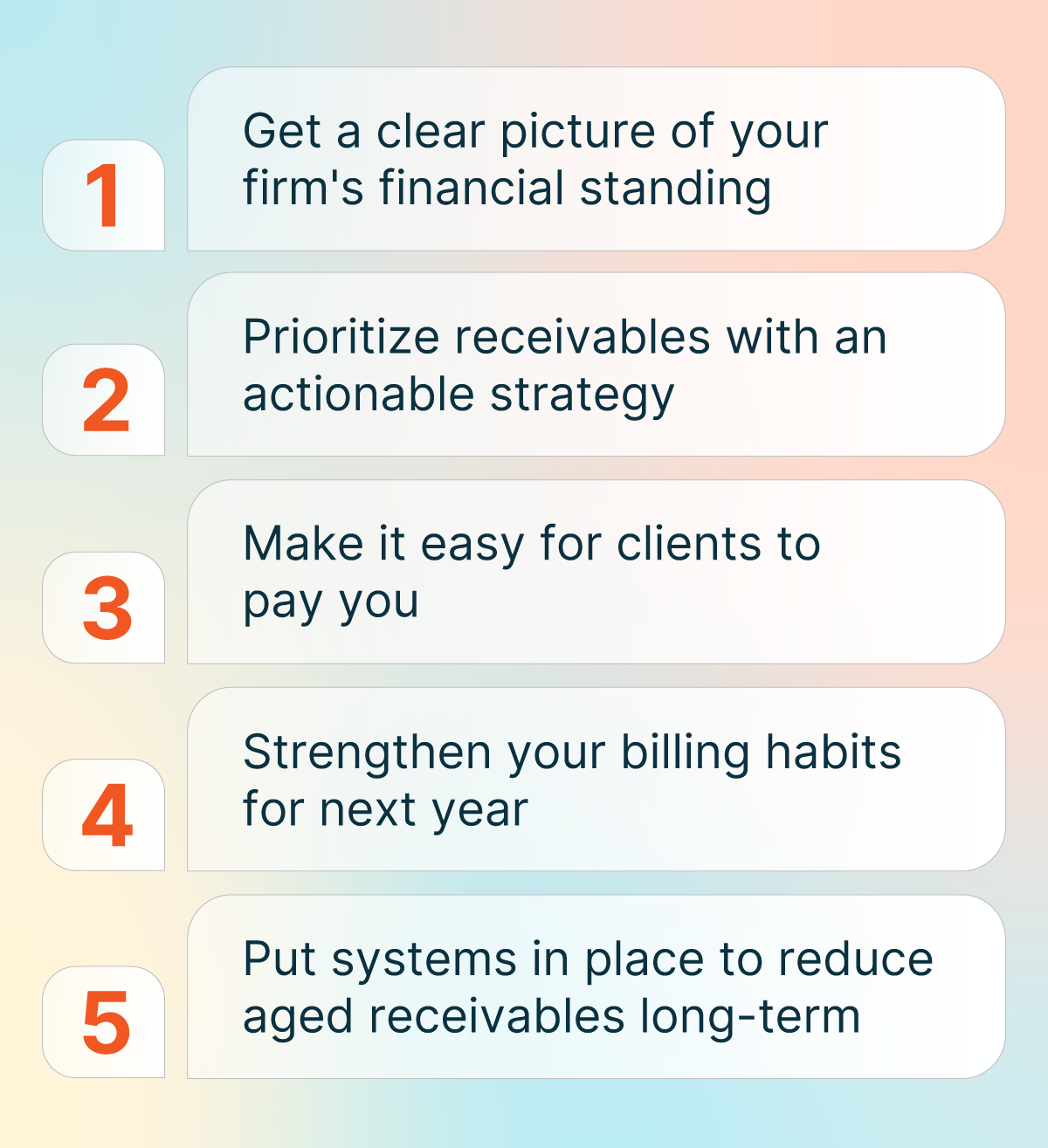
1. Get a clear picture of your firm’s financial standing
Before you can take meaningful action, gather a complete view of what’s owed, who owes it, and how long balances have been outstanding. This foundational step sets the tone for the rest of your year-end checklist, ensuring you prioritize your efforts effectively.
Start by compiling or exporting a list of clients with unpaid invoices. Include details like:
Client contact information
Total balance owed
Age of each invoice
Last payment date and amount
Notes on past communication or follow-ups
Many firms build this list manually, while others rely on practice management software to generate it instantly. If your system supports filters or tags, categorize clients by urgency so you know exactly where to focus your attention first.
Keeping all this information in one place—whether in a spreadsheet or your billing platform—helps you tailor your approach for each client. It also keeps your team aligned, especially when multiple staff members are handling collections or client outreach.
It’s also useful to look at historical trends. Some clients may always pay a few days late but rarely default, while others frequently let balances age without response. Insights like these help you set realistic expectations as you move into the next steps of your plan.
As you look toward 2026, the goal isn't just to survive the year-end close, but to thrive in the new year. For a broader strategy on future-proofing your firm, read Business spend management: Building financial resilience in uncertain times.
2. Prioritize receivables with an actionable strategy
Not all unpaid invoices are equal, and treating them the same can slow progress or lead to unnecessary write-offs. A focused accounts receivable management strategy—one that prioritizes invoices based on age and client behavior—helps you recover more revenue before the year ends.
Break your list into two categories:
Younger receivables (0–120 days)
These typically have the highest likelihood of full payment. Personalized outreach works well here—especially when it comes from the accountant who manages the client relationship. Clients tend to respond faster when they hear from someone they know rather than a general billing email address.
A few tips to improve results in this group:
Use clear, friendly language that outlines the outstanding balance and includes a direct payment link.
Follow up within a shorter timeframe (for example, every 7–10 days) rather than waiting for weeks at a time.
Make sure the person contacting the client has visibility into the entire relationship, including recent work or open questions.
When clients can take action in a single click—especially on mobile devices—the likelihood of a quick turnaround increases dramatically.
Older receivables (120+ days)
For older balances, a different approach is required. Once invoices age past four months, the likelihood of full payment drops, making a case-by-case review essential.
Begin by assessing which clients may still be willing or able to pay. Look at factors like:
Past payment behavior
Whether communication has recently stopped
Client size and capacity
Any ongoing or upcoming work still in progress
Clients who appear willing to resolve their balance may just need a different kind of motivation. One effective tactic is offering a one-time settlement option—reducing the total owed if payment is made by a specific deadline. While not ideal, recovering part of the funds is often better than writing off the entire amount.
Clients in this category are often more responsive when they
Receive a clear deadline
Understand what portion of their balance will be forgiven
Can pay digitally within minutes
This type of structured, time-bound offer communicates both urgency and good faith, giving clients a compelling reason to settle their balance before year-end.
3. Make it easy for clients to pay you
Clients today expect quick, flexible payment options. When payment requires multiple steps, printing paperwork, or calling your office, clients are far more likely to put it off.
Offering modern, convenient methods helps speed up collections and supports steady cash flow for accounting firms. Consider incorporating:
Electronic billing
Sending invoices digitally reduces lag time compared to mailing paper copies or attaching PDFs that require multiple steps.
Secure payment links
One of the most effective ways to encourage same-day payment, payment links, which remove friction, especially for clients on mobile devices.
Mobile-friendly
Clients increasingly pay invoices on their mobile devices. Ensuring your payment portal loads quickly and displays correctly on any device gives them fewer reasons to put it off.
Multiple payment methods
Credit cards, debit cards, ACH, and stored payment options give clients flexibility while supporting your firm’s cash flow.
Adding features like saved payment information and recurring billing can also prevent late payments altogether—especially when paired with authorization forms during client onboarding. These simple additions keep payments consistent and minimize back-and-forth follow-ups on overdue balances.
4. Strengthen your billing habits for next year
Once you’ve addressed immediate needs, shift your focus to building habits and systems that reduce aged receivables in the future. Creating a more predictable billing process can dramatically improve collections and client satisfaction.
Set expectations early
Discuss payment expectations during the initial consultation and include them in your engagement letter. When clients know what to expect—costs, timing, billing cadence—they’re better prepared to stay current.
Bill on a predictable schedule
Sending invoices on the same day each month creates consistency. Aim for earlier in the billing cycle, when clients are reviewing other bills and typically have more financial clarity.
Write invoices that clients understand
Avoid jargon and use straightforward descriptions of the work completed. This builds trust and reduces clarification emails that slow down payments.
Follow up sooner, not later
A short follow-up window—about one week after sending the invoice—keeps outstanding balances top of mind for clients and helps prevent accounts from aging unnecessarily.
Document communication
Record notes in your CRM or practice management system about client interactions related to billing. This keeps your team aligned and protects your firm if questions arise later.
Adopting simple billing practices can prevent delays before they happen. See exactly which habits move the needle in our 2026 Cash Flow Guide.
5. Put systems in place to reduce aged receivables long-term
Modern accounting firms rely on automation and integrated payment tools to cut down on repetitive tasks and ensure no bill goes unnoticed. When these tools are woven into your broader accounting workflows, they improve cash flow, reduce staff workload, and prevent late payments from snowballing into larger issues.
Consider implementing:
Recurring monthly payments for ongoing services
Automated payment reminders for upcoming or past-due invoices
Dashboards that give your team real-time visibility into receivables
Payment capture during onboarding to avoid delays later
Ownership within your team for monitoring receivables during key periods
When systems are aligned and automated, your firm spends far less time chasing outstanding balances—and more time supporting clients and growing the business.
Give your clients a better way to pay with 8am™ CPACharge
Closing out the year doesn’t have to feel overwhelming. With organized records, a structured approach to collections, and modern payment tools in place, your firm can reclaim revenue and start the new year with confidence.
If you’re ready to simplify payments, reduce friction in client billing, and support a healthier financial outlook for your firm, explore how 8am CPACharge helps accounting professionals get paid quickly and securely—wherever and however their clients prefer. Book a demo.
H2: FAQs: Accounting Firm Year-End Processes
What should accounting firms prioritize at year-end?
At year-end, firms should begin with a clear understanding of their financial position. This includes reviewing outstanding invoices, assessing productivity, and compiling accurate records of what’s owed and by whom. Establishing a structured year-end accounting workflow ensures your team can quickly identify priorities, focus on the most urgent receivables, and plan next steps with confidence.
How can accountants reduce aged receivables at the end of the year?
Reducing aged receivables starts with prioritizing outstanding balances based on invoice age and client behavior. Younger invoices often respond well to personalized outreach and clear, friendly reminders that include a direct payment link. For older balances, accountants may need a more tailored approach—such as offering time-bound settlement options or escalating communication frequency. Pairing these efforts with easy online payment options helps clients take action quickly and improves year-end collections.
What billing habits help accounting firms start the new year strong?
Strong billing habits set the foundation for better cash flow in the year ahead. Firms benefit from consistent invoicing schedules, setting expectations early in engagement letters, and automating routine tasks, such as payment reminders. Writing clear, client-friendly invoices and following up within a short window—about one week after sending—also helps prevent receivables from aging unnecessarily.
How do digital payment tools support accounting year-end workflows?
Digital tools make it easier for firms to move invoices from “sent” to “paid.” By sending invoices digitally and offering online payment options, firms reduce friction and give clients more flexibility. Features like secure payment pages, mobile payments, and stored payment methods help clients pay instantly—supporting faster cash flow and smoother accounting year-end workflows overall.
What systems should accounting firms put in place to improve next year’s financial operations?
Building stronger accounting workflows for the year ahead starts with the right systems. Automation can handle repetitive tasks such as reminders and recurring billing, while dashboards give teams real-time visibility into receivables. Scheduling follow-ups, capturing payment details during onboarding, and standardizing processes across the firm all help streamline operations and reduce aged receivables long-term.