

Key takeaways
69% of legal professionals now use general-purpose generative AI tools for work, more than double the 31% reported in last year's survey, making AI adoption in law firms one of the fastest technology shifts in the profession's history.
Despite rapid individual adoption, 54% of law firms offer no AI training, and 43% have no AI governance policy, creating a widening gap between AI experimentation and institutional readiness.
Firms that embed AI within trusted legal-specific platforms report higher confidence in output quality, with 52% choosing tools already integrated into existing practice management software.
The legal profession has experienced exponential rates of technology adoption in recent years. Since generative AI tools were introduced more than three years ago, they have been implemented faster than any technology that preceded them.
Historically, lawyers have been cautious about new technology. Their reticence is understandable; lawyers are trained to respect precedent and focus on reducing their clients’ past, present, and future risk. This attitude necessarily impacts their perspectives on new technology, which is often viewed through a lens of ethical and privacy concerns.
Generative AI has been a noticeable exception to this trend. Data from 8am’s 2026 Legal Industry Report indicates that high generative AI adoption rates are impacting legal workflows and changing how law firms operate. We track how quickly this shift is happening, where firms are seeing the greatest impact, and what it means for the future of legal practice.
Individual and law firm adoption climbs
This is the third consecutive year we’ve analyzed law firm trends in generative AI adoption. Survey data from 1,300 respondents shows a sharp increase in generative AI adoption across the legal industry.
Nearly seven in ten legal professionals now use general-purpose AI tools for work, which is more than double last year’s percentage (up from 31% to 69%). Individual adoption of legal-specific AI tools has also grown, with 42% of respondents reporting work-related use.
At the firm level, almost half of law firms (46%) have implemented general-purpose AI tools, and adoption is even higher among firms with 20 or more lawyers, where 58% report using them. Use of legal-specific AI tools within firms has also risen, from 21% to 34% in this year’s report.
The fact that more individuals than law firms have adopted these tools suggests that many legal professionals are using them without their firms' blessing. As the following data shows, the notable productivity benefits across a range of use cases likely drive their choice to use unapproved AI tools.
Top ways generative AI is used in law firms
For general-use AI tools, the most common applications require less confidential information. For example, top use cases include drafting correspondence (58%) and brainstorming (54%). Conducting general research was also popular, having more than doubled from 26% last year to 58%. Another 47% summarized documents with general-purpose AI tools (up from 39%).
Legal-specific AI tools are used somewhat differently, with top uses often involving sensitive information. Legal research was the most common at 58%, followed by document drafting (49%), and summarizing documents (47% up from 39%). Finally, 43% use these tools for drafting correspondence.
Not surprisingly, firms relying on legal-specific generative AI tools cited trust in the provider as the primary reason for their choice. More than half (52%) said the AI features were introduced into software their firm already uses, indicating confidence in established platforms.
Another 47% believe that their legal provider understands their firm’s needs and workflows, and 46% say the provider understands their ethical obligations. In addition, 43% report greater trust in the output of legal-specific tools compared to consumer-based options. Together, the data points to a clear theme: Firms prefer AI delivered by partners they already rely on that understand the realities and compliance obligations of law practices.
How much time does AI save lawyers?
AI is quickly becoming a part of everyday legal workflows. More than a quarter of respondents (28%) use AI every day, including 41% of immigration practitioners. Another 31% use it several times per week, 12% once per week, and 10% once per month or less. Only 19% report never using AI for legal work.
The benefits gained are significant, with 38% reporting that they save one to five hours per week because of AI adoption. Another 14% save 6 to 10 hours, 4% save 11 to 15 hours, and 4% save 16 or more hours per week. Only 6% report no productivity gains at all, down from 17% last year.
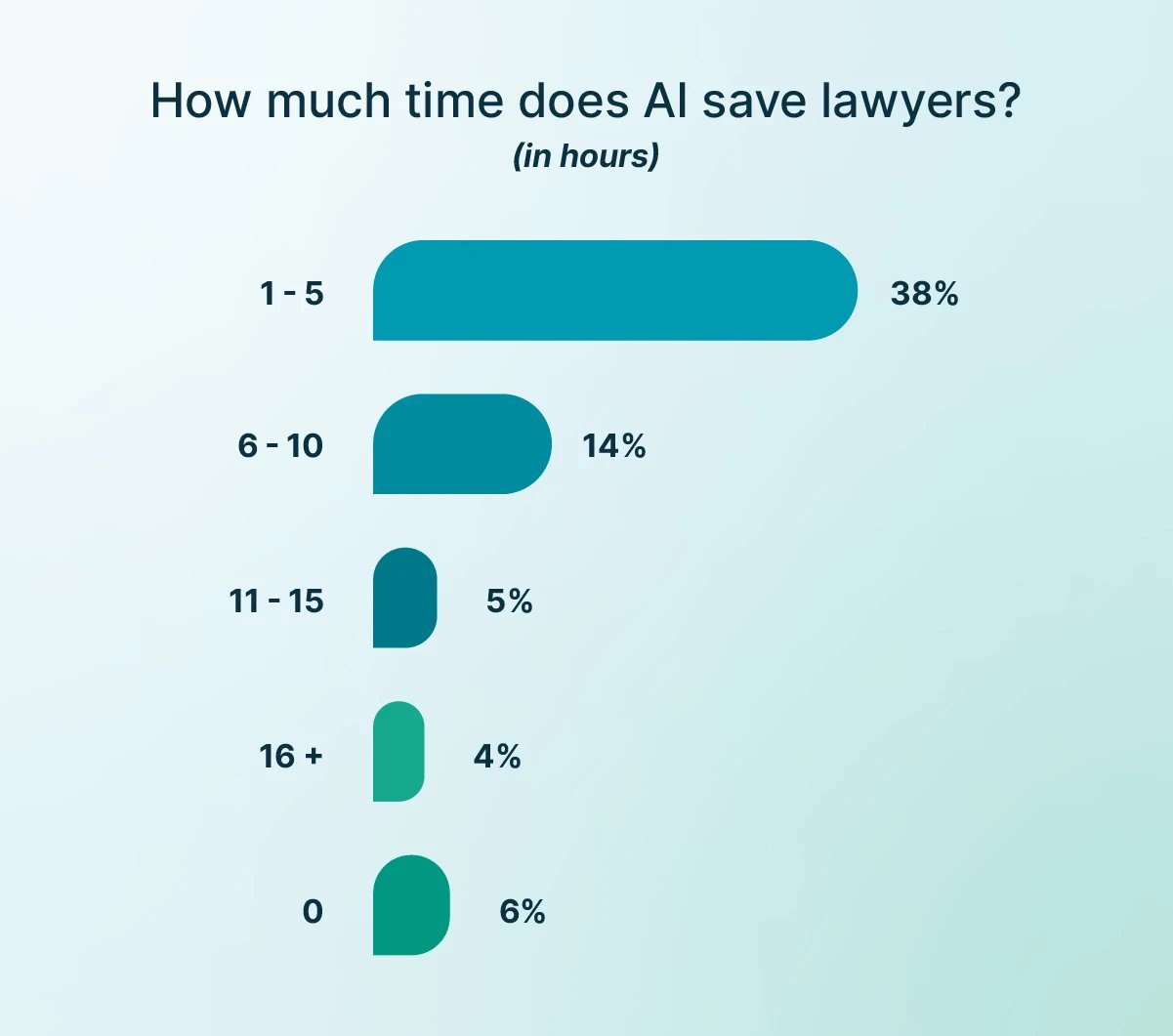
Interestingly, 33% report no time savings but say AI improves the quality of their work, suggesting that even when AI doesn’t result in productivity gains, its value extends beyond efficiency alone.
The training and governance disconnect
Despite widespread adoption, training and governance are noticeably lacking. Surprisingly, more than half of respondents (54%) say their firms offer no AI training and have no plans to implement it, and a mere 11% report mandatory training. When training is prioritized, it most often targets paralegals (39%), followed by partners (30%) and associates (26%).
Internal AI guidance is also limited. Forty-three percent said their firm has no AI policy, nor do they plan to create one. Less than one quarter (24%) report that a policy is in progress, and only 9% have a policy in place and actively enforced.
The disconnect between widespread use and limited oversight creates both opportunity and risk. We’re at a turning point in our profession. Legal professionals are reaping the benefits of AI and adopting it at a record pace, often without meaningful guardrails or guidance from their employers.
Meanwhile, many law firm leaders continue with business as usual, carefully weighing real risks and approaching the AI shift with caution rather than the urgency it deserves.
The data from this year’s report is a clear call to action: Now is not the time to rest on your laurels. Decisive action is needed. Firms that take a proactive approach to training, governance, and responsible implementation will be better positioned to manage risk while leveraging the many benefits of generative AI. If your firm has not yet investigated generative AI and determined a path forward, there’s no better time than now.
Download the full report here to hear more insights from your peers on legal AI adoption.