


Key takeaways
-
64% of criminal law professionals now use general-purpose AI tools at work, though firmwide adoption of legal-specific AI remains in the early stages.
-
Research, document review, drafting, and brainstorming are the most common ways criminal defense professionals are using AI today.
-
Most criminal law professionals report that AI improves efficiency, while many also see higher-quality work even without measurable time savings.
-
Trust, ethics, data security, and attorney-client privilege remain the biggest barriers to broader AI adoption in criminal defense firms.
Interest in AI continues to grow across the legal profession, and criminal law is no exception. From solo practices to larger firms, attorneys are exploring how AI for criminal defense lawyers can reduce repetitive work and free up more time for clients and case preparation.
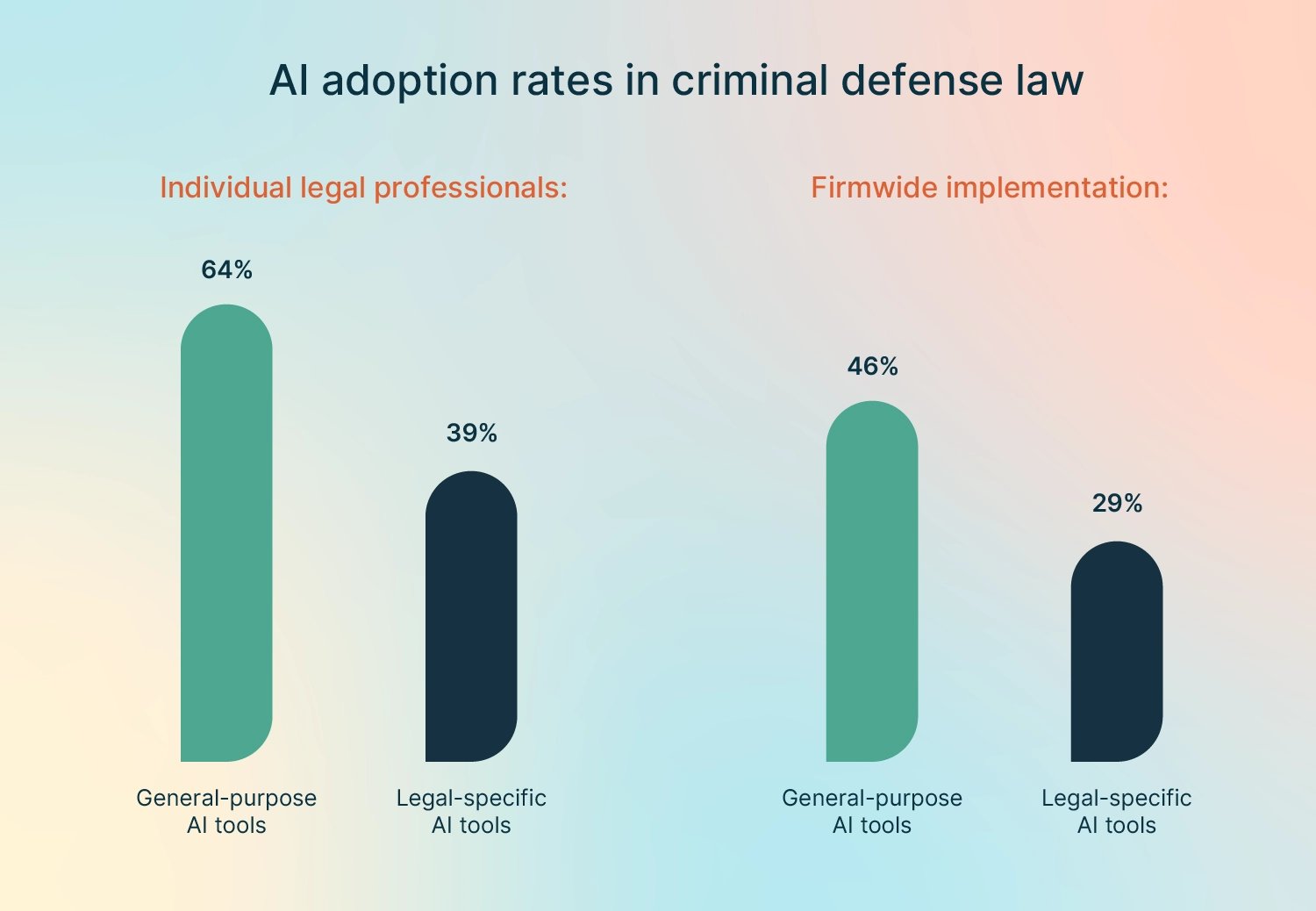
Nearly two-thirds of the criminal law professionals surveyed for the 8am 2026 Legal Industry Report said they personally use general-purpose AI tools such as ChatGPT, Claude, or Gemini. Yet fewer than 30% of criminal law firms have officially adopted legal-specific AI at the organizational level.
This gap reveals an important trend: Individual attorneys and staff are testing AI in their daily work, while many firms are still deciding how to use it responsibly, securely, and consistently.
AI cannot replace legal judgment, courtroom advocacy, or the attorney-client relationship, but it can significantly reduce time spent on tasks like summarizing records, searching through discovery documents, and drafting communications. In doing so, it eases the administrative strain, which 8am's Admin Misery Index found delaying client work for 35% of legal professionals. Admin work ultimately pulls attorneys away from focusing on case strategy and client service. This is an especially important consideration for solo and small practices that have limited support staff.
This article explores how criminal defense professionals are using AI today, where firms are seeing measurable benefits, which concerns are slowing adoption, and how legal teams expect AI to affect the future of criminal defense work.
How widespread is AI adoption among criminal defense firms?
AI use is becoming increasingly common in criminal defense practices, although most firms are still in the early stages of formal implementation.
According to the Legal Industry Report:
-
64% of criminal law professionals use general AI platforms for work-related tasks.
-
46% of criminal defense firms use general-purpose AI across the organization.
-
Only 29% of criminal defense firms have officially implemented legal-specific AI .
General AI platforms are easier to test, often require less upfront investment, and can support a wide range of everyday tasks, from preliminary research and brainstorming to marketing copy and business planning.
Because legal-specific AI tools are used for substantive legal work, criminal defense firms have to weigh questions about accuracy, confidentiality, ethics , and attorney oversight before formally adopting them. A firm may be willing to use a general AI tool for administrative work before approving legal AI for criminal law case analysis, research, or document drafting.
That hesitation doesn't necessarily signal lack of interest. It suggests many firms are still working through how to use AI in a way that fits the ethical, procedural, and practical realities of criminal defense.
What are criminal defense lawyers using AI for?
Criminal defense professionals who use general-purpose AI for legal work rely on it most often for research, document review, and drafting. Marketing is the most common area where firms are putting AI to use outside of direct legal work.
Research and brainstorming
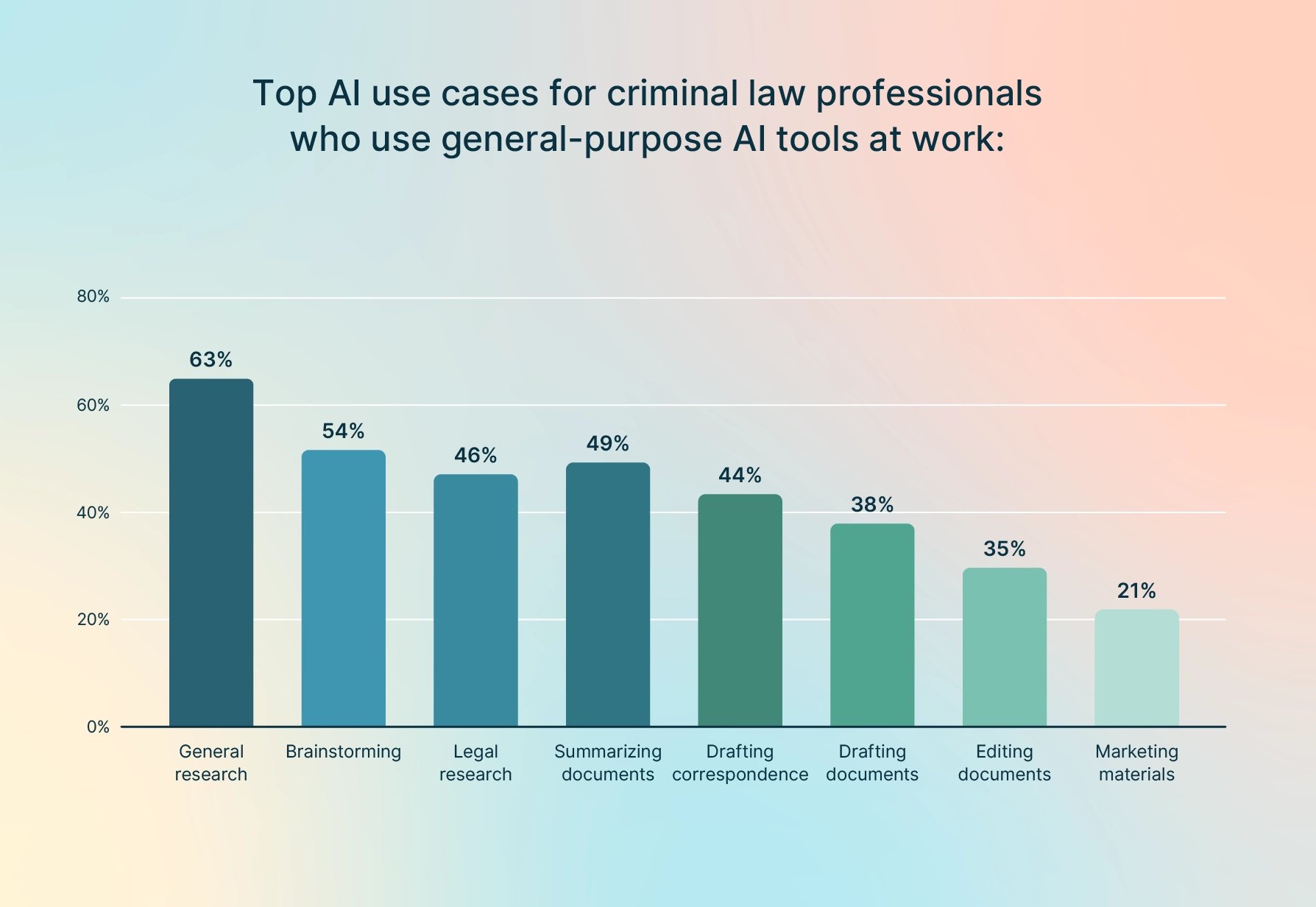
Research is the top use case for AI among the criminal law professionals who reported using AI tools in the Legal Industry Report: 63% of these respondents said they use general-purpose AI for general research, 54% for brainstorming, and 46% for legal research.
Attorneys and staff at criminal defense practices may use these tools to organize early case ideas, identify issues for further investigation, develop questions for witness interviews, or gather background information before conducting more in-depth legal analysis.
Summarizing documents
Nearly half of criminal law AI users surveyed for the 2026 report (49%) use general-purpose AI to summarize documents . That can be especially helpful in cases involving police reports, discovery files, witness statements, body camera transcripts, and other records that attorneys and staff need to review quickly without losing sight of key facts or inconsistencies.
Drafting documents and correspondence
Criminal defense professionals are also using AI to help with written work , including drafting correspondence (44%), drafting documents (38%), and editing documents (35%). These tools can help prepare first drafts of client updates, routine communications, internal notes, and other materials that require attorney review before they’re finalized.
Creating marketing materials
Marketing is the most common business-related AI activity among criminal law professionals who use general-purpose AI, with 21% using it to create marketing materials. AI marketing for criminal lawyers may include:
-
Content creation : Draft blog posts, FAQs, and educational content to drive organic search traffic and establish authority.
-
Local search engine optimization (SEO) : Use AI to generate location-specific landing pages, Google Business Profile content, and practice-area descriptions tailored to firm’s local area.
-
Social media and reputation management : Generate social content, respond to reviews, and create educational video scripts that position the firm as a trusted resource.
-
Advertising : Draft copy for print ads, billboards, digital display campaigns, sponsored articles, and other marketing materials that promote the firm's services across multiple channels.
How does AI benefit criminal defense law professionals?
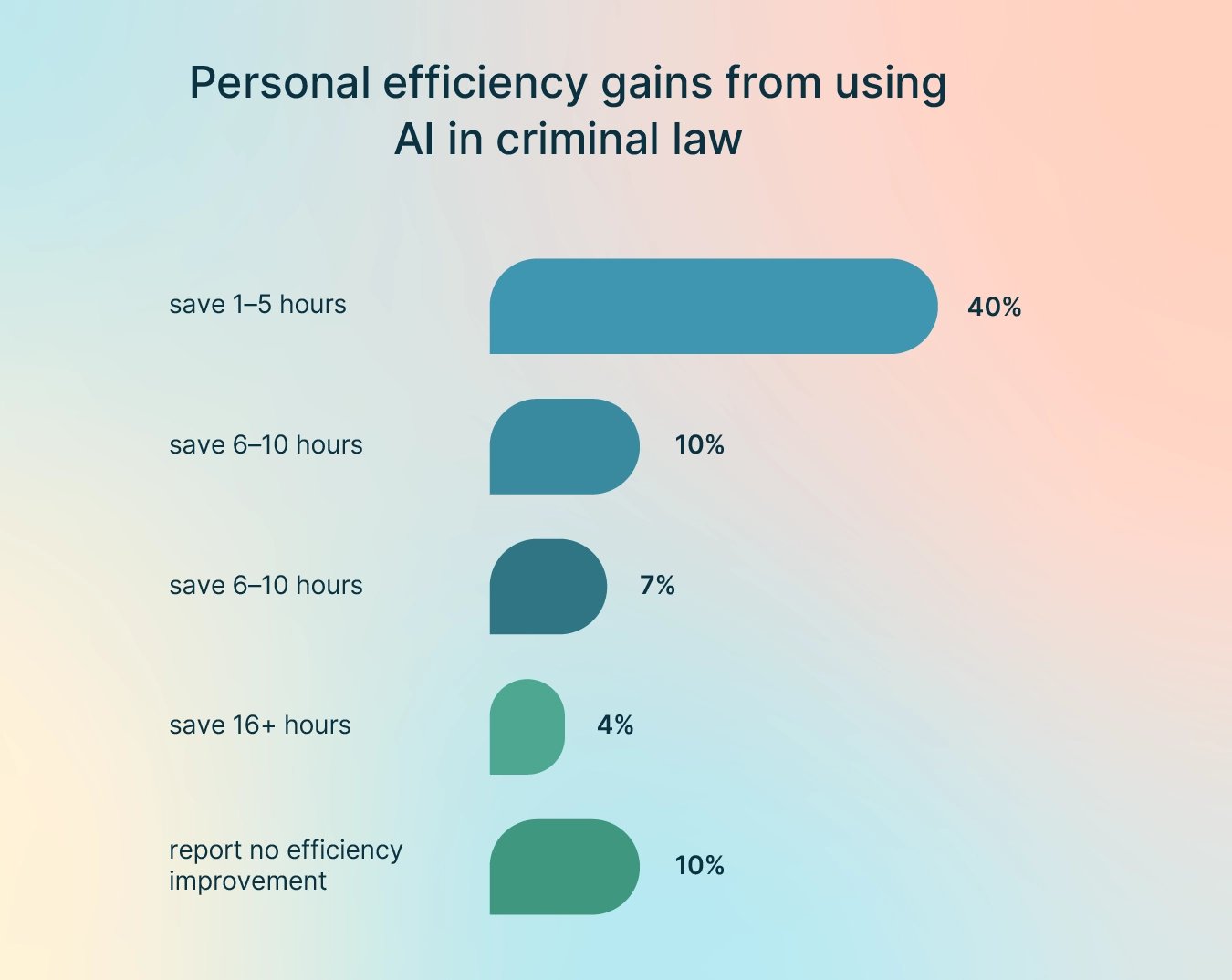
For most criminal defense professionals surveyed, AI is delivering measurable efficiency gains. Among respondents who shared insights on AI's impact at their practices, 61% said they have experienced time savings, with the largest group (40%) saving between one and five hours each week.
Reported weekly time savings break down as follows:
-
40% save 1–5 hours
-
10% save 6–10 hours
-
7% save 11–15 hours
-
4% save 16+ hours
-
10% report no efficiency improvement
Those numbers can add up over the course of a month. Time previously spent reviewing lengthy documents, preparing first drafts, or organizing information can instead be directed toward client meetings, hearing preparation, plea negotiations, trial strategy, and other work that requires an attorney's attention.
The benefits extend beyond efficiency. In the 2026 Legal Industry Report, 29% of criminal law professionals reported that AI helped them do higher-quality work without measurable time savings. That finding suggests the value of AI for criminal defense attorneys isn't limited to completing tasks faster. It can also help them produce more complete, consistent, and thoughtfully prepared work, even when the overall time required stays about the same.
What’s holding criminal defense firms back from adopting AI?
Trust remains the biggest obstacle to AI adoption in criminal defense. According to the 8am Legal Industry Report, 87% of criminal law attorneys and staff said a lack of trust in AI-generated results is significantly or moderately limiting adoption at their firms.
Attorneys cannot rely on inaccurate case summaries, fabricated citations, incomplete research, or overlooked facts in discovery. These concerns aren't unique to criminal defense, but they can have particularly serious consequences in criminal cases when a client's freedom may be at stake. Every AI-generated output has to be reviewed, verified, and evaluated before it can inform legal strategy or client advice.
The most commonly cited barriers to AI adoption at criminal defense firms include:
-
87% Lack of trust in AI-generated results
-
77% Ethical concerns
-
74% Data security concerns
-
73% Attorney-client privilege concerns
-
63% Cost concerns
Notably, concerns about trust, ethics, security, and privilege all rank higher than cost. This finding suggests that before financial questions come into play, criminal defense firms are heavily focused on whether the technology can be used in a way that protects confidential information, meets professional obligations, and produces work attorneys can rely on.
As legal AI tools continue to improve, many of these concerns can be addressed through thoughtful implementation. Clear firm policies, secure platforms, attorney oversight, and well-defined guidelines on how to vet AI tools and use them responsibly can help firms gain efficiency while maintaining the standards clients expect.
Will AI replace criminal defense lawyers?
AI is no substitute for criminal defense lawyers. The technology is changing how attorneys and staff review case information, complete routine work, and manage their time, but it cannot replicate the core human skills that criminal defense requires.
Attorneys have to read a jury, build trust with clients, make real-time decisions in court, and negotiate plea deals. They also must uphold ethical duties related to confidentiality, competence, and independent professional judgment.
The biggest changes are happening at the task and administrative level. As AI speeds up document summarization, preliminary research, and other routine work, attorneys have more time to focus on advocacy, client counseling, and strategic decision-making.
That may help explain why criminal defense professionals are generally optimistic about AI's long-term impact. According to the Legal Industry Report, 60% of respondents in this practice area said they’re somewhat or very optimistic about AI's future in legal settings, while only 18% said they are pessimistic.
Many also expect AI to affect how firms are staffed and structured. Criminal law professionals surveyed by 8am said they expect the following changes:
-
28% expect fewer junior associates
-
38% expect fewer paralegal or support roles
-
35% expect new AI specialist roles
-
35% expect no significant structural change
-
40% believe AI will create new legal specialties
New responsibilities may also emerge around AI oversight, prompt design, quality control, data handling, and workflow management.
For criminal defense practices, the central question is how to shift routine work to AI while keeping strategy, ethics, and client advocacy firmly in human hands.
How 8am IQ helps criminal defense firms work smarter with AI
The Legal Industry Report findings show that criminal defense professionals are using AI to expedite many of the routine tasks that support case preparation, giving attorneys more time to focus on legal strategy and client representation.
8am IQ brings legal AI operations directly into MyCase, allowing firms to use these tools within the same solution they rely on to manage cases, documents, financial reporting, and client communications.
Each of 8am IQ’s AI assistants supports a different component of the criminal defense workflow:
-
Document Assistant: Quickly summarizes documents such as police reports, discovery materials, witness statements, and other case materials, helping attorneys identify key facts and issues that warrant closer review.
-
Writing Assistant: Improves the quality of written materials, including client correspondence, notes, and fund requests, giving attorneys a well-organized first draft to review and refine.
-
Case Assistant: Answers questions about case files, surfaces relevant information from documents, and helps attorneys prepare case strategies without manually searching through every file.
-
Discovery Assistant: Automatically converts scanned PDFs and image-based documents into searchable text using OCR, making large discovery productions easier to search, review, and analyze.
8am IQ is included with MyCase Advanced subscriptions at no extra charge.
Learn more about practical AI tools from 8am that can help your firm review case information more efficiently, automate routine tasks, and spend more time on client advocacy.