


Key takeaways
-
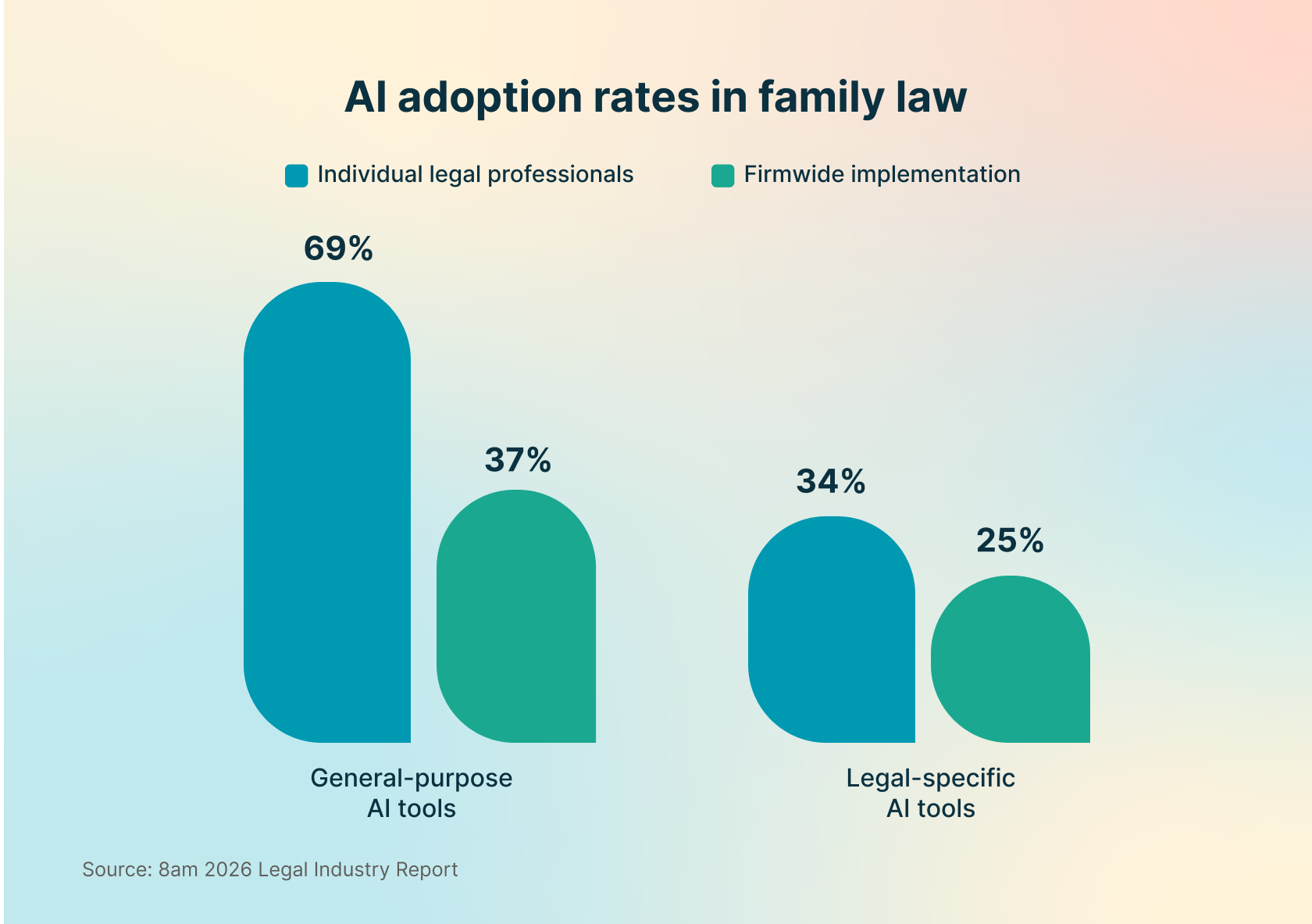
The adoption gap: 69% of family law professionals personally use general-purpose AI, but only 25% of firms have adopted legal-specific AI tools.
-
High usage frequency: 55% of practitioners use AI tools every day or several times per week.
-
Lagging governance: 55% of family law firms have no formal AI policy, and 64% provide no staff training.
-
Primary workflows: Document drafting (84%) and strategic brainstorming (78%) represent the top use cases for AI among family law professionals.
Many solo and small-firm family lawyers are actively testing artificial intelligence to see how it can ease their administrative workloads. According to survey data from the 8am™ 2026 Legal Industry Report , which surveyed 177 family law professionals, a distinct gap exists between personal experimentation and formal firm integration.
While nearly 70% of family law practitioners use general-purpose AI tools on their own, only 1 in 3 uses legal-specific AI platforms. This indicates that while lawyers recognize the value of automation, many are still testing AI for family law informally rather than integrating specialized tools into daily workflows.
For solo and small-firm environments where resources are tightly managed, understanding this technology curve is critical. This guide outlines current adoption trends, core use cases, barriers, and readiness gaps across the practice area.
How widespread is AI adoption among family law firms?
While most individual attorneys are now comfortable experimenting with AI tools, family law firms have been slower to officially adopt the technology.
The 2026 Legal Industry Report data highlights a clear difference between personal use and firm implementation:
-
69% of family law legal professionals personally use general-purpose AI.
-
25% of family law firms have adopted legal-specific AI.
-
55% of family law firms operate with no formal AI policy.
These findings suggest that many firms are still evaluating how AI should fit into their workflows, policies, and day-to-day operations.
How often are family lawyers using AI, and what are the results?
AI has transitioned from an occasional experiment into a routine part of many lawyers’ workflows. Over half of the family law professionals surveyed by 8am (55%) use AI every day or several times per week, while 21% never use it.
Family law professionals who use AI reported a range of outcomes:
-
42% saw improved quality of work but no measurable hours saved.
-
32% save between 1 and 5 hours per week.
-
10% save between 6 and 10 hours per week.
-
13% report no efficiency or quality improvements.
Even modest weekly time savings provide a meaningful operational lift in solo and small-firm environments, where attorneys frequently handle both casework and business operations. Explore more detailed data in our comprehensive analysis of lawyer statistics .
What's holding family law firms back from adopting AI?
Organizational readiness is a common barrier to firm-wide AI adoption. While many family law professionals now use consumer AI tools regularly, relatively few firms have established the governance, training, or policies needed to support responsible implementation.
This gap can create regulatory, ethical, and malpractice risks when lawyers experiment with unvetted systems without clear guidance. For example, entering sensitive information into public AI tools may raise concerns about confidentiality, inaccurate outputs, and compliance with professional responsibility rules.
The 2026 Legal Industry Report highlights several areas where AI governance remains limited:
-
64% of family law firms provide no AI training and have no plans to do so.
-
Only 8% have mandatory AI training for all staff.
-
Only 15% have established a formal firm AI policy.
-
22% of family law professionals feel somewhat or very unprepared for AI-driven changes.
AI use cases reshaping family law workflows
Attorneys and staff at family law firms primarily use AI to speed up document production, analyze case files, and brainstorm litigation strategies. Many firms look for tools that integrate with their existing legal technology to reduce friction and avoid the need to switch between systems.
To see how these trends compare across the profession, explore our comprehensive guide to AI in the legal industry . You can also browse our list of ten AI use cases for lawyers to learn how firms are applying AI across legal research, drafting, and practice management.
Drafting and document work
Document production is one of the most common uses of AI in family law. Rather than replacing legal analysis, AI helps attorneys draft routine communications, organize information, and complete repetitive writing tasks more efficiently.
Family law attorneys use these tools to summarize case materials, create document templates, and organize information from files including parenting plans, asset division records, and client intake materials. Attorneys remain responsible for legal judgment, case strategy, and client counseling.
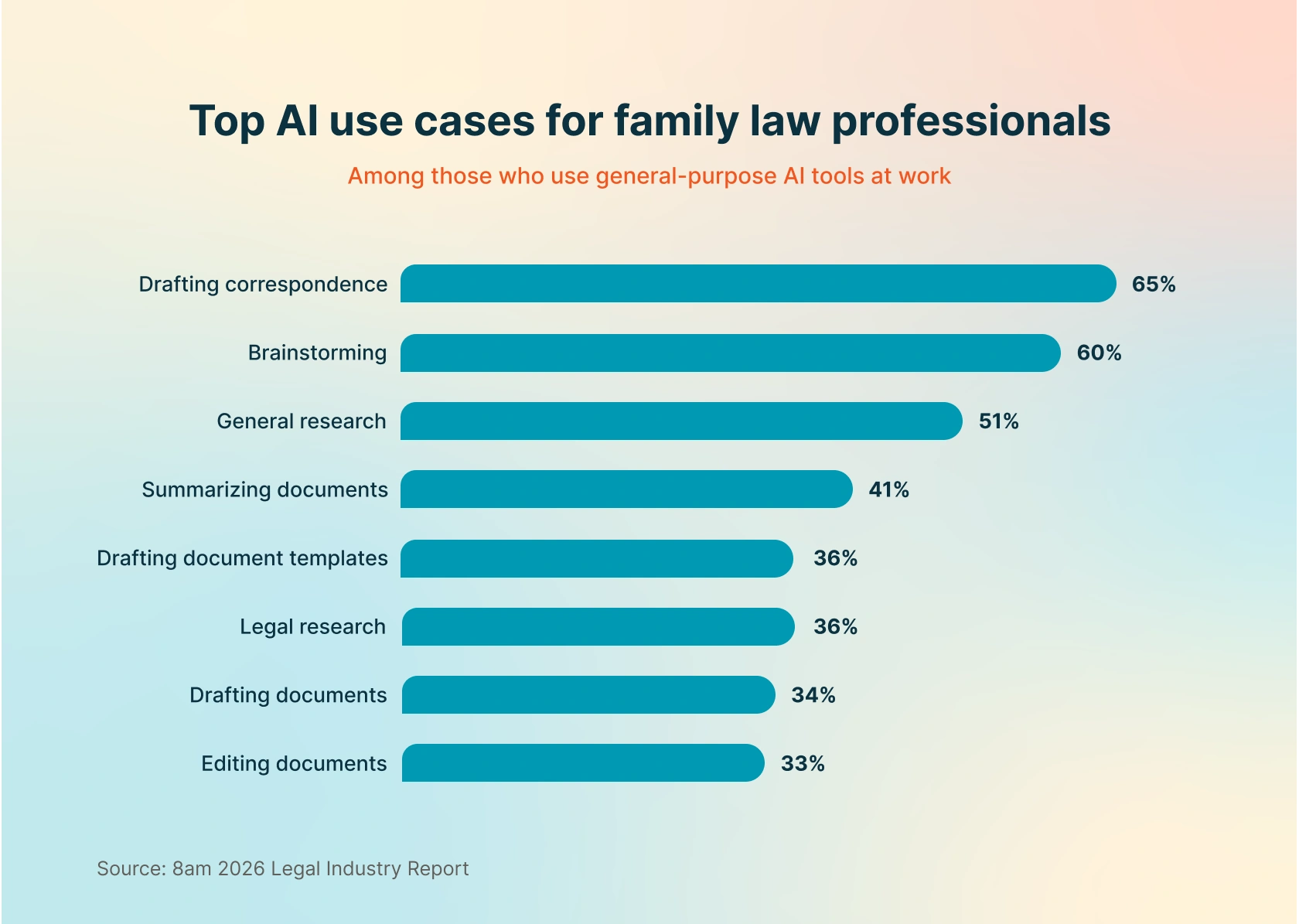
Among family law professionals who use AI, 84% apply it to document-related tasks, including:
-
Drafting routine correspondence: 65%
-
Summarizing extensive case files and records: 41%
-
Building structured document templates: 36%
-
Generating initial document drafts: 34%
-
Editing and refining existing text: 33%
Research and brainstorming
Family law practitioners are also using artificial intelligence as a strategic thinking partner. Instead of using it solely for information retrieval, 78% of users deploy AI for research and brainstorming to explore alternative arguments, analyze communication approaches, and map out strategic options:
-
Brainstorming case strategies: 60%
-
General informational research: 51%
-
Substantive legal research: 36%
Practice management tasks
AI is also becoming a useful tool for practice management. According to the 2026 report, 41% of family law professionals now use AI to help manage daily firm operations.
Because solo and small practices often lack dedicated marketing, training, or operations staff, attorneys must handle these operational and admin responsibilities themselves. 8am's 2026 Admin Misery Index identified that 39% of the legal workforce loses 4+ hours of productive and billable time per week to admin work. This makes workflows like client intake, scheduling, and billing natural candidates for AI assistance.
Ethical considerations for AI in family law practices
Family law matters often involve children, financial records, domestic abuse allegations, and other highly sensitive information. As a result, attorneys have significant professional responsibilities related to competence, confidentiality, supervision, and client communication.
As AI adoption expands, firms should establish policies and review processes that align with the American Bar Association’s Model Rules of Professional Conduct:
-
Rule 1.1 (Competence): Requires attorneys to understand the benefits and risks of relevant technology, including the potential for inaccurate AI-generated content (also known as hallucinations).
-
Rule 1.6 (Confidentiality): Requires attorneys to protect client information, including carefully evaluating whether sensitive data should be entered into AI tools.
-
Rule 1.4 (Communication): Requires attorneys to keep clients informed. In some jurisdictions, this may include disclosing AI use as courts adopt AI-related disclosure or certification requirements.
-
Rules 5.1 and 5.3 (Supervision): Require firm leadership to ensure that attorneys, staff, and outside vendors comply with applicable professional standards.
Judicial oversight of AI continues to evolve. For example, the Florida Supreme Court now requires attorneys to formally certify that they have verified the accuracy of all cited legal cases before filing in Florida courts. Requirements vary by jurisdiction, so attorneys should review current local rules before submitting AI-assisted filings.
Firms can reduce risk by establishing clear review procedures, protecting confidential client information, and selecting secure AI platforms designed for legal work. For more guidance, explore our hub on AI for law firms .
8am IQ: Modern AI for family law firms
As AI becomes a regular part of legal work, many firms are looking for tools designed specifically for legal professionals rather than relying on general-purpose consumer platforms. 8am IQ for MyCase brings AI directly into your case management solution, allowing attorneys and staff to work with case information in a secure environment without exposing client data to public AI models.
8am IQ includes four integrated AI tools that support common family law workflows:
-
Document Assistant: Summarizes key facts, dates, and other important details from case files, including bank statements, tax returns, and supporting records, reducing time spent on reviewing lengthy documents.
-
Writing Assistant: Refines the quality and tone of written communications, including notes, client messages, invoices, and requests for funds.
-
Case Assistant: Answers questions about matters using information stored in MyCase, making it easier to locate notes, filings, court orders, timelines, and other case details.
-
Discovery Assistant: Uses optical character recognition (OCR) to index scanned and image-based files automatically, making large discovery collections searchable the moment they're uploaded.
By using AI tools built into your practice management solution, you can work more efficiently with your case information in the same secure environment.
Schedule a demo of MyCase today to see how 8am IQ helps family law firms put AI to work.