

Key takeaways
Mobile payment systems help accounting firms get paid faster and reduce administrative burden.
Security features like encryption and tokenization protect sensitive client financial data.
Mobile payments improve client experience by offering convenient, modern payment options.
Integrating mobile payment systems with your firm’s accounting software streamlines reconciliation and reporting.
8am CPACharge offers mobile payment solutions purpose-built for accounting professionals.
Mobile payments are no longer limited to retail checkouts. As more consumers get in the habit of making purchases by tapping their phones, many expect the same convenience when paying for professional services.
For accounting firms, that shift is already influencing how clients expect billing and payments to work. Understanding the benefits of mobile payment systems can help accounting professionals decide whether this technology meets their needs.
This guide explores how mobile payment systems work for accounting firms, the operational advantages they can offer, and the factors to consider when evaluating a solution for your practice.
How mobile payment systems work for accounting firms
Mobile payment systems allow accounting practices to accept digital payments via a smartphone, tablet, or mobile reader instead of a fixed countertop terminal. Clients can pay with contactless cards or mobile wallets such as Apple Pay or Google Pay, and the transaction is processed securely before funds are deposited into the firm’s business account.
To enable these payments, firms typically use a mobile device paired with a payment application and either tap-to-phone technology or a small Bluetooth card reader. These tools support near-field communication (NFC), which allows clients to complete a transaction by briefly holding their phone, smartwatch, or contactless card near the reader or tap-enabled device.
Once the payment is submitted, the transaction is authorized through the payment network and processed in real time. The funds are then deposited into your firm’s business account according to the processor’s settlement schedule. Throughout the process, the client’s sensitive card data is protected through tokenization, meaning the actual card number is never stored on your device.
For accounting professionals, this setup provides flexibility that traditional payment terminals cannot match. You can accept payments at your office, during an on-site client meeting, or immediately after completing a consultation. Once you understand how mobile payment systems work, it becomes easier to see the advantages of mobile payments for service-based firms that collect payments wherever client interactions take place.
Key benefits of mobile payment systems for accountants
Accounting practices can gain significant advantages by adopting mobile payment technology. Below is a breakdown of the key benefits.
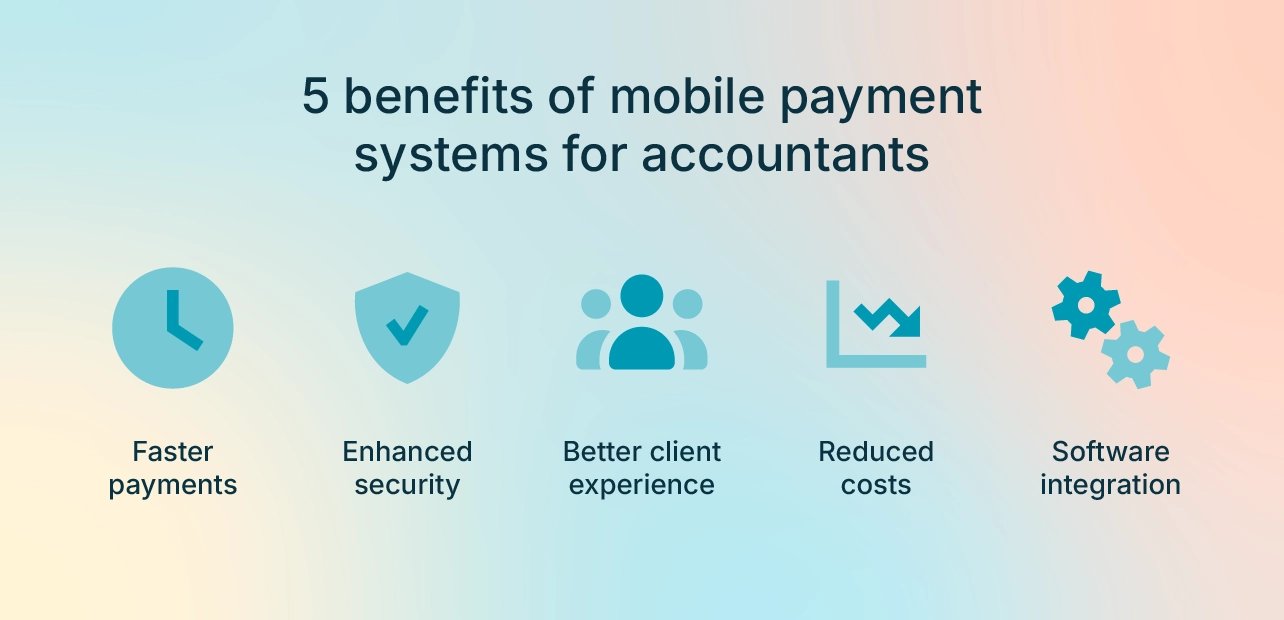
Faster payments and improved cash flow
One of the most immediate benefits of mobile payment systems is speed. When clients can pay on the spot, the billing cycle shortens significantly. Transactions are authorized in real time, allowing firms to collect payment immediately rather than waiting for checks to arrive in the mail or clear through the bank.
Speed also matters when receiving deposited funds. 8am™ CPACharge is a payment solution that offers next-day deposits, helping ensure that collected payments reach your firm’s bank account without unnecessary delays. Faster deposits reduce the gap between completing work and accessing the revenue you’ve earned.
Mobile payments can also help reduce accounts receivable balances. Clients can pay immediately after reviewing an invoice rather than delaying payment for days or weeks. This can be especially helpful during tax season, when firms are handling a high volume of client work and need more predictable cash flow to support day-to-day operations.
Enhanced security and PCI compliance
Security is a top concern when evaluating payment technology. Modern mobile payment security measures include multiple layers of protection to safeguard clients’ financial information. Encryption is one of the key safeguards used in mobile payments, protecting sensitive data as it travels between the client’s device, the payment processor, and your firm’s bank.
Tokenization provides another layer of security. In systems that use tokenization for mobile payments, a client’s card number is replaced with a temporary token during the transaction. Because the token does not contain the original card details, no usable payment information is exposed if it’s intercepted. Many mobile wallets also require biometric verification, such as fingerprint or facial recognition, before approving a transaction.
Payment platforms must also follow the Payment Card Industry Data Security Standard (PCI DSS), which sets requirements for protecting cardholder data, as outlined in the PCI Security Standards. Using a PCI-compliant solution such as CPACharge shifts much of the compliance responsibility to the payment platform, easing the burden on your firm. Compared with paper checks that can be lost, stolen, or forged in transit, mobile payments offer a more controlled way to manage client transactions.
Better client experience and convenience
The payment process is often the final touchpoint for clients after you complete your engagement. A key advantage of mobile payments is that they help make that step faster and easier, allowing clients to complete transactions using familiar tools such as contactless cards or mobile wallets.
These systems also remove several points of friction from the billing process. A client can review an invoice, tap their phone or card, and receive confirmation within seconds. Digital receipts and immediate payment confirmation provide clear documentation of the transaction, which can be helpful for individuals who need to track business expenses or maintain financial records.
Some platforms that accept contactless payments for business can also support recurring or scheduled billing. Automatic payments can be set up in advance for clients who work with their accountant on an ongoing basis, such as monthly bookkeeping or quarterly advisory services. This approach reduces administrative back-and-forth while giving clients a predictable, low-effort way to stay current on their accounts.
Reduced administrative costs
Managing payments often involves a number of small administrative tasks that can quietly take up staff time. Mobile payment systems reduce much of this work by automating the recording and tracking of transactions.
Payments are logged automatically and can sync with accounting software, which minimizes manual data entry and simplifies reconciliation. When clients pay promptly, firms also spend less time sending reminders, following up on overdue invoices, and managing collections.
For accounting practices, this matters because time spent managing payments is usually non-billable. When these steps happen automatically, your team has more time to focus on client work.
Mobile payment systems for business can also lower the costs associated with physical payment equipment and supplies. Because transactions can be processed through a smartphone or tablet, firms may not need traditional countertop terminals. Digital receipts replace printed slips, eliminating the need for thermal paper rolls and reducing the effort required to store and organize physical records.
Expanded payment options and accessibility
Your clients do not all have the same preferences when it comes to paying for services. Some may want to tap their phone or use a mobile wallet, while others may choose to pay with a credit or debit card. Mobile payment systems make it easy for accounting firms to accept multiple payment methods through a single setup. With a mobile reader, firms can process transactions from mobile wallets, chip cards, and contactless tap-to-pay cards.
This flexibility can be helpful when meeting with clients outside the office. A mobile device and reader allow firms to accept payments at a client’s location, during an on-site consultation, or at a temporary workspace such as a conference room or shared office.
Payment platforms designed for professional services support these scenarios with tools built for mobility. For example, CPACharge offers in-person payment solutions that include tap-to-phone technology and Bluetooth card readers, allowing accounting firms to accept payments wherever client interactions take place.
Easy integration with accounting software
The best payment systems integrate with the financial software that firms already rely on to manage their business. CPACharge integrations, for instance, connect payment processing tools to leading accounting applications.
When these systems are connected, payment data flows into your financial records as transactions occur. Each payment is tied to the correct client account and reflected in the reports used for reconciliation and financial tracking.
For accounting firms, this reduces manual entry and lowers the risk of errors when matching payments to invoices. With fewer administrative steps involved, your books stay current, and your team spends less time reviewing transactions.
Choose the right mobile payment solution for your firm
Mobile payment technology can reshape how accounting firms handle billing and collections. By enabling faster transactions, strengthening payment security, improving client convenience, and reducing administrative overhead, these systems help firms manage revenue more efficiently while offering a modern client experience.
When evaluating payment solutions for accounting firms, look for features that support the way accounting practices manage billing and financial records, including:
PCI-compliant security to ensure client payment data is protected
Seamless integration with your accounting software
Next-day deposits to maintain steady cash flow
Support for multiple payment methods, such as contactless cards and mobile wallets
A provider that understands accounting workflows and the unique needs of CPAs and bookkeepers
CPACharge is designed specifically for accounting professionals and supports a range of modern payment capabilities. Firms can accept mobile payments, process in-person transactions using tap-to-phone technology, receive funds through next-day deposits, and sync payment data with leading accounting platforms.
Schedule a demo today to see how CPACharge can modernize your firm’s payment experience.