

Key takeaways
A strong legal cover letter is tailored to one firm and one role—never generic.
Structure matters: Follow a clear format with a professional header, compelling opening, focused body paragraphs, and a confident close.
Quantifying achievements, even as a law student, strengthens your case.
Keep it concise, error-free, and limited to one page.
Competition for associate roles at reputable firms is intense. In many markets, a single opening can attract dozens—even hundreds—of qualified applicants with similar academic credentials and experience. When that happens, small distinctions carry real weight. Research shows that 83% of hiring managers say they read most cover letters (even when one isn’t required as part of the application), underscoring how much this document can shape first impressions.
That’s why your lawyer cover letter is a critical part of your resume and application strategy.
In this guide, we’ll walk through how to write a cover letter for a law firm, share practical tips, and provide customizable templates you can adapt for your next application.
How to structure a law firm cover letter
Before drafting, it helps to understand the framework. A persuasive law firm cover letter sample follows a clear, professional structure that hiring managers expect. Law firms value organization and precision—your formatting should reflect both.
A strong cover letter typically includes:
Header
Opening paragraph
Body paragraph 1 (firm fit)
Body paragraph 2 (skills and achievements)
Closing paragraph
Let’s walk through each section.
Header components
Your header should follow a traditional business letter format. Keep it clean, professional, and easy to scan.
Include:
Your full name
Phone number
Professional email address
LinkedIn profile (optional, but recommended)
The date of submission
The recipient’s name, title, and firm address
Whenever possible, address your letter to a specific person. Taking the time to identify the recruiting coordinator, hiring partner, or practice group leader shows initiative and attention to detail. Avoid generic greetings like “Dear Hiring Manager” if you can find a name.
Firm websites and LinkedIn are usually the best places to confirm the correct contact information.
Opening paragraph
Your opening paragraph should be clear, confident, and focused. Your goal is to give the hiring partner a reason to keep reading. In just a few sentences:
State the exact position you’re applying for
Mention how you learned about the opportunity (if relevant)
Quickly connect your background to the firm’s needs
Here’s a simple example:
I am writing to apply for the litigation associate position at Smith & Howard LLP. With experience supporting complex commercial disputes and a strong academic background in trial advocacy, I am eager to contribute to your growing litigation team.
Notice how the example immediately names the role and highlights relevant experience. There’s no long introduction or personal history, just a direct connection between the candidate and the firm.
Body paragraph 1
This paragraph should show that you’ve done your homework. Hiring partners want to know why you’re interested in their firm—not just any firm.
Use this section to reference details such as:
Key practice areas
Representative matters or notable cases
Recent growth, awards, or announcements
The firm’s typical client base
Then, connect those details directly to your own experience.
For example:
I am particularly drawn to your firm’s focus on healthcare compliance. During law school, I worked with a regional hospital system to analyze regulatory changes and draft internal policy updates, giving me firsthand insight into the challenges your clients face.
This is where your legal cover letter becomes specific and tailored. Instead of repeating your resume, you’re demonstrating alignment that shows you understand their work and are prepared to contribute.
Body paragraph 2
This is where you clearly demonstrate the value you bring to the firm. Instead of listing responsibilities or relying on broad traits like hardworking or detail-oriented, focus on outcomes. Emphasize what improved, what you contributed, and the impact of your work. Whenever possible, include numbers or specific examples. The candidates who stand out are those who highlight measurable results and concrete accomplishments rather than general claims.
Compare the difference between these inserts of legal cover letter examples:
Weak example: I regularly assisted with client communication and billing.
Stronger example: I helped implement a standardized client communication process that reduced response times by 25% and improved client satisfaction scores. I also supported billing operations that increased accounts receivable recovery by 20% through structured follow-ups and digital invoicing.
The second example shows impact. It gives the hiring partner something concrete to evaluate.
Even if you’re a law student or new attorney, you can highlight measurable achievements such as:
Research projects that influenced the case strategy
Moot court awards or rankings
Clerkship contributions to successful motions
Process improvements in internships or clinics
Closing paragraph
Your closing paragraph should be short, confident, and professional. This is your final impression, so keep it polished and direct. In a few sentences, make sure to:
Reinforce your interest in the role
Express appreciation for the reader’s time
Indicate your availability for an interview
For example:
I welcome the opportunity to further discuss how my background aligns with your firm’s needs. I am available at your convenience for an interview and can be reached at the contact information above. Thank you for your time and consideration.
End with a professional sign-off such as “Sincerely,” followed by your full name.
Best practices for writing a law firm cover letter
A strong lawyer cover letter does more than repeat your resume. It shows judgment, professionalism, and a clear understanding of what the firm needs. The following best practices will help you write a letter that feels intentional, polished, and specific.
Tailor your letter to the firm
Sending the same generic letter to every firm is one of the fastest ways to blend in. Hiring partners can immediately tell when a cover letter has been recycled.
Instead, customize each version to the specific firm and role. Address the letter to a real person whenever possible. Mention the firm by name. Reference its practice areas, client base, or recent work. Show that you’ve taken the time to understand who they are and what they do.
A tailored approach signals genuine interest and attention to detail—two qualities every firm values.
Match your experience to the job requirements
Carefully review the job posting and align your experience with the skills the firm is seeking. Even if you’re early in your career, you likely have relevant experience from internships, clinics, clerkships, or part-time roles.
Be specific about how your work adds value. Whenever possible, quantify your impact. For example:
General statement: At my last firm, I increased accounts receivable and regularly brought in new business by taking a client-first approach.
Stronger statement with measurable results: At my last firm, I developed a process to improve accounts receivable by implementing software-based invoicing, electronic payments, and automated billing reminders, which increased payment collection by 20%. I also used case management tools to improve client communication, boosting positive reviews by 30% and referrals by 20%.
Specific numbers and concrete improvements make your contribution easier to understand and more credible.
Keep your writing concise and error-free
Your cover letter can also be seen as a writing sample. It should reflect the same care and precision you would apply to a court filing or client memo. Before sending your cover letter:
Proofread at least twice
Read it aloud to catch awkward phrasing
Ask a trusted colleague, mentor, or friend to review it
Even small spelling or grammar errors can undermine an otherwise strong application.
Avoid clichés and buzzwords
Phrases like “team player,” “go-getter,” and “detail-oriented” appear in countless applications. On their own, they don’t differentiate you. Clear examples are far more persuasive than buzzwords.
Rather than labeling yourself with generic traits, demonstrate them through examples. If you’re detail-oriented, show it through a research project that influenced case strategy. If you’re a strong communicator, highlight a client communication system you improved or presentations you delivered.
Keep your cover letter to one page
A legal cover letter should be concise and focused. Hiring partners are busy, and clarity is appreciated.
Limit your letter to one page and concentrate on the experience most relevant to the position. You don’t need to cover every role you’ve ever held, just the ones that strengthen your candidacy for this specific job.
Don't just rehash your resume
A cover letter for law firms shouldn’t mimic your resume. Instead, go into detail on how specific points in your resume add value and relate to the desired position. For instance, if your resume states that you increased client referrals, explain how you accomplished this task with clear details and quantitative data, if you have it.
Lawyer cover letter sample
Sometimes the easiest way to understand what works is to see it in action. Reviewing a strong law firm cover letter sample can help you visualize the tone, structure, and formatting that hiring partners expect.
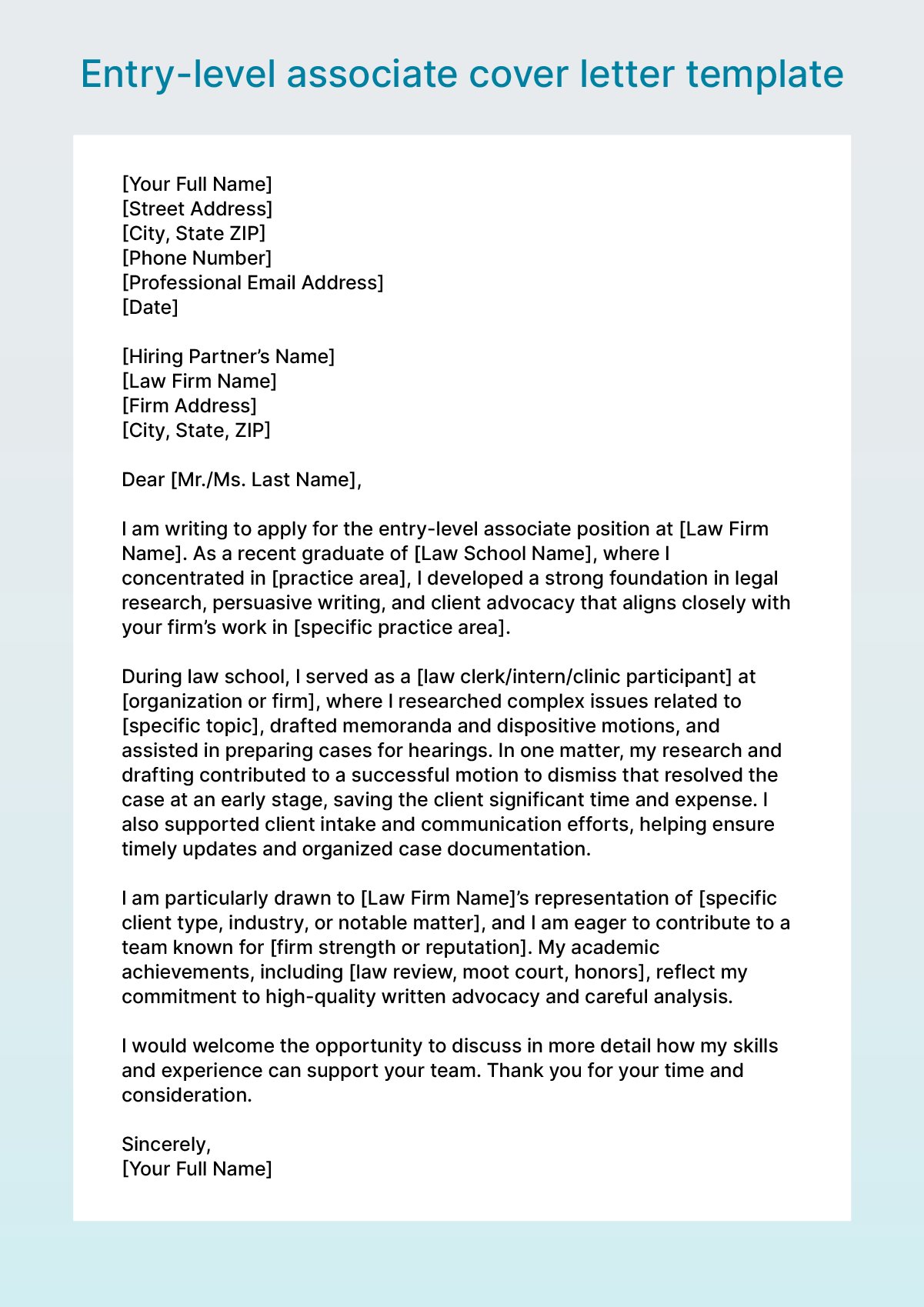
Sample cover letter for entry-level associate
This template is designed for law students, recent graduates, and attorneys applying for their first associate role. If you’re early in your career, your focus should be on academic achievements, internships, clerkships, clinics, research, and any hands-on experience that demonstrates strong writing, analytical ability, and professionalism.
Even without years of practice, you can still present a compelling case by highlighting measurable accomplishments, leadership roles, and relevant coursework. Below is a customizable template you can adapt.
Sample cover letter for mid-level attorney
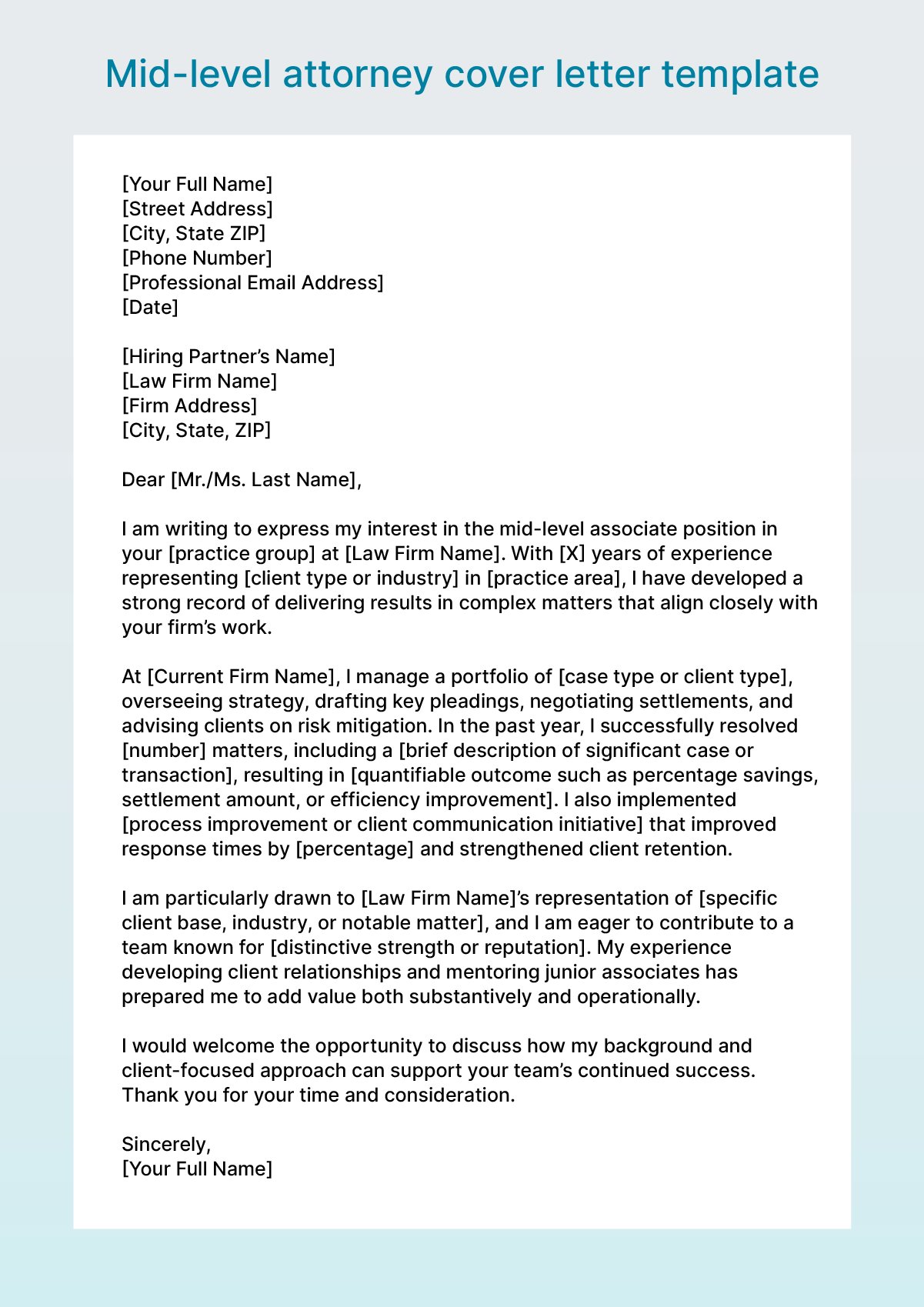
This template is designed for attorneys with several years of experience who are seeking to lateral to a new firm or move into a more specialized practice area. At this stage in your career, hiring partners expect to see clear results, increasing responsibility, and evidence that you can manage matters and client relationships independently.
Your focus should be on measurable outcomes, business impact, and how your experience aligns with the firm’s strategic goals. Check out this customizable template you can adapt for your own law firm cover letter.
Example cover letter follow-up emails
If you haven’t heard back within one to two weeks, it’s appropriate to send a brief follow-up email. A thoughtful follow-up shows professionalism, organization, and genuine interest in the role. It also keeps your name top of mind without being overly persistent.
Keep your message short and respectful. You don’t need to restate your full qualifications—just remind the hiring manager of your application and express continued interest. Here’s a polished legal cover letter example you can adapt:
Follow-up email template
Subject: Follow-Up on Associate Application
Dear Ms. Henry,
I recently applied for the attorney position at James & Henry on August 1 and wanted to follow up regarding my application. I remain very interested in the opportunity and would welcome the chance to discuss how my experience in litigation and client advocacy could support your team.
For your convenience, I’ve reattached my resume and cover letter. Please let me know if there is any additional information I can provide.
Thank you for your time and consideration.
Sincerely, John Doe
How 8am™ MyCase and 8am LawPay support new lawyers
Landing the job is just the beginning. Once you step into your new role, you’ll quickly see that strong writing and advocacy skills are only part of what makes a successful attorney. Organization, communication, and financial awareness matter just as much. That’s where the right legal technology makes a difference.
MyCase and LawPay are designed to help modern law firms operate efficiently while delivering a better client experience. For new lawyers especially, these tools provide the structure and visibility needed to manage cases confidently and support firm growth.
With MyCase, firms can centralize their operations in one platform, including:
Online payments through secure legal payment collection powered by LawPay
Case management to track matters, deadlines, and tasks
Document management for storing and organizing case files
Expense tracking to ensure accurate billing
Legal accounting for improved financial oversight
Legal CRM tools to manage leads and client relationships
Instead of juggling spreadsheets, email chains, and disconnected tools, attorneys can work from one system that keeps information organized and accessible.
For new lawyers, this means:
Clear visibility into case progress
More accurate time tracking and billing
Better client communication
Stronger financial reporting
Fewer administrative bottlenecks
As you build your reputation within your firm, advocating for efficient systems shows initiative and business awareness. It also supports the kind of client service and attention to detail that you highlighted in your cover letter.
If you’re interested in learning how MyCase and LawPay can support your firm, you can connect with the team here.