

Immigration law shapes the futures of individuals, families, and entire communities, often more directly than any other area of law. Immigration lawyers are on the front lines of life-changing cases, whether they’re helping families reunite, guiding businesses through visa complexities, or defending asylum seekers.
As humanitarian crises grow, visa policies shift, and programs like the H-1B lottery evolve, the demand for skilled immigration attorneys becomes even more critical. According to the 8amTM 2025 Legal Industry Report: State of Immigration, the U.S. immigration court backlog reached a record 3.4 million cases in 2024, indicating that immigration lawyers’ services will likely remain in high demand for years to come.
The journey to becoming an immigration lawyer is not easy. It requires patience, careful planning, and a willingness to engage with a constantly evolving facet of law. However, for those willing to put in the work, immigration law can lead to an extremely fulfilling career.
If you’re wondering how to become an immigration lawyer, a deep understanding of the process can set you on the right path. In this article, we’ll give a comprehensive overview of:
An immigration lawyer’s key duties
Educational requirements and extracurricular recommendations
Post-law school options for launching your career
Timelines, licensing requirements, and other key information
What do immigration lawyers do?
Immigration lawyers are legal professionals specializing in navigating the intricate landscape of immigration law. They are pivotal in assisting individuals and families with various matters, including visa applications, green card petitions, asylum claims, and deportation defense. They can serve as advocates, advisors, and allies for individuals navigating the complexities of the immigration process.
With an in-depth understanding of immigration statutes, regulations, and policies, these attorneys provide expert guidance and representation to clients from diverse backgrounds and serve a wide variety of unique needs.
In addition to their legal expertise, the most successful immigration attorneys often possess cultural competency and language skills that allow them to communicate effectively and empathetically with clients from different countries and cultural backgrounds. Many immigration lawyers are driven by a passion for justice and a commitment to upholding the rights and interests of immigrants.
Considering different immigration practice areas?
Immigration law includes many niche practice areas. Some more specializations within immigration law include:
Family-based immigration: This area of law includes assisting with spousal visas, foreign adoption, reunifying international families, and obtaining green cards.
Employment-based immigration: Also known as “business immigration”, this area is mostly concerned with helping businesses hire qualified foreign workers and ensuring that businesses and their employees remain compliant with immigration laws.
Nonimmigrant visas: Many people come to the United States temporarily, such as students, journalists, and athletes, but they still need help getting the proper visas.
Humanitarian cases: This specialty helps asylum seekers and others seeking protective status obtain visas that allow them to remain in the country and avoid dangerous conditions in their home countries.
Naturalization and citizenship: Immigration lawyers can also help green card holders navigate the often complex process of becoming a U.S. citizen.
Removal defense: If the government seeks to deport an individual, then an immigration lawyer may be called to defend that individual and challenge the government’s ruling.
Immigration compliance: With immigration law so complex, this niche helps businesses navigate I-9 audits and documentation to ensure they remain in good standing with the government.
These descriptions only scratch the surface of the matters you might handle as an immigration attorney. However, it should also give you an idea of the broad range of cases handled by immigration law firms.
How to become an immigration lawyer
From undergraduate education to law school and passing the bar exam, aspiring immigration lawyers undergo rigorous training to equip themselves with the necessary skills and knowledge to navigate the complexities of practicing immigration law.
There isn’t a single, one-size-fits-all approach to becoming an immigration attorney, and your area and business experience will largely determine the exact path to an immigration legal career.
For example, many fresh immigration lawyers will opt to join an established firm to gain hands-on experience, while others may seek to launch their own immigration law practice to capitalize on high demand in their area. There is no one right answer, but below are seven steps in the general process most immigration lawyers follow.
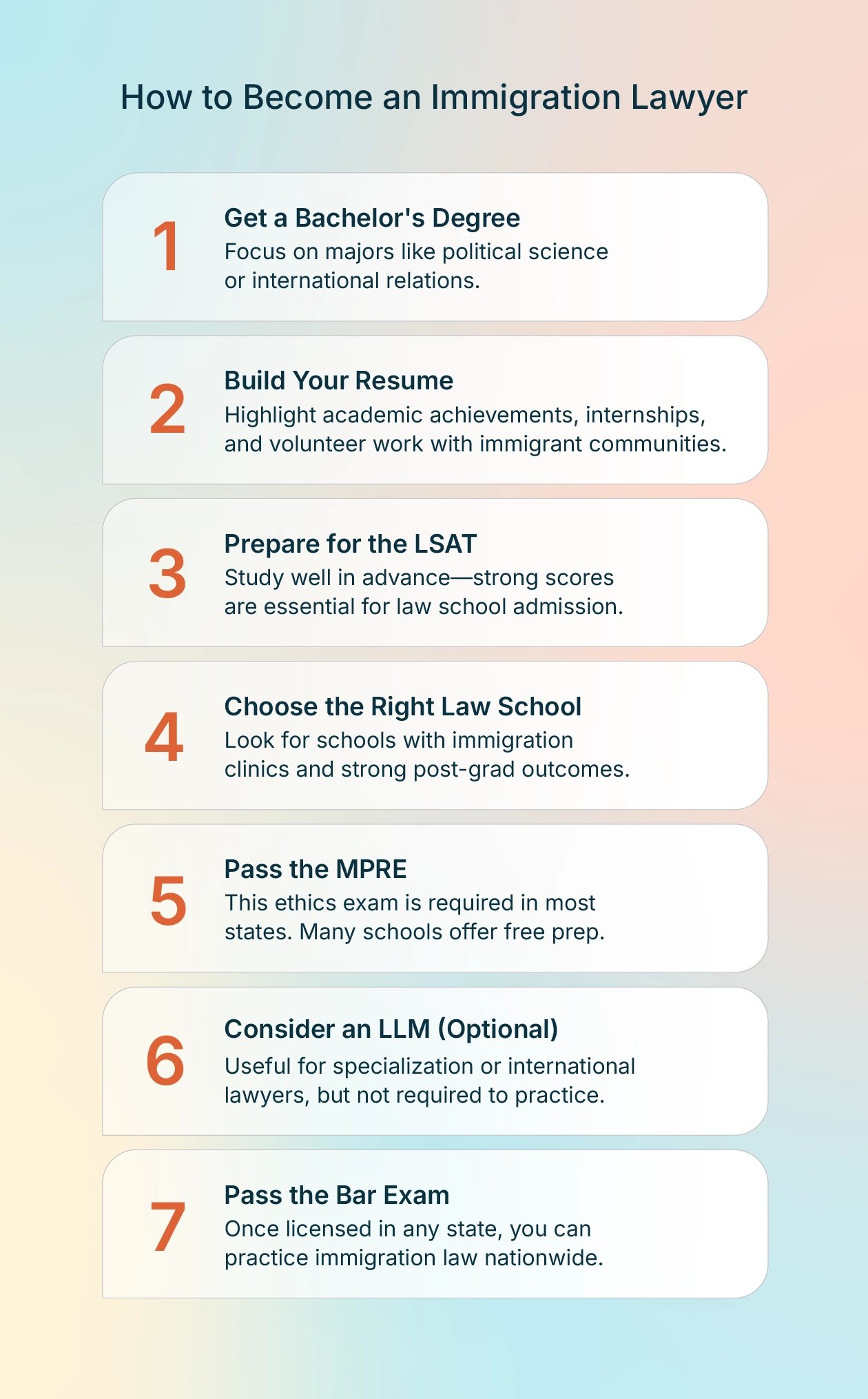
1. Pursue your undergraduate degree
Before becoming an immigration lawyer, you must earn a bachelor's degree from an accredited institution. While no specific degree is required to apply to law school, certain courses are helpful for pursuing immigration law, such as foreign languages, sociology, political science, and international relations.
Maintaining a high GPA is essential for law school admission, with some experts estimating that undergraduates should maintain a GPA between 3.5 and 3.8 at a minimum. Additionally, consider participating in extracurricular activities and internships related to law or social justice to gain valuable experience.
You can also pursue legal internships or participate in legal-adjacent extracurriculars, such as a research assistantship, mock trial, or work with organizations like being a research assistant, mock trial, or working with organizations that are heavily involved in legal causes or policy.
2. Build a strong resume
As part of your law school application, you must submit a comprehensive resume highlighting your academic achievements, work experience, volunteer work, and extracurricular activities.
Consider pursuing legal internships or participating in legal-adjacent extracurriculars, such as serving as a research assistant, participating in mock trials, or working with organizations heavily involved in legal causes or policy.
That said, any activity that builds strong leadership, research, and business skills can be helpful, even if it isn’t directly related to legal practice. You may also consider volunteering with immigrant communities to gain a first-hand sense of the challenges people face and to build rapport with local immigrant groups.
Lastly, paralegal immigration law certification programs offer non-lawyers a first-hand look at the tasks involved in a typical immigration law practice.
3. Excel in the Law School Admission Test (LSAT)
The Law School Admission Test (LSAT) is a standardized test that assesses critical thinking, analytical reasoning, and logical reasoning skills—passing it is also essential for gaining admission to most law schools.
The LSAT is only administered four times a year. Plus, the cost for registering and receiving your score report is approximately $200 to $250, with additional fees for late registration or other services. Going in unprepared could result in a lot of wasted time and money.
Instead, invest in a study plan that familiarizes you with the skills you’ll need to do well on the LSAT. Even people who have previously excelled at standardized tests can struggle—be sure to give yourself at least six months to study and prepare.
4. Select the right law school
When evaluating potential law schools, consider factors such as location, faculty expertise, bar passage rates, and post-graduation employment outcomes. Keep in mind that tuition costs can vary widely, depending on the institution and whether you attend a public or private school.
While you can prepare for a career in immigration law at many institutions, some schools offer clearer pathways to hands-on experience in this practice area.
For example, law schools located near major immigration hubs often give students direct access to externships, clinics, community partnerships, and other opportunities to get meaningful exposure to real case work while still in school.
5. Pass the multistate professional responsibility examination (MPRE)
Before being admitted to the bar in most jurisdictions, aspiring lawyers must pass the Multistate Professional Responsibility Examination (MPRE). The MPRE assesses candidates' knowledge and understanding of ethical standards and professional conduct in the legal profession.
Registering for the MPRE costs approximately $125 to $150, and preparation is essential to ensure success on the exam.
Luckily, many law schools provide free preparation materials, so be sure to check your school's resources.
6. Pass the bar exam
The final step in becoming a licensed attorney is passing the bar exam in your jurisdiction. The bar exam assesses candidates' knowledge of legal principles and procedures, as well as their ability to apply legal reasoning and analysis to various scenarios.
The format and content of the bar exam vary by state, but most consist of multiple-choice, essay, and performance questions. If you want or need help studying for the bar, you can also sign up for a bar prep course like Barbri or Kaplan.
The cost to register for the bar exam ranges from approximately $500 to $1,000, depending on the jurisdiction. Thorough preparation, including taking a bar review course and completing practice exams, is essential to passing the bar exam and obtaining licensure to practice law.
An important point: Because immigration law is federally regulated, a bar license from any U.S. state allows you to practice immigration law nationwide.
7. Consider an LLM in immigration law
While a Juris Doctor (JD) degree is the primary requirement for practicing law, completing a Master of Laws (LLM) program in immigration law can provide additional expertise and specialization in this field.
LLM programs typically require one year of full-time study and offer advanced coursework and research opportunities in immigration law. Tuition costs vary by institution and program length.
However, it’s worth noting that an LLM is not required to practice immigration law in the US, and most immigration lawyers choose to enter the field directly after passing the bar. That said, an LLM can still be a good choice for those who studied law internationally and need a U.S. credential or lawyers who want to pursue academic or policy work.
How long does it take to become an immigration lawyer?
The timeline to become an immigration lawyer in the U.S. is about seven years and requires rigorous academic and professional development. Individual timelines may vary based on factors such as retaking the bar exam, pursuing additional degrees, or participating in internships or volunteer opportunities.
Here is a more detailed breakdown:
Undergraduate degree: ~4 years
Law school (JD): ~3 years
MPRE + bar prep: ~6–12 months
Optional LLM specialization: ~1 year
Internships & clinics (parallel): Can be pursued throughout undergrad/law school
The timeline for becoming an immigration lawyer isn’t quick, and at least at first glance, pursuing additional internships might not seem like a worthwhile way to spend your time. However, gaining practical experience will help you hit the ground running, arming you with a deep understanding of immigration law and procedures that will allow you to hone your skills and jump headfirst into areas like immigration advocacy with confidence.
Should I become an immigration lawyer?
Whether you should pursue a career in immigration law really comes down to two things: what motivates you, and how well you handle change.
Is it challenging to practice immigration law? Yes, it can be. Immigration law has complex rules that change often, and the cases you work on can carry real emotional weight for clients and families. That said, if you’re passionate about helping immigrants navigate the system, the difficulty is often worth it because the work is so meaningful.
Immigration law is not only complex but also constantly changing. Because policy is decided at the federal level, each incoming administration can significantly affect the lives of those waiting for visas or preparing to apply.
And immigration law isn’t only shaped by changes in U.S. policy. It’s also influenced by global events, emerging humanitarian crises, and shifting economic conditions. In that sense, many of the best immigration lawyers stay closely tuned in to what’s happening in the world and genuinely care about the people trying to build safer, more stable lives in the U.S.
In other words, immigration law may not be the right fit for someone who prefers predictability or dislikes rapid change.
Leveraging technology as an immigration lawyer
As an immigration lawyer, you’ll have a chance to help people pursue a better life by navigating the waters of U.S. immigration law. With the right passion, determination, and a willingness to adapt to changing policies and events, you’ll be equipped to handle whatever is thrown your way.
However, other aspects of the legal industry are equally important but not always taught in law school. Technology, such as immigration case management systems and AI is rapidly changing how legal professionals work, and having a firm grasp of how these technologies are used can have a huge impact on your ability to meet modern client expectations and stand out to potential employers.
8am DocketWise, the #1 immigration law case management software, was created to help lawyers manage every aspect of their practice, including:
Automating form entry and ensuring that the correct forms are being used
Tracking immigration status to promptly update clients and supply supporting evidence, or make corrections to existing applications
Streamlining client communication
Giving clients a secure place to access and upload pertinent documents
Demo DocketWise today to see these features in action and start freeing up your day of administrative tasks, so you can focus on what matters most: your clients.
FAQs from aspiring immigration lawyers
What are immigration lawyer education requirements?
To become an immigration lawyer, individuals must complete a bachelor's degree from an accredited institution, attend an accredited law school to obtain a Juris Doctor (JD) degree, and pass the bar exam in the jurisdiction where they intend to practice law. Some may pursue additional education, such as a Master of Laws (LLM) in Immigration Law, for further specialization.
How much does it cost to become an immigration lawyer?
The cost of becoming an immigration lawyer can vary depending on factors such as the college attended, geographic location, and personal circumstances. Law school tuition can range from $50,000 to $151,000 annually. Additional expenses include fees for standardized tests such as the LSAT and bar exam, study materials, and living expenses during education and training.
What should college students major in to become an immigration lawyer?
No specific degree is required to become an immigration lawyer. However, immigration-adjacent areas of study are recommended, including foreign languages (Spanish, Arabic, Mandarin, etc.), political science, public speaking, and international relations.
Moreover, maintaining a high GPA and gaining experience through internships, volunteer work, or extracurricular activities relevant to the legal profession is essential.
What is the average immigration lawyer salary?
The average immigration lawyer salary in the U.S. is around $90,000, with the salary range typically falling between $75,000 and $100,000. Nonetheless, the actual salary of an immigration lawyer depends on many important factors, such as education, additional skills, certifications, the number of years the lawyer has spent in immigration law, etc.
Do I need to pass the bar in a specific state to practice immigration law?
Unlike family or criminal law, which are mostly created at the state level, immigration law is decided entirely at the federal level. As a result, an immigration attorney can practice immigration law in any U.S. state as long as they’ve passed a state bar exam and are in good standing.
However, if an immigration lawyer wants to practice in areas that may overlap with state law (e.g., family petitions or employment law in conjunction with immigration), they may also need to gain admission to the bar in the state where they practice.