


Key takeaways
-
72% of legal professionals say the high cost of legal services is the biggest barrier to access to justice
-
Only 22% of legal professionals believe access to justice has improved over the last decade, 40% say it's stayed the same, 38% say it's declined
-
62% of lawyers agree or strongly agree that the rule of law is currently under threat in the U.S.
-
76% of legal professionals believe AI can help expand access to justice, particularly through automation, self-help tools, and remote services
-
Lawyers, who often work most directly within the court system, consistently report lower confidence in its current state than other legal professionals
The American legal system is founded on the promise of equal justice under the law. The judiciary is an essential element of our democracy, and justice for all is the fundamental premise upon which our country was founded. Unfortunately, current data suggest that fulfilling this promise has become increasingly difficult.
According to the 8am 2026 Legal Industry Report , the legal system is currently under significant pressure. In the report, based on a survey of 1,300 legal professionals, we explored the current environment and its impact on access to justice, and whether core institutions are functioning as intended.
The data showed there was a widening justice gap and a growing concern among legal professionals that the rule of law is at risk. A primary takeaway was that those who work closest within the system often express the least amount of confidence in its current state.
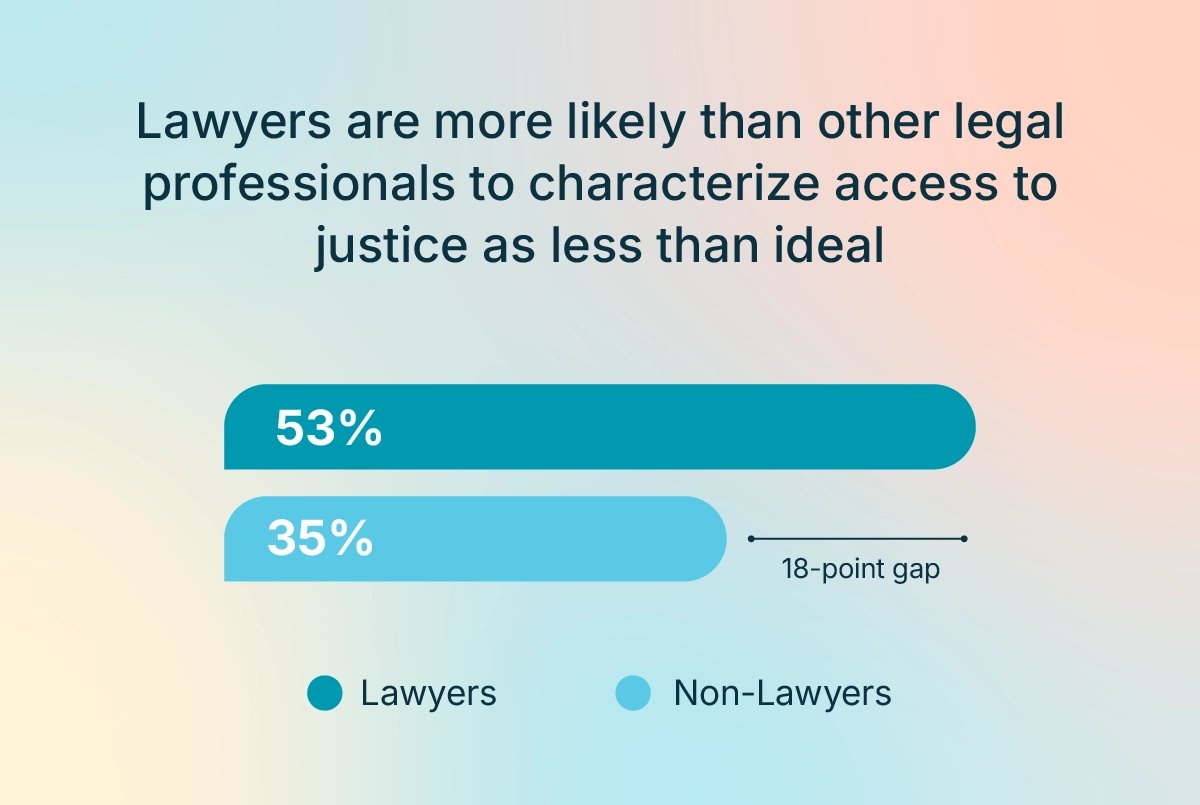
Beginning with access to justice, the data shows that it continues to be a challenge, with perspectives on the severity of this issue depending largely on an individual’s professional role. For example, 53% of the lawyers surveyed characterized access to justice as less than ideal, while only 35% of other legal professionals shared that view. Additionally, 22% of lawyers were neutral on the topic compared to 38% of other respondents. This disparity suggests that those who work most directly with the court system's inner workings are more likely to recognize and report its current limitations.
There is also a sense that efforts to close the justice gap have stalled. When asked about progress over the last decade, 40% of respondents stated that access to justice has remained about the same, while 38% believe it has declined. Only 22% reported seeing improvement. These statistics indicate that professionals who regularly face systemic barriers remain unconvinced that justice is accessible to those who need it most.
Opinions on the top hurdles that reduce access were mixed. Notably, 72% of respondents felt that the high cost of legal services was the most significant obstacle, although other structural issues were also identified. Nearly half of the participants cited court backlogs and general inefficiency (48%), the complexity of legal processes (46%), and systemic barriers such as language and socioeconomic status (45%) as major barriers. When combined with a shortage of pro bono representation and limited public knowledge of legal rights, the result is a system that many find difficult to enter and nearly impossible to navigate without costly professional help.
In response to these challenges, many in the profession have suggested that technology may offer a potential solution. Specifically, 76% of respondents believe that artificial intelligence can play a part in expanding access to justice. The most promising areas for technology-enabled improvement highlighted in the report were: Automating routine tasks, developing self-help tools , and increasing the availability of remote and virtual services.
Survey respondents were also deeply divided over the strength of the rule of law in the United States. When asked if it is currently under threat, 23% of lawyers agreed, and 39% strongly agreed. Meanwhile, 41% of other legal professionals held a neutral stance, and only 17% strongly agreed.
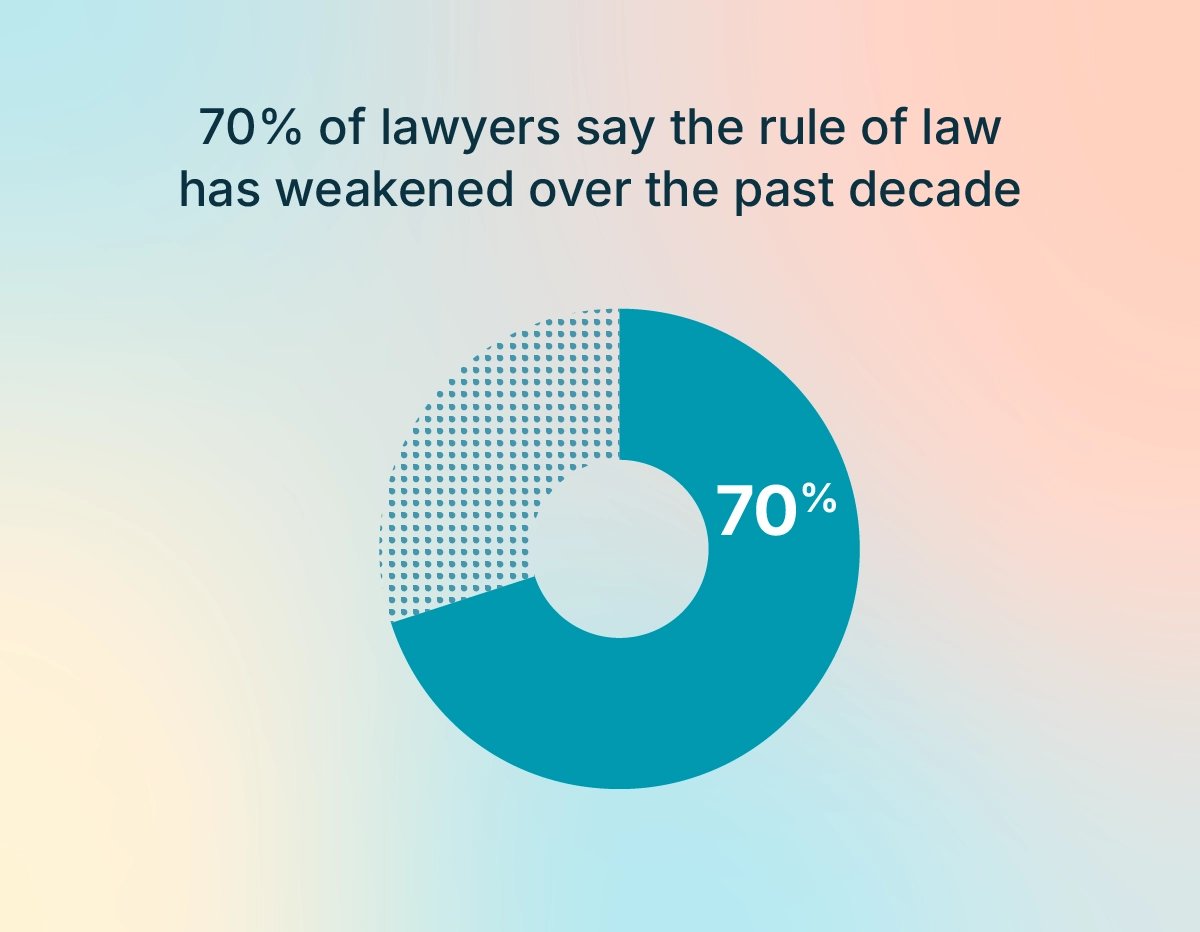
The data regarding long-term trends is similarly pessimistic. Nearly 70% of lawyers reported that the rule of law has weakened compared to ten years ago, with 38% stating it is much weaker. Other legal professionals were also concerned, though to a lesser degree, with 48% reporting a decline and 19% stating the system is much weaker. This difference in perspectives shows that the people most involved in the daily operations of the justice system and its impact on participants also tend to be the most attuned to issues impacting its stability.
The threats identified by respondents are largely cultural rather than institutional. Corruption and the abuse of power were the most frequently cited concerns (59%), followed by political polarization (51%) and the spread of misinformation (49%). When asked what might help restore public trust, 55% of respondents emphasized the importance of accountability for public officials.
In other words, the data shows that there is a significant divide between legal ideals and the current state of the justice system. While the report does not offer a single solution, it provides insights into how legal professionals view perceived threats to the stability of the judicial branch of our government and the institutional challenges we face ahead.
Addressing these issues will require a combination of better funding, increased efficiency, improved public education, and the thoughtful application of technology. However, these goals can only be achieved if there is agreement on the importance of ensuring equal access to justice and upholding the rule of law. Without that consensus, the report makes clear that our profession stands at a crossroads—one where the decisions made in the next few years will chart our course through the turbulent and unpredictable waters ahead.