

Key takeaways
Law firm expense tracking is the process of recording, categorizing, and assigning expenses to the correct client and matter for accurate billing and reporting.
Real-time expense capture helps firms recover more billable costs and avoid revenue leakage.
Clear workflows, like receipt capture, matter-level coding, and approvals, improve financial visibility and reduce administrative work.
Dedicated expense-tracking software can connect to purchases, receipts, and billing systems so expenses automatically appear on client invoices.
How to track your law firm's case expenses
Every unbilled expense is money left on the table, and in most firms, those losses add up faster than anyone realizes. Court filing fees, expert witness costs, travel, medical records, and document services all add up during the life of a case. But if those costs aren't captured and linked to the correct matter in real time, they often disappear before billing day.
And when you can't see every dollar as it's spent, you likely aren’t attributing costs to the right cases and aren't really in control of your firm's financial health.
This article walks through a practical, step-by-step approach to law firm expense tracking, from coding expenses as they occur to recovering costs on client invoices without the month-end scramble.
What is law firm expense tracking?
Law firm expense tracking is the process of recording, categorizing, and assigning firm and client-related expenses to the correct client and matter for accurate billing and reporting.
The primary goal is to capture billable expenses in real time, attach proper documentation, and ensure those costs appear on client invoices without month-end reconciliation chaos. When firms track expenses properly, they gain several business advantages:
Improved cost recovery
Fewer write-offs
Faster billing cycles
Clearer visibility into matter-level profitability
Without structured expense tracking for lawyers, many firms rely on disconnected tools—spreadsheets, email receipts, and accounting software. As a result, the process becomes fragmented, increasing the risk that expenses never make it onto client bills.
Types of law firm expenses
Understanding the different types of expenses a firm incurs during a case is essential for accurate billing and maintaining profitability. Most law firm expenses fall into two categories:
1. Hard costs are direct case expenses paid to third parties and typically reimbursed by clients. Examples include:
Court filing fees
Expert witness fees
Medical records retrieval
Deposition transcripts
Travel and lodging for litigation
Because these costs can be substantial, failing to track them accurately can significantly impact profitability.
2. Soft costs are internal expenses incurred during a case. Common examples include:
Printing and copying
Postage and courier services
Online research tools
Administrative supplies
While these costs are smaller individually, they accumulate quickly across many cases.
Best practices for tracking case expenses in a law firm
Strong expense tracking depends on clear processes, consistent habits, and the right tools. In the following section, we’ll cover best practices that help law firms capture expenses accurately and recover costs efficiently.
Assign every expense to the right matter from the start
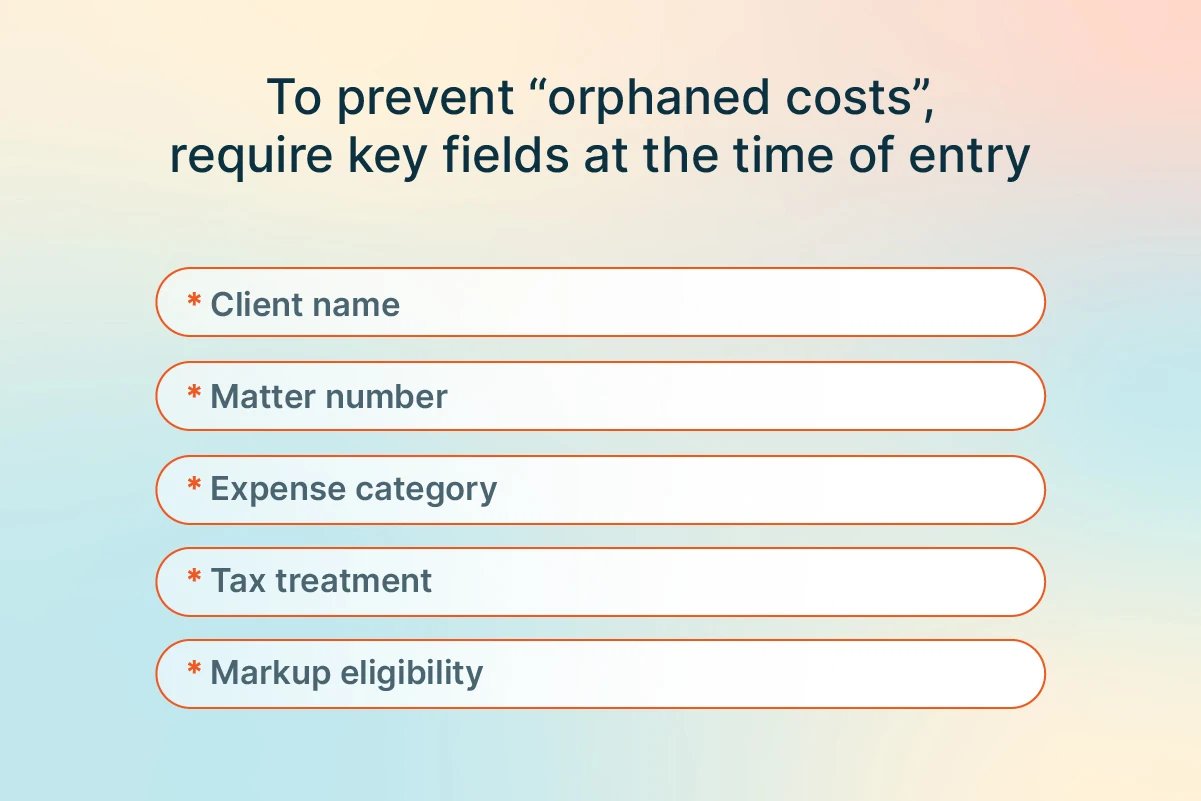
Many unbilled costs occur because expenses are entered quickly without all the necessary information. Missing details often create “orphaned costs” that aren’t tied to a specific case. To prevent this issue, require key fields at the time of entry:
Client name
Matter number
Expense category
Tax treatment
Markup eligibility
For example, one litigation team significantly reduced unbilled costs by enforcing matter-level coding whenever an expense was entered.
Capture receipts and documentation at the point of purchase
A receipt-first workflow ensures documentation is captured immediately when an expense occurs. When firms wait until the end of the month to gather receipts, they often encounter problems such as:
Missing documentation
Forgotten expenses
Incomplete descriptions
Write-offs during billing review
Expense capture tools help attorneys and staff document expenses as they occur via desktop notifications, improving accuracy and speeding up billing preparation.
Allocate shared and bulk expenses across multiple matters
Shared expenses can easily create billing errors if they aren't allocated consistently. Common scenarios include research subscriptions, expert consultations, or travel expenses related to multiple cases.
Firms typically allocate these costs using one of these methods:
Percentage-based allocation: Dividing costs proportionally across cases
Quantity-based allocation: Splitting expenses based on usage
Fixed-share allocation: Assigning equal portions to each matter
Using standardized templates or allocation rules creates an auditable trail and reduces billing disputes.
Set up approvals and enforce documentation standards
Clear approval workflows prevent billing errors before invoices reach clients. A well-defined process should include:
Who reviews expenses
Dollar thresholds that trigger review
Pre-bill approval checks
Firms should also implement role-based permissions to control who can edit or approve entries. Documentation standards should specify required details, including:
Receipt
Payee
Expense purpose
Rate table
Client authorization
These controls help firms maintain defensible records during client reviews or internal audits.
Connect expense data to billing and accounting systems
Expense tracking becomes far more accurate when it connects directly to billing and accounting tools. Integration automatically converts approved expenses into invoice-ready line items while keeping vendors and chart-of-account categories synchronized across systems. As a result, firms can eliminate the need for double data entry and reduce the risk of errors.
A strong QuickBooks integration, for example, allows two-way syncing of vendors, items, and expense categories. With systems working together, reimbursable expenses and advanced client costs are mapped correctly in accounting records, helping ensure accuracy across billing and financial reporting.
Implement law firm expense tracking software
Manual tracking methods, like spreadsheets or disconnected credit cards, often create blind spots in firm finances.
Dedicated law firm expense tracking software can automatically link purchases, receipts, and matter details so expenses flow directly onto client invoices. These tools also provide real-time dashboards showing spending by card, matter, or category.
Benefits of law firm expense tracking software
Dedicated lawyer expense tracking software helps firms recover more billable costs, reduce administrative work, and gain clearer financial visibility.
Below are several common challenges these tools help solve.
Complex and fragmented tracking systems: Many firms track expenses across credit cards, receipts, spreadsheets, and accounting tools. This patchwork approach makes it difficult to see where firm money is going or which cases generate the highest costs. Modern tools centralize this data, giving firms a clearer view of spending. For broader strategies on financial visibility, refer to these guides to business expense management and business spend management.
Missed billable expenses and revenue leakage: When receipts aren't tied to a case immediately, expenses can easily be forgotten. Firms often pay for costs such as filing fees, expert witnesses, travel expenses, medical records, etc.
If these expenses aren't properly captured, firms end up absorbing the costs themselves.
Time-consuming, error-prone manual processes: Manual expense tracking drains valuable staff time. Instead of focusing on client work, teams spend hours chasing receipts, correcting billing errors, and answering invoice questions.
Automated workflows reduce this administrative burden while improving accuracy.
For additional guidance on improving financial operations, see these expert tips on law firm expense management and key law firm KPIs.
How expense tracking software is used by different firm types
Different law firms use expense-tracking tools in distinct ways, depending on their practice areas, billing models, and case structures.
Immigration firms
Immigration firms often handle high volumes of government filing fees and administrative expenses tied to individual cases. Because many matters involve multiple applications and supporting filings, costs can add up quickly—and each one must be tied to the correct client and matter for accurate billing and compliance.
Virtual cards help simplify this process by allowing firms to assign expenses directly to a case at the time of purchase. For example, a USCIS filing fee can be paid with a dedicated virtual card and immediately linked to the client’s matter, creating a clear one-to-one record. This has become especially important as many immigration firms moved away from paper checks in October 2025 due to the change in USCIS requirements and needed a new way to maintain the same level of transparency and expense tracking.
Family law firms
Family law firms often operate on retainers and handle a steady stream of small case-related expenses, from filing fees to document preparation costs. Because these firms must also follow strict trust accounting rules, careful expense tracking is essential to ensure costs are recorded accurately and billed appropriately.
Expense tracking tools help family law practices maintain compliance, track reimbursements, and reduce billing friction with cost-sensitive clients. By clearly documenting expenses and linking them to the correct matter, firms can provide more transparent invoices while protecting their revenue.
Personal injury firms
Personal injury firms often front significant case costs, including expert witness fees, medical records, and investigation expenses, while cases move through lengthy timelines. Because these costs are typically recovered at settlement, accurate long-term tracking is critical to protecting case profitability.
Structured expense tracking helps personal injury firms keep a clear record of advanced costs and ensure nothing is missed when it’s time to reconcile expenses. By organizing expenses at the matter level, firms can recover more costs, maintain accurate financial records, and protect their margins throughout the life of a case.
Criminal defense firms
Criminal defense firms often operate in urgent, high-stakes situations where decisions must be made quickly, and expenses can arise without much notice. Costs like investigation services, expert consultations, travel, and court-related fees must be carefully documented as cases move quickly.
Expense tracking tools help criminal defense firms maintain clear financial records without disrupting their workflow. When expenses are linked to the correct matter as they occur, firms gain better visibility into case costs, stay organized for billing, and maintain accountability while focusing on each case's demands.
Streamline expense tracking with 8am™ Smart Spend
Effective expense tracking helps law firms capture every billable cost, maintain clear financial visibility, and reduce administrative work.
Smart Spend is designed to make that process easier by connecting firm spending directly to billing workflows. Instead of managing expenses across credit cards, receipts, spreadsheets, and accounting tools, Smart Spend keeps everything in one place—so purchases, documentation, and case details stay connected.
With Smart Spend, firms can:
Capture receipts and link expenses to matters at the time of purchase so reimbursable costs aren’t missed and can flow directly onto client invoices
Assign physical and virtual cards with customizable spend limits to staff, departments, or individual cases to help control budgets and manage cash flow
Monitor spending in real time through dashboards and reporting tools that show activity by card, category, and case
For firms using MyCase and LawPay together, Smart Spend connects spending, billing, and payments in a single workflow. Expenses can be captured as they happen—through mobile or desktop notifications—reducing missed costs and keeping records accurate. Instead of tracking inflows and outflows across disconnected systems, firms can view expenses alongside billing and payment data, improving financial visibility. When expenses, receipts, and billing are connected, firms spend less time chasing documentation and more time focusing on clients.
Clear insight into firm spending is essential for maintaining strong financial oversight. Learn more about how 8am Smart Spend helps law firms manage expenses, monitor spending, and recover more billable costs.