

With all the time you spend managing cases, doing research, and overseeing day-to-day tasks, you might not have the bandwidth to monitor your performance metrics as closely as you’d like. And that’s understandable—most lawyers would prefer to focus on client work rather than statistical modeling. Still, without consistent benchmarks to measure progress and growth, you’ll miss opportunities to streamline operations, increase revenue, and improve efficiency.
Success can feel elusive without a clear strategy, and competing firms are no longer relying on intuition alone. That’s where key performance indicators (KPIs) come into play. When used strategically, legal KPIs provide the direction and data-driven insights you need to achieve your goals and make smarter business decisions.
In this article, we’ll walk through the essential KPIs your firm should track, how they vary by firm type, and how modern practice management platforms can make progress easier to measure without pulling your attention away from client work.
Why is it important to track law firm KPIs?

Tracking the right metrics gives you a clear view of your firm’s financial position and operational stability. KPIs translate day-to-day activity into measurable signals, making it easier to assess what’s working, what isn’t, and where adjustments are needed as the firm evolves. Without that visibility, strategies are harder to evaluate, and small problems can go unnoticed until they start affecting revenue or client service.
Put simply, KPIs help firms stay focused on priorities that support steady progress. They surface risks early, highlight performance gaps, and provide a factual basis for decisions that would otherwise rely on guesswork.
Let's look at three key reasons for tracking KPIs at your firm.
1. Monitor performance
KPIs make it easier to see how close the firm is to achieving specific goals, whether that’s improving cash flow, increasing case volume, or reducing delays in billing. Examining the same metrics over time also reveals patterns that can be overlooked in day-to-day work, allowing firms to refine priorities and adjust plans proactively.
2. Maintain accountability
Clear metrics create shared expectations across the firm. When goals are tied to measurable targets and reviewed regularly, it becomes easier to track follow-through and address gaps early. That structure encourages ownership at every level and supports steady, incremental improvement rather than reactive course corrections.
3. Eliminate guesswork
Decisions grounded in data are typically more reliable than those based on assumptions or incomplete information. KPIs provide a straightforward way to evaluate performance using consistent criteria. They also pinpoint areas that need attention, which helps teams focus their time on changes that will have the greatest impact.
Beyond high-level performance tracking, a KPI for law firms can also shed light on the effectiveness of operational, financial, and payment workflows. That visibility reduces uncertainty and brings underlying trends to the surface, making it easier to spot inefficiencies, address weak points, and build processes that support long-term stability.
How to choose which KPIs to measure
Modern firms generate an enormous amount of data, but trying to quantify everything is impractical and will likely lead to lawyer frustration and burnout. Narrowing your focus to a defined set of law KPIs is far more effective and far easier to sustain over time.
To identify which metrics are worth monitoring, start with these steps:
Define your objectives. Outline what you want the firm to accomplish in both the near and long term. Setting realistic, well-defined SMART goals (those that are specific, measurable, achievable, relevant, and time-bound) helps clarify which outcomes matter most and what data will be useful in measuring progress.
Review current performance. Take stock of how the firm is operating today. Look for areas where results fall short of expectations, as well as parts of the business that appear poised for growth. These pressure points often signal which KPI for law firms will be most valuable to track.
Assess available data. There’s a good chance you have access to helpful data through systems your firm is already using. Most social media platforms and website hosts offer basic analytics dashboards, and payment and billing solutions such as LawPay can provide visibility into financial activity, productivity, and client behavior. If certain KPIs require data and legal analytics you’re not yet collecting, decide whether it makes sense to start gathering that information.
Use both financial and non-financial KPIs. Monitoring your law firm’s profitability and revenue is essential for understanding financial stability, but it only tells part of the story. Non-financial KPIs tied to client satisfaction, retention, and staffing trends also provide valuable insights. Together, these metrics offer a more complete view of firm performance.
Keep it simple. A smaller, well-chosen set of law firm KPIs is easier to review regularly and act upon decisively compared to unwieldy reports packed with low-value data.
The essential legal KPI metrics to monitor
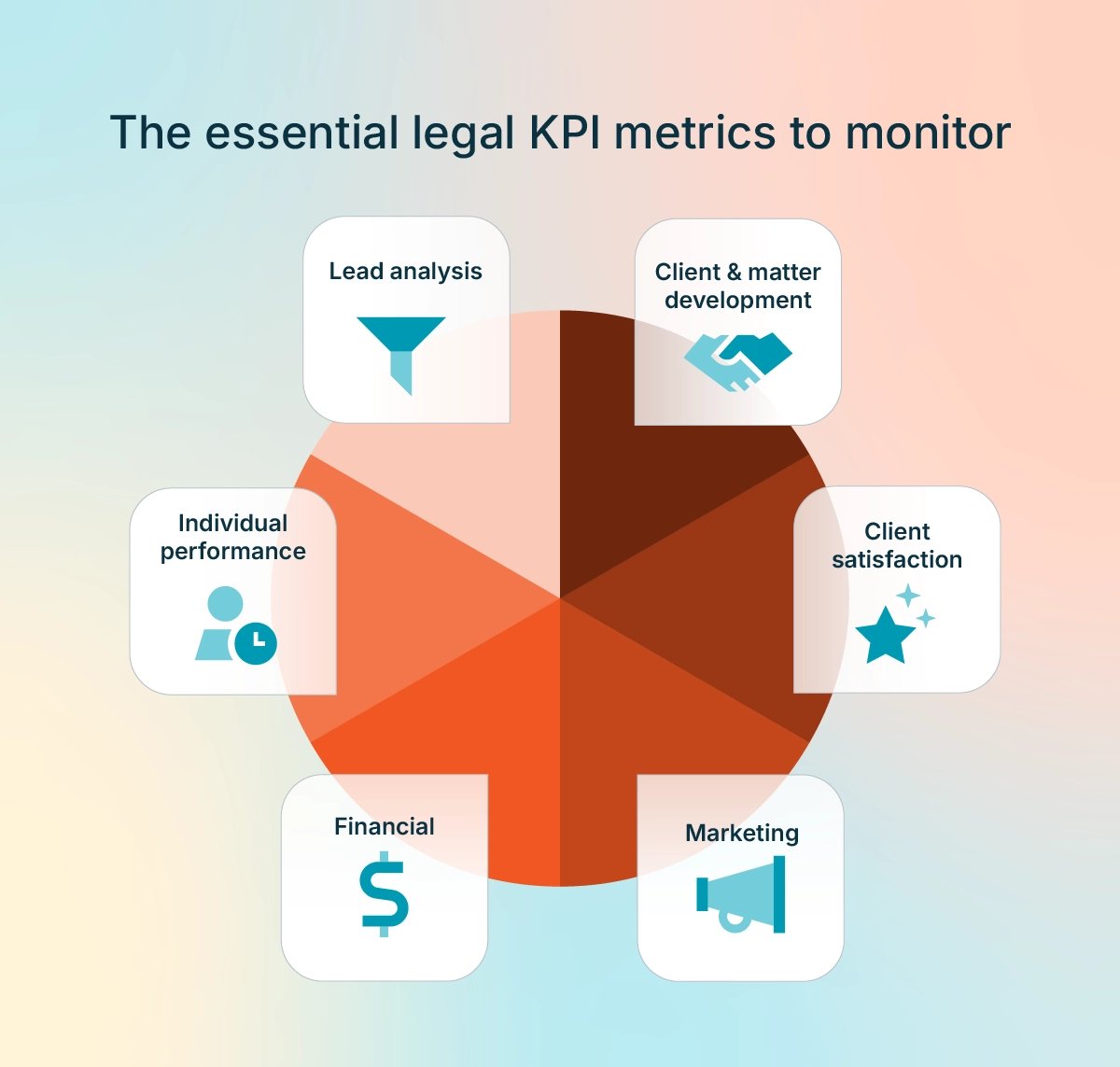
While each law firm should consider its individual needs and objectives when selecting KPIs to track, there are six types of metrics that play a crucial role in developing successful strategies for law firm management and performance evaluation.
Client and matter development KPIs
Client and matter development metrics show whether the firm is building sustainable demand for its services. They help teams evaluate how effectively new business is being generated and whether existing client relationships are continuing to grow. The following KPIs can offer early signals about future workload and revenue stability:
New client acquisition rate: Shows how many new clients a firm signs within a given period, helping gauge the effectiveness of marketing and referral efforts.
Client growth rate: Captures the percentage change in total active clients over time to indicate whether the firm’s client base is expanding or contracting.
Average number of cases: Provides insight into workload distribution and overall capacity across attorneys and practice areas.
Average fee per client: Dividing total revenue by the number of clients reveals the typical financial value of each client relationship.
Number of lawyers per client: Indicates how many attorneys are typically involved in serving a single client, which can reveal whether resources are being allocated efficiently or stretched too thin.
Number of matters per client: Repeated engagements signal stronger client relationships and greater potential for cross-practice work.
These KPIs help firms spot early trends in client demand and matter distribution, improving resource planning and forecasting.
Client satisfaction KPIs
Client experience plays a direct role in how firms grow and how they are perceived in the market. Paying attention to how clients feel about communication, outcomes, and overall service helps firms strengthen relationships and avoid issues that can quietly damage trust over time. The following metrics offer practical ways to monitor satisfaction and protect your firm’s reputation.
Client retention rate: Measures the percentage of clients who return for additional matters, signaling long-term satisfaction and loyalty.
Client satisfaction ratings (surveys or reports): Summarize direct feedback from clients to highlight strengths and uncover areas that need improvement.
Star ratings: Reflect public review scores on platforms such as Google or Avvo, which influence credibility and new client acquisition.
Qualitative data (long-form client reviews): Provides detailed feedback that reveals specific service issues, communication gaps, or positive experiences.
Number of client referrals: Tracks how often existing clients recommend the firm to others, serving as a practical indicator of trust.
Net Promoter Score (NPS): Quantifies how likely clients are to recommend the firm on a scale of 1-10.
Tracking this type of law firm KPI can help build trust, strengthen relationships, and turn satisfied clients into referral sources.
Marketing KPIs
Marketing activity shapes how potential clients discover your firm and decide whether to reach out. Because client acquisition requires both time and budget, it’s important to understand which channels are delivering meaningful results and which ones need refinement. These metrics help firms evaluate visibility, lead quality, and return on marketing spend. Here are some law firm metrics to track for marketing:
Number of website visitors per month: Indicates how many people are reaching the firm’s site monthly—a baseline measure of online visibility and lead gen potential.
Landing page conversion rates: Shows the percentage of visitors who complete a desired action, such as submitting a contact form, which reflects how effectively pages turn interest into inquiries.
Email marketing performance: Tracks engagement through metrics like open rates and click-through rates to reveal how audiences respond to firm communications.
Client acquisition cost (CAC): Calculates the average amount spent to gain one new client, helping assess whether marketing efforts are financially sustainable.
Referral traffic: Measures how many visitors arrive from external sources such as directories, partner sites, or social platforms, highlighting the strength of off-site visibility.
Lifetime customer value (LCV): Estimates the total revenue a typical client generates over their full relationship with the firm, which can help guide marketing and retention decisions.
Social media engagement: Captures activity such as likes, shares, comments, and follows to indicate audience interest and brand awareness.
Marketing ROI: Measures how much revenue is generated for each dollar spent on marketing; calculated by dividing campaign revenue by campaign cost.
Monitoring this legal KPI category helps firms understand which channels actually drive profitable new matters and where intake bottlenecks may be causing lost opportunities.
Financial KPIs
Financial metrics help assess whether a practice is operating on a stable footing and where adjustments may be needed. Regularly reviewing financial KPIs helps firms spot cash flow issues early, evaluate profitability, and make informed decisions about spending, pricing, and growth. Keep these KPIs in mind to ensure your business meets its financial goals:
Monthly law firm revenue: The total income generated by the firm each month, serving as the baseline measure of financial performance.
Total firm debt: The combined value of all outstanding liabilities, including loans, credit lines, and unpaid obligations, which helps clarify financial risk and leverage.
Collection rate: Compares the total amount billed to the amount actually collected to show how effectively the firm converts completed work into income.
Length of accounts receivable (A/R aging): The average time it takes to receive payment after an invoice is issued, with longer periods signaling increased cash flow risk.
Current estimate of operating costs: Ongoing expenses such as payroll, taxes, office overhead, software, and other recurring obligations required to run the firm.
Current estimate of annual revenue: A projection of total revenue for the year based on recent performance, commonly used for budgeting and financial planning.
Net income as a percentage of revenue: The portion of revenue that remains after all expenses are paid, indicating the firm’s overall profit margin.
Net overhead: The percentage of revenue consumed by operating expenses, with lower overhead leaving more income available for reinvestment or distribution.
Preferred client payment method: Records how clients typically pay, such as by card, ACH, or check, which can inform payment options and reduce friction in collections.
Matter type profitability: Compares revenue and costs by practice area to identify which types of work contribute most to profitability and which may strain resources.
Measured with financial reporting tools, these legal KPIs give firms visibility into cash flow health, profitability drivers, and financial risk areas that need attention.
Individual performance KPIs
Understanding how time and effort are distributed across the firm can be difficult when everyone is focused on meeting client deadlines. Still, productivity metrics play a direct role in revenue consistency, staffing decisions, and long-term sustainability. A performance framework built on clear, measurable data helps firms manage workloads more effectively and avoid hidden inefficiencies. Here are some productivity KPIs to keep track of:
Billable hours: Records the amount of time attorneys and staff spend on client work that can be invoiced, forming the primary revenue base for most firms.
Non-billable hours: Time spent on administrative tasks, internal projects, training, or business development that cannot be billed to clients and should be monitored to prevent productivity drain.
Average bill rate: The average hourly amount charged across all matters, which helps assess pricing strategy and the mix of work the firm is taking on.
Case progression: Tracks how quickly matters move through major stages, making it easier to identify delays and estimate future timelines.
Case access: Measures how frequently and how quickly team members open case files, offering insight into engagement levels and workload distribution.
Expense tracking: Follows individual costs submitted for reimbursement or client billing to support accurate records and compliance.
Utilization rate: The percentage of total working hours spent on billable tasks, showing how much time is dedicated to revenue-generating work.
Realization rate: The share of billable time that is ultimately invoiced and collected after write-offs, discounts, or unpaid balances.
Number of unbilled days: The average gap between completing work and issuing an invoice, with longer delays putting pressure on cash flow.
Number of uncollected days: The average time between sending an invoice and receiving payment, which reflects how efficient the firm’s collection process is.
Case cycle time: Measures how long a matter takes to move from opening to resolution, with shorter cycles supporting higher capacity and steadier revenue when quality is maintained.
Employee turnover: Calculates the percentage of staff who leave over a given period, with elevated rates often pointing to workload strain, morale issues, or management gaps.
These KPIs for law firms help identify high performers, spot inefficiencies, and ensure time and talent are being used productively.
Lead analysis KPIs
Bringing in new clients is crucial to firm growth, but identifying which efforts actually drive signed matters can be challenging. Lead analysis metrics connect marketing activity to real outcomes by showing where prospects come from and how they move through intake. That visibility helps firms invest in channels that perform well and fix gaps that slow conversion. Use the following metrics to learn how prospective clients find your firm:
Client acquisition cost (CAC): Calculates the total expense required to convert a lead into a signed client, including marketing, intake, and sales costs, with lower figures indicating more efficient growth.
Total number of new clients: Counts how many clients sign with the firm during a given period and serves as a baseline indicator of business development momentum.
Number of new clients by source: Group new clients by origin, such as referrals, website traffic, or review platforms, to show which channels consistently deliver results.
Estimated average value of each new case: Projects the expected revenue from a typical new matter to help prioritize lead sources that tend to produce higher-value work.
Number of consultation appointments set (or total consultation fees collected): Tracks how many inquiries turn into scheduled meetings or paid consultations, reflecting how effectively the intake process captures interest.
Number of new cases or matters opened: Tallies how many new matters begin within a set timeframe to indicate whether client intake aligns with growth targets.
Rate of prospective clients who show up for consultations: Measures the share of scheduled consultations that actually take place, with lower rates pointing to friction or weak follow-up during intake.
Conversion rate of leads to clients: Compares total leads to signed clients to reveal how well the firm turns initial inquiries into active matters.
Clear intake metrics make it easier for firms to see where leads fall off, refine their funnel, and double down on what’s converting.
How KPIs differ by firm type
No single set of KPIs is equally helpful to every practice. The metrics that matter most depend on how a firm bills, the type of work it handles, and how revenue is generated over time. For example, corporate advisory firms often concentrate on financial metrics, while personal injury firms may place more weight on tracking client success and satisfaction as they look to build their brand and reputation.
Focusing on metrics that reflect how your firm actually operates will yield more relevant, valuable insights that you can apply on a daily basis.
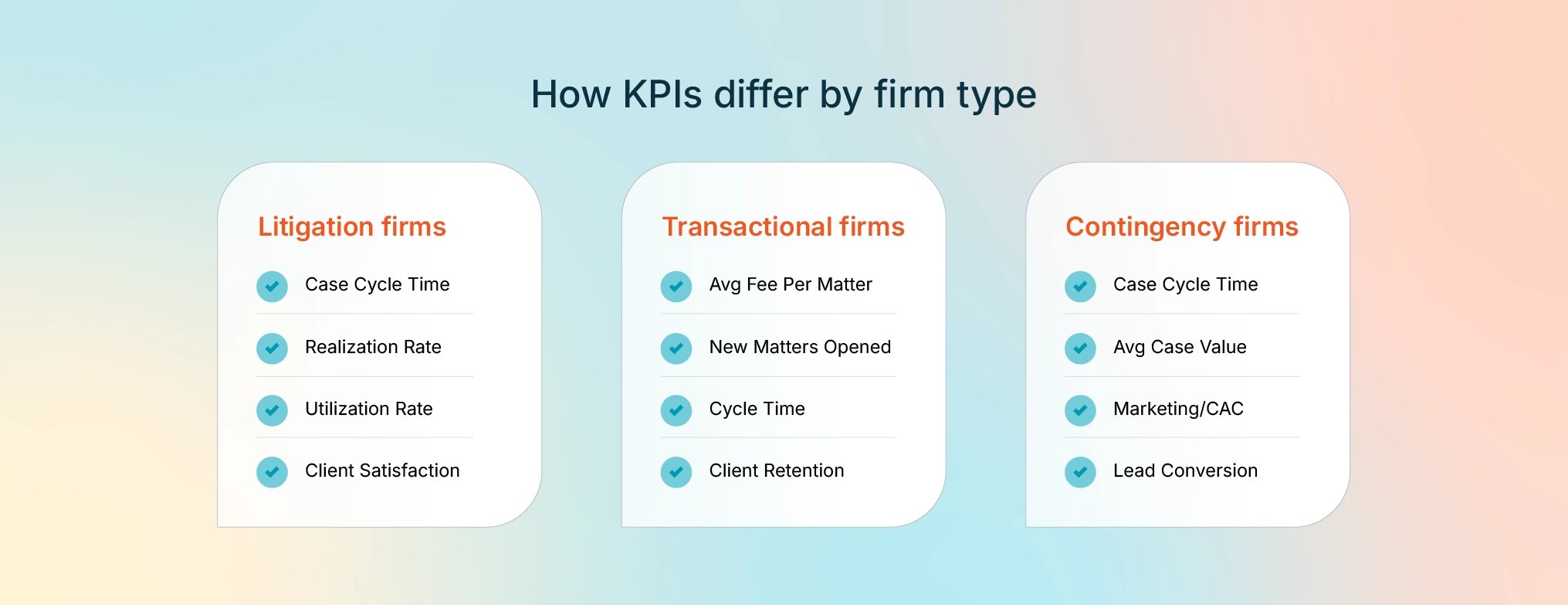
Litigation firms
Litigation work often involves long timelines, unpredictable workloads, and complex billing arrangements. Revenue may lag months behind the work itself, and client expectations can be high during stressful disputes. Important KPIs for law firms of this type include:
Case cycle time: Shorter timelines allow firms to resolve matters sooner, recognize revenue earlier, and take on additional cases without compromising quality.
Realization and collection rates: Tracking how much billed work is ultimately invoiced and paid helps firms manage write-offs, disputes, and cash flow gaps common in complex matters.
Utilization rate: Monitoring billable time ensures research, preparation, and court work are balanced against administrative demands that can quietly erode revenue capacity.
Client satisfaction: Strong satisfaction metrics help firms maintain trust and retention when outcomes are uncertain and cases are emotionally demanding.
Transactional firms
Transactional practices often operate on tighter timelines and predictable workflows, with many matters billed at flat or capped fees. Growth usually depends on volume, efficiency, and repeat business rather than long case cycles. These firms may focus on KPIs such as:
Average fee per matter: Keeping a close eye on typical matter value helps confirm that pricing remains profitable as costs and workloads change.
New matters opened: A steady flow of new work signals healthy demand and supports reliable revenue planning.
Cycle time: Faster deal completion frees up capacity and allows teams to handle more matters without adding headcount.
Client retention rate: Repeat engagements reflect satisfaction and reduce reliance on constant new-client acquisition.
Contingency firms (including personal injury practices)
Contingency-based firms face unique financial pressure because payment depends on case resolution. Marketing often represents a major expense, and intake volume can be high relative to the number of cases that move forward. Here are some KPIs for these practices to prioritize:
Case cycle time: Shorter resolution periods improve cash flow predictability and reduce the strain of carrying case costs for long stretches.
Average case value: Understanding which matters generate stronger returns helps firms prioritize resources and refine case selection criteria.
Marketing KPIs and client acquisition cost: Measuring how much is spent to sign each client keeps advertising budgets aligned with realistic revenue potential.
Lead-to-client conversion rate: Higher conversion efficiency determines how effectively large volumes of inquiries translate into viable cases.
Tools that help law firms monitor KPIs
Manually tracking KPIs can be slow and prone to errors, especially when data lives across multiple systems. Purpose-built software simplifies the process by collecting information automatically and presenting it in dashboards that are easy to review and update. The result is a more reliable way to monitor performance without adding administrative burden.
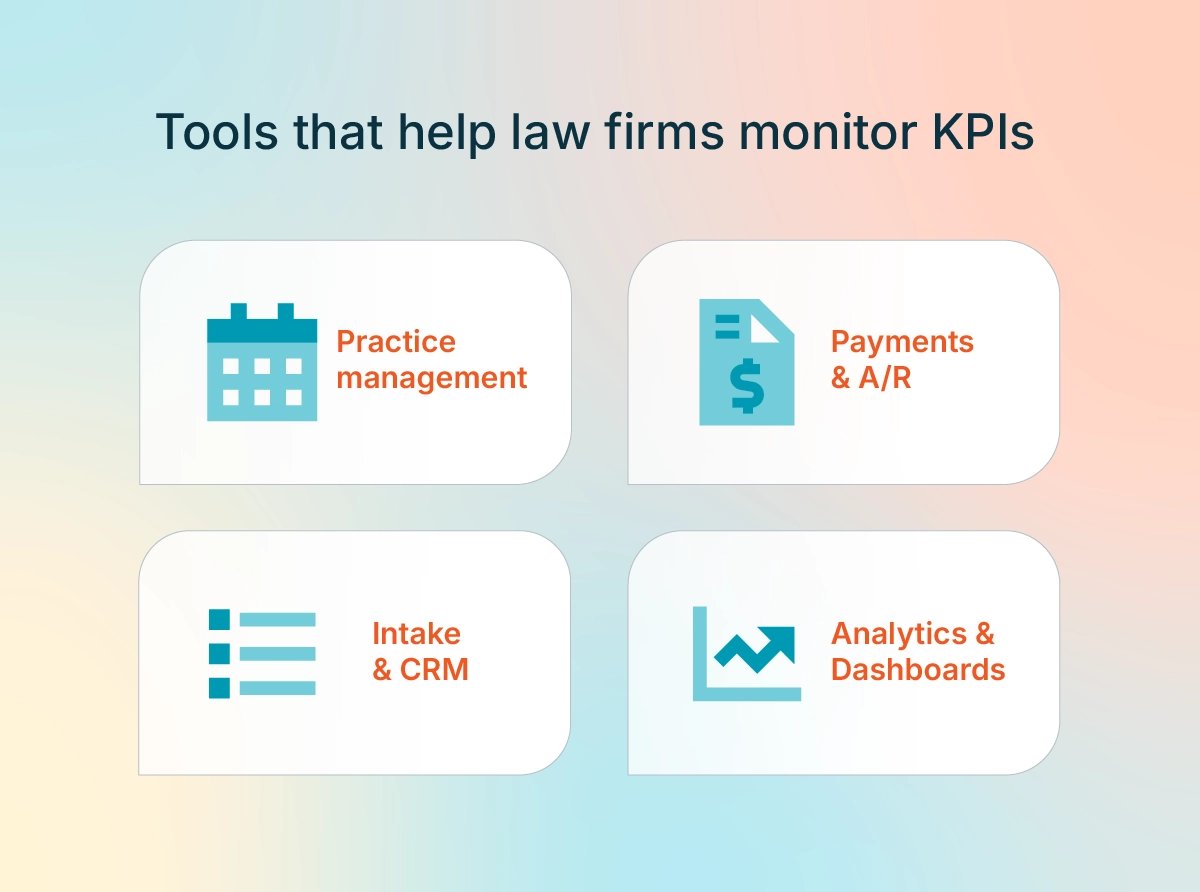
Popular types of tools for tracking KPIs include:
Practice management systems: Platforms such as 8am MyCase and 8am CasePeer centralize reporting on case activity, productivity metrics, staff performance data, and matter-level details, giving firms a clearer picture of how work moves through the practice.
Payments and A/R reporting tools: Solutions like LawPay help firms track payment timing, accounts receivable aging, collection rates, and client payment preferences, which are key inputs for financial KPIs.
Intake and CRM platforms: These tools focus on lead volume, conversion rates, client acquisition trends, and source attribution to show how new business enters the firm.
Business intelligence dashboards and analytics tools: Reporting platforms visualize KPIs over time, surface patterns, and support custom reports that leadership teams can use for planning and performance reviews. Some practice management systems also include extensive built-in reporting libraries, with dozens of preconfigured reports covering areas such as case timelines, lead sources, settlements, and staff productivity.
Many firms use a law firm KPI dashboard built into software that they use to manage daily operations. Look for tools that mesh well with your existing workflows and reduce the need for manual data entry.
Visibility creates stronger firms
By tracking KPIs, attorneys gain a clearer view of how work, revenue, and resources flow through their firms. They can spot risks early, evaluate tradeoffs, and make adjustments based on evidence rather than instinct.
Firms that consistently review their performance metrics tend to plan with more confidence, allocate resources more effectively, and avoid hidden problems that can disrupt cash flow and client service.
If you’re ready to get started, focus on a few of the KPIs from this guide that reflect your firm’s goals and operating model, and make a habit of reviewing them regularly. Start small and use your observations to guide meaningful changes in how your business runs.
Learn more about how the 8am family of legal solutions can help your firm track, understand, and act on the metrics that matter.