

Key takeaways
A law firm’s realization rate measures how much of its billable work ultimately turns into collected revenue, making it a core indicator of profitability.
Firms should track their realization rates to understand how discounts, write-downs, and unpaid invoices are affecting their overall revenue.
To improve realization rates, firms can adjust discount policies, track time consistently, manage collections proactively, and closely monitor financial performance.
Legal software solutions like 8amTM MyCase and 8am LawPay help firms capture billable work accurately, streamline invoicing and payments, and gain visibility into the full billing lifecycle.
In order to grow and remain profitable, law firms need to understand the financial side of their operation.
One important component of this is the realization rate, which measures how much of the money you’ve earned that you actually collect.
There are several types of realization rates, each serving a different purpose. In this article, we’ll explore these categories, explain how to track realization rates, and outline practical ways to improve them.
What is a law firm’s realization rate?
A law firm’s realization rate is the total percentage of billable time that is actually paid. For example, if you work 100 hours on a legal case and only get paid for 90 of those hours, your law firm realization rate would be 90%.
There are many things that can cause a realization rate to be less than 100%. A particular client could continually delay payment or otherwise refuse to pay. But, there are other, more benign reasons, too. You might negotiate a discount for a client, which would reduce your realization rate before you send the bill. Alternatively, you might write off particular services, which would reduce your realization rate after you send the bill.
Realization rate formula
Firms use the following formula to calculate realization rates:
Realization rate = (total amount collected / total value of billable work) x 100%
For instance, if your total billable value is $10,000 but you collect $8,000, your realization rate is 80%.
How to calculate realization rates for your law firm
Law firms track realization rates to understand how billable work translates into collected revenue. There are three main types of realization rates: billing, collection, and overall realization. Each of these metrics offers insights into a different stage of the billing and collections process.
Rate type | Description | Formula | Example |
Billing realization rate | Measures discounts or write-downs before invoices are paid | Amount billed ÷ Standard value of recorded time | $9,000 ÷ $10,000 = 90% |
Collection realization rate | Measures how much of billed revenue is actually collected | Amount collected ÷ Amount billed | $8,000 ÷ $9,000 = 88.9% |
Overall realization rate | Measures total cash received compared to standard value of time worked | Amount collected ÷ Standard value of recorded time | $8,000 ÷ $10,000 = 80% |
Billing realization rate
The billing realization rate reflects how much of your standard billable value makes it onto the invoice after discounts and other pricing adjustments that occur before a bill is sent to a client.
If you’re wondering how to calculate realization rates for billing, it’s fairly straightforward. For example, if your standard rate is $200 per hour and you work 50 hours for a client, the value of that work is $10,000. If your client negotiates a lower bill of $9,000, your billing realization rate is $9,000 ÷ $10,000, or 90%.
Firms monitor this rate to understand how often discounts are applied and whether those adjustments align with pricing policies and client expectations. Many practices have billing realization rates below 100%, and that’s typically not a cause for concern. For instance, you may offer a particular client a discount to support a promising long-term relationship.
Collection realization rate
The collection realization rate for a law firm measures how much of billed revenue is ultimately collected. It focuses on what happens after invoices are issued.
For example, if you bill a client $9,000 and collect $8,000 of that amount, your collection realization rate is $8,000 ÷ $9,000, or 88.9%.
You can use this metric to evaluate how effectively you’re converting invoices into cash and how write-offs are impacting your bottom line. The higher your collection realization rate, the better you are at making sure bills get paid and bringing in money that your firm needs to continue operating. Low rates may indicate a need to improve client satisfaction or address issues with your collections process.
Overall realization rate
The overall realization rate combines billing and collection performance into a single metric. It compares total cash collected to the standard value of the work performed.
Using the same example, if 50 hours of work at $200 per hour equals $10,000 in billable value, and the firm ultimately collects $8,000, the overall realization rate is $8,000 ÷ $10,000, or 80%.
This rate reflects the cumulative impact of discounts, write-downs, and collections on firm revenue.
Using realization rates as financial KPIs
Many firms track realization rates as ongoing financial indicators rather than one-time calculations. Reviewing billing and collection realization percentages over time can reveal patterns related to pricing decisions, client behavior, or internal workflows.
The value of tracking these law firm KPIs lies in understanding trends, identifying inconsistencies, and determining where adjustments may improve profitability.
Why is the realization rate important for law firms?
Like any other business, a profitable law firm needs to have a good grasp of its finances. Firms need to understand what they’re bringing in every month, as well as how much money they’re spending, and on what.
This knowledge allows a legal practice to answer questions about its law firm revenue, where it can reduce expenses, and whether it needs to expand or reduce staff.
The billing, collection, and overall realization rates are important tools that can help. Together, they allow you to quantify a particular aspect of your law firm’s operation, which allows you to make adjustments to how you handle discounts or billing to bring in more money.
How to improve your law firm’s realization rate
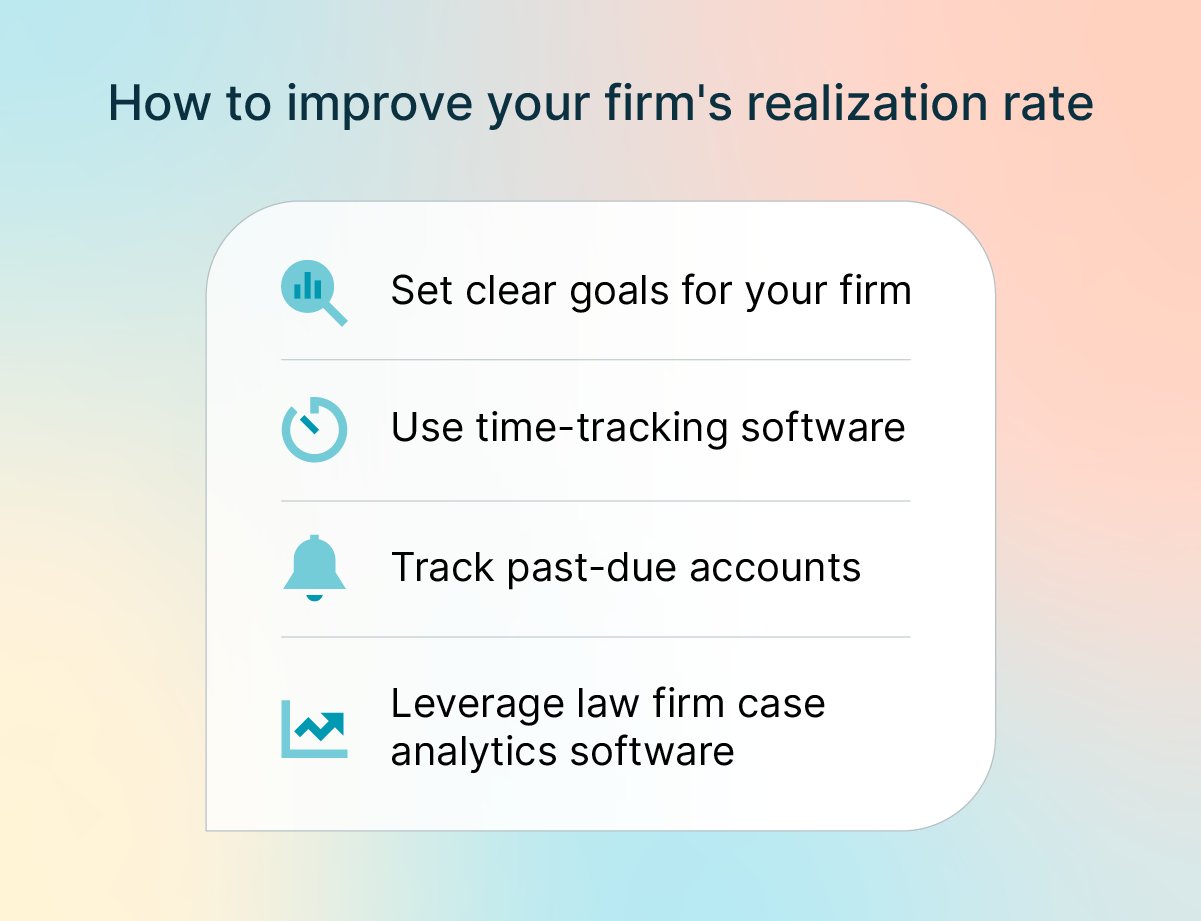
Your law firm’s realization rate is extremely important to the success of your business, so you need to understand the primary ways of improving it. This includes setting clear goals, using time-tracking software such as LawPay, and tracking past-due accounts.
Set clear goals for your firm
We’ve noted that realization rates can decrease because of discounts and write-offs. There’s nothing wrong with this practice, but it’s important to understand when it’s occurring and why, so you can make adjustments as required.
One way to approach this task is by setting SMART goals, i.e., goals that are specific, measurable, achievable, relevant, and time-bound.
When it comes to improving realization rates, for example, you can start by clearly stating your firm’s policies on discounts and making sure your lawyers understand what they are. When someone in your firm does offer a discount, have them explain their reason for it in writing.
This way, you can make sure they’re abiding by the established rules and not leaving money on the table.
Use time-tracking software
Since hourly billing is still the most common way for attorneys to price their services, it’s crucial that you keep track of your time. Not only does this ensure that you’re billing for all the work you do, it also allows you to spot inefficiencies and correct them.
Law firm billing solutions like LawPay make this task significantly easier. You can effortlessly track time entries and expenses with built-in timers. Afterward, your invoices will dynamically update, making it easy once it’s time to bill.
In addition, LawPay supports other crucial functions like invoice creation and collections, contact management, and payment scheduling.
More firms are starting to see the value of automated time-tracking tools. According to the 8am 2025 Legal Industry Report, 24% of legal professionals now use time-tracking software that automatically records work in the background—and 56% of firms using these tools report measurable time savings each month.
Track past-due accounts
Unpaid invoices directly affect your realization rate. Even firms with strong billing practices can see revenue stall if follow-up processes are inconsistent or delayed.
Automated accounts receivable reporting makes it easier to stay on top of collections. Instead of manually reviewing invoices, firms can rely on reports that show which balances are outstanding and how long they’ve been open.
For example, MyCase provides financial reports designed to improve billing oversight, including:
Accounts receivable reports that list aging invoices and highlight overdue balances
Trust account reports that show balances and activity to help manage client funds properly
Productivity reports detailing billable and non-billable time for each staff member
Offering online payment options also removes friction from the billing process. When clients can pay quickly and securely, firms often see steadier cash flow and fewer aging invoices.
Leverage law firm case analytics software
Collections are only part of the picture. Realization rates can also be affected by the speed at which work moves from time entry to invoicing and from invoicing to revenue collection.
Case analytics software provides a comprehensive view of the billing lifecycle. By consolidating billing and matter data into customized reports, firms can examine performance across attorneys, practice areas, or time periods. This makes it easier to detect issues such as delayed billing, excessive write-downs, or gaps between recorded time and issued invoices.
For example, MyCase includes legal analytics reporting tools that provide clearer visibility into realization rates, including:
Customizable financial reports comparing billed and collected revenue
Work-in-progress reporting to identify time that has not yet been invoiced
Productivity reporting by attorney or matter
Real-time dashboards that track law firm financial metrics like revenue trends and trust balances
These financial and case analytics reports support more informed decision-making. To optimize realization rates, firms can take actions like refining billing review processes, minimizing write-offs, and addressing unbilled time and workflow bottlenecks.
Streamline your financial operations with 8am legal software
As firms grow, financial oversight becomes more complex. Tracking time accurately, billing promptly, managing trust balances, and collecting payments all play a role in maintaining a healthy realization rate.
MyCase and LawPay are part of the 8am family of law firm software solutions, which is built to support the full financial lifecycle of your practice. MyCase includes built-in time tracking, invoicing, financial management tools, and case analytics reports that give firms clear visibility into performance. LawPay complements those capabilities with secure online payments, next-day deposits, trust account safeguards, and flexible payment options designed for legal professionals.
Together, these tools help firms record billable work consistently, invoice efficiently, monitor financial performance, and accelerate collections—all within a compliant, purpose-built ecosystem.
Learn more about how 8am legal solutions can strengthen your firm’s financial operations by scheduling a demo today.