

Key takeaways
Law firm risk management starts with identifying financial, operational, compliance, and technology risks and prioritizing the ones you can control first.
Financial risks like poor expense tracking and unclear billing are among the most common and preventable.
A structured framework helps firms reduce exposure over time.
Better visibility into spend, billing, and workflows strengthens risk control without adding administrative burden.
Running a successful law firm means managing a constant flow of deadlines, client relationships, and financial decisions. With the right systems in place, even complex work can stay organized, transparent, and on track.
Law firm risk management is about creating that foundation. It spans financial, operational, compliance, and technology considerations, but financial risk is often the most immediate and controllable starting point.
In this guide, we’ll walk through the core risk categories that many law firms face, outline a practical framework for managing them, and show how greater visibility into spending and processes can strengthen stability across the firm.
The core risk categories every law firm must address
Before you can manage risk, you need to identify it. These four categories capture where exposure typically originates in a law firm, and where controls must be layered.
1. Financial risks from poor expense tracking
Financial risk is often underestimated. Incomplete expense tracking can lead to write-offs, limited visibility into spend can create unpredictable cash flow, and unclear engagement terms can result in fee disputes.
Common drivers of law firm financial risks include:
Scope creep without updated budgets
Delayed or incomplete expense capture
Weak accounts receivable (AR) processes
Billing inconsistencies that make invoices harder to defend
Reducing this risk requires real-time expense tracking, matter-level visibility, and clear billing processes that align with client expectations.
2. Ethics, conflicts, and regulatory compliance risks
Often, ethical risk comes down to gaps in process. When conflict checks are incomplete, especially during lateral hiring or new-matter intake, firms can unintentionally expose themselves to serious compliance risks.
Key risk areas:
Inconsistent or outdated conflict databases
Lack of ongoing monitoring for emerging conflicts
Poor documentation of waivers or disclosures
3. Operational risks across people and process
Many malpractice issues can be traced back to breakdowns in day-to-day operations. When teams are stretched thin or processes aren’t clearly defined, small gaps can quickly impact client outcomes.
Common challenges include:
Missed deadlines due to unclear ownership
Inconsistent workflows across matters or teams
Limited supervision or lack of structured review processes
Strong operational controls help standardize how work gets done, reduce variability, and improve defensibility across the firm.
4. Technology, cyber, and data privacy
Law firms are entrusted with highly sensitive client information, which makes strong data protection essential. Without the right safeguards in place, gaps in systems or access controls can increase the risk of breaches and compliance issues.
Common vulnerabilities include:
Data spread across multiple, unsecured tools
Lack of Multi-Factor Authentication (MFA)
No clear incident response plan
Addressing these areas helps protect both your clients and your firm. Strong cybersecurity practices not only reduce risk but also reinforce trust and support long-term stability.
How to build a practical law firm risk management framework
A strong risk management plan for law firms doesn’t have to be complex. What matters is consistency, ownership, and repeatability.
Try using this simple cycle: Identify → Assess → Control → Monitor → Improve

Identify: Map risks across financial, operational, and compliance areas
Assess: Prioritize based on likelihood and impact
Control: Implement policies, tools, and workflows
Monitor: Track performance and emerging risks
Improve: Adjust based on data and outcomes
To keep your program effective, assign clear ownership, whether that’s a dedicated role or shared responsibility across leadership, and establish a regular review cadence. Even a quarterly review can help ensure risk management stays active, visible, and aligned with how your firm operates day to day.
Prevent malpractice through stronger operational controls
Missed deadlines, unclear responsibilities, and inconsistent documentation are often at the root of malpractice claims. These risks are highly preventable with the right systems and oversight in place.
Firms that prioritize operational discipline create more consistency across matters, reduce errors, and strengthen their ability to defend decisions if issues arise.
Focus on:
Docketing, deadlines, and redundancy: Use a centralized calendaring system with clear ownership for every deadline. Built-in reminders and backup reviews help ensure nothing is missed.
Supervision, delegation, and handoff protocols: Define responsibilities clearly and standardize when reviews are required. Structured workflows and documented handoffs reduce miscommunication and keep work moving smoothly.
Documentation norms and audit trails: Maintain consistent, centralized documentation of advice, scope changes, and key decisions. Strong audit trails improve internal clarity and support defensibility if issues arise.
Strengthen financial management and expense tracking
Financial management is one of the most effective and often overlooked risk controls in a law firm. Poor expense tracking and limited visibility into spend create billing inefficiencies, undermine operational efficiency, and ultimately lead to client disputes, revenue leakage, and even compliance issues.
Focus on:
Engagement terms and spend controls: Start with clear scope definitions, agreed-upon budgets, and expense approval thresholds. These guardrails prevent scope creep and reduce the risk of unexpected costs that can strain client relationships.
Expense tracking and billing visibility: Capture expenses as they happen and tie them directly to matters. With real-time budget vs. actual tracking, firms gain transparency into spend—making invoices easier to explain and defend.
Collections and cash flow management: Strong financial controls extend beyond billing. Use retainers, consistent AR processes, and early identification of at-risk matters to reduce write-offs and improve cash flow predictability.
Protect client data with baseline cyber controls
Protecting client data is a core part of running a modern law firm. A single breach can lead to financial loss, regulatory exposure, and lasting reputational damage, especially when sensitive client information is involved. Strong baseline controls help reduce that risk while reinforcing client trust.
The goal isn’t to build a complex security program overnight. It’s to put the right fundamentals in place so your firm can prevent, detect, and respond to issues effectively.
Focus on:
The small-firm cyber minimum viable stack: Start with high-impact basics: Multi-factor authentication (MFA), encryption, secure backups, and trusted communication tools. These controls significantly reduce the risk of unauthorized access without adding unnecessary complexity.
Incident response essentials: Have a clear plan in place for when something goes wrong. Define who is responsible, how to contain the issue, when to notify your insurer, and how to communicate with clients, especially in the critical early stages.
Secure financial data handling: Store financial data in centralized, role-based systems with audit trails. This limits access, reduces data sprawl, and makes it easier to respond quickly and accurately if an issue occurs.
Manage conflicts and ethics exposure across the firm
Conflicts and ethics risks don’t stop at intake; they evolve as your firm grows, hires new attorneys, and takes on new matters. Without consistent oversight, issues can emerge over time, creating serious compliance exposure.
A proactive approach helps ensure that potential conflicts are identified early, addressed appropriately, and clearly documented.
Focus on:
Conflict checks and intake controls: Use standardized conflict checks for every new matter and clearly document results, including any waivers or disclosures.
Ongoing monitoring and relationship visibility: Regularly update and review conflict data to catch new or evolving issues as client relationships change.
Escalation and documentation protocols: Define when to escalate conflicts and document decisions consistently, including client consent where required.
Track, train, and continuously improve your risk program
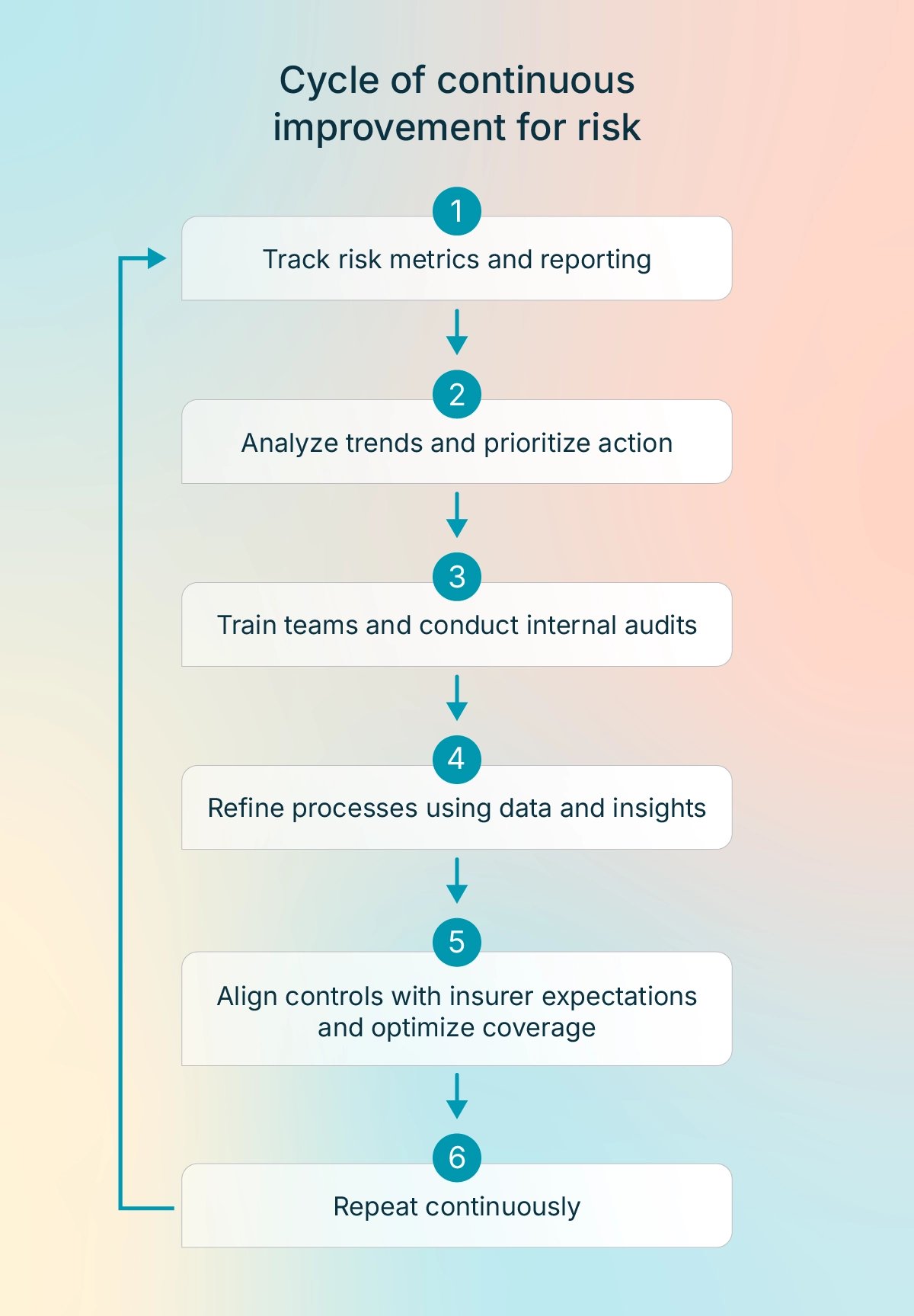
A strong risk management program improves over time. The most effective firms regularly track performance, identify patterns, and adjust their approach based on the data.
By consistently reviewing key metrics and reinforcing best practices across the team, you can catch issues early and strengthen your controls before they become larger problems.
Focus on:
Risk metrics and reporting: Track key indicators like missed deadlines, AR aging, write-offs, and incidents. Regular reviews help identify trends and prioritize action.
Training and internal audits: Provide ongoing, role-based training and conduct periodic audits to ensure processes are followed consistently.
Continuous improvement and insurance alignment: Refine your program using data and near-miss insights, and align controls with insurer expectations to strengthen coverage and reduce costs.
Over time, this cycle creates a more proactive approach to risk—one in which your firm continuously learns, adapts, and improves.
Types of software that help reduce risk in law firms
Technology plays a central role in modern law firm risk management. The right tools help standardize how work gets done, improve visibility into key processes, and reduce the likelihood of errors across financial, operational, and compliance areas.
Rather than relying on disconnected systems or manual workarounds, firms can use purpose-built software to create more consistency and control.
Key categories of risk-reducing software include:
Practice management software: Centralizes matters, deadlines, and communications—reducing missed deadlines and workflow gaps.
Financial and expense management tools: Improve real-time expense tracking, budget visibility, and billing accuracy to reduce disputes and revenue leakage.
Time tracking and billing software: Standardize timekeeping and invoicing, making bills clearer and easier to defend.
Document management systems (DMS): Provide centralized, searchable storage to prevent version issues and support audit trails.
Conflict checking tools: Automate conflict checks and monitor relationships to reduce compliance risk.
Cybersecurity and data protection tools: Protect sensitive data with MFA, encryption, and secure communication tools.
Workflow and automation tools: Standardize processes and reduce manual errors through automation.
Reporting and analytics tools: Surface key metrics, such as AR aging and missed deadlines, to identify risks early.
Bringing these capabilities together in a single platform can significantly strengthen a firm’s risk management approach. Solutions like 8am™ MyCase combine matter management, financial tools, billing, and reporting, helping law firms improve visibility, maintain control, and reduce risk across the board.
Start building your law firm risk management program today
When your firm has clear visibility into case expenses, billing, and matter-level spend, you’re not just improving financial performance. You’re also reducing operational gaps and strengthening compliance across the board. Financial clarity becomes the foundation that supports better decisions, fewer disputes, and more consistent outcomes.
8am Smart Spend helps make that possible by giving firms the tools to manage financial risk proactively:
Real-time expense tracking tied directly to matters
Greater visibility into spend across matters to keep work aligned with expectations
Approval workflows that prevent overspending before it happens
Clear, audit-ready financial records that support transparency and compliance
By improving how your firm tracks and manages spend, you can reduce revenue leakage, strengthen billing defensibility, and create a more predictable financial environment.
Combined with MyCase’s broader capabilities, matter management, billing, and reporting, you gain a complete view of your firm’s operations and finances in one place. This integrated approach helps reduce risk while improving day-to-day efficiency.
If you’re looking to build a stronger foundation for risk management, start with the tools that give you better visibility and control. Learn more about how 8am Smart Spend works, or explore how MyCase helps law firms manage financial, operational, and compliance risk in one unified platform.