

Key takeaways
The LCA is a foundational filing in the H-1B process. Accuracy in wage data, worksite details, and job classification is critical, as inconsistencies can lead to delays or increased scrutiny later in the petition lifecycle.
LCA processing times are predictable, but not immune to disruption. While most LCAs are certified within about seven business days, system outages, filing errors, and peak H-1B seasons make proactive planning and buffer time essential.
Centralized tracking and e-filing reduce risk and administrative burden. Using immigration case tracking and e-filing tools helps attorneys monitor LCA status, maintain compliance, and keep cases moving without relying on manual status checks.
In the H-1B process, the Labor Condition Application (LCA) often sets the pace for everything that follows. Careful attention to wage data, worksite details, and notice requirements helps immigration attorneys maintain momentum and meet filing timelines with confidence.
At the same time, attorneys are navigating shifting policy guidance, evolving Department of Labor (DOL) systems, and increasing client demand for visibility into case progress. Knowing how to file an LCA correctly is only part of the equation; tracking LCA case status, understanding processing timelines, and coordinating next steps with Form I-129 have become just as critical to keeping matters on schedule.
This guide walks through the LCA filing process from start to finish, with a practical focus on certification timelines, common issues that cause delays, and best practices for tracking LCA status once filed. It also explores how immigration case tracking and e-filing tools can help law firms reduce administrative risk and maintain momentum throughout the H-1B process.
What is the labor condition application?
A Labor Condition Application or LCA is a document required by the DOL before an employer can sponsor a foreign national under certain work visas—most commonly the H-1B. In the H-1B process, the employer must attest in the LCA that they are offering the foreign worker the prevailing wage (or higher) for the position and will provide working conditions that do not adversely affect other employees.
Essentially, the LCA serves as a means of:
Legal compliance: It confirms that the employer meets wage and working condition standards.
Protection for U.S. workers: By establishing prevailing wage requirements, the LCA helps ensure that hiring a foreign national won’t undercut wages or opportunities for U.S. employees.
Since the LCA is a legal attestation, many employers rely on immigration attorneys or law firms to handle the process. Immigration legal professionals do the following:
Ensure compliance: Reviews job details and prevailing wage data to confirm that the employer is offering at least the required wage under DOL standards.
Prepare and file the LCA: Completes Form ETA-9035 on behalf of the employer via the DOL’s Foreign Labor Application Gateway (FLAG) system.
Manage posting requirements: Advises the employer on properly posting the required notices at the worksite to inform employees of the filing.
Handle LCA audits & issues: If the DOL audits the employer or flags issues in the LCA, the attorney assists with responses, corrections, and documentation.
Coordinate with the H-1B petition: Ensures the approved LCA is included in the Form I-129 filing with USCIS, a key step in the overall H-1B petition process.
Filing an LCA accurately and on time is extremely important. Any mistakes can delay the broader H-1B petition, creating complications for both the employer and the prospective employee. For this reason, employers often retain lawyers to prepare and file LCAs and to advise them on compliance measures to maximize the chances that their LCAs and subsequent visa petitions will be approved.
Steps in the LCA filing process
While the LCA process may seem straightforward, even minor errors can derail an application or lead to compliance issues. So let’s go over each step carefully.
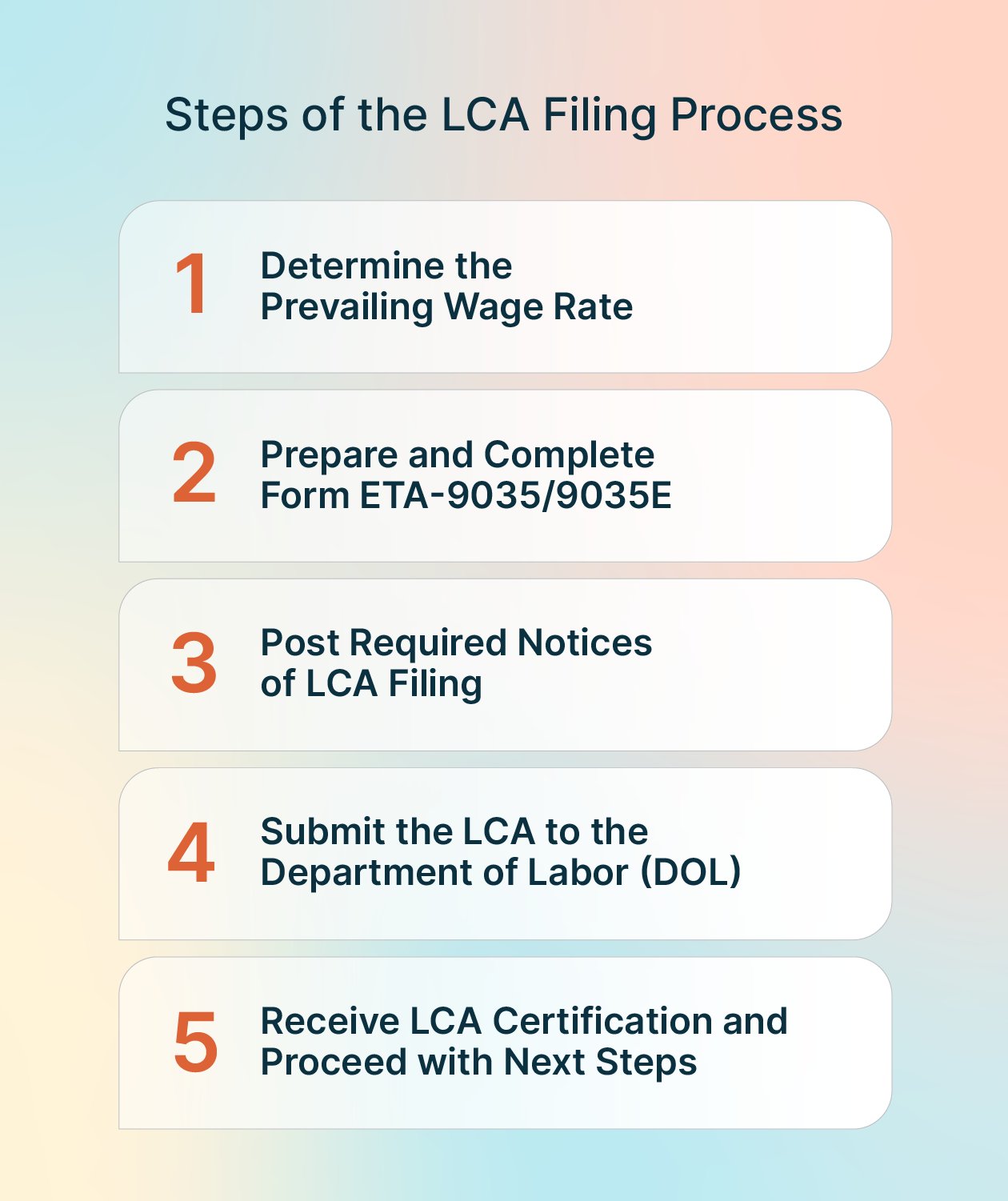
Step 1: Determine the prevailing wage rate
The first step in LCA filing is to determine the correct prevailing wage for the position. The DOL uses several sources to calculate the appropriate wage level, including:
National Prevailing Wage Center determinations
The OFLC Wage Search database
Independent wage surveys
Collective bargaining agreements
Choosing the right wage source is essential for compliance—incorrect wage data often triggers application delays or denials.
Step 2: Prepare and complete Form ETA-9035/9035E
Form ETA-9035/9035E is the official LCA document you submit to the DOL. You’ll need to provide details about:
The employer (FEIN, address, contact information)
Job title, duties, and location
The prevailing wage and actual wage
Employer attestations regarding wages, working conditions, and notice posting
Accuracy here is key. Any mistakes on this form can significantly affect LCA processing time.
Step 3: Post required notices of LCA filing
Before filing, employers must post two notices of the LCA filing at the worksite or provide electronic notice to affected employees. This requirement ensures transparency for U.S. workers who might be affected by the hiring of a foreign national.
Step 4: E-filing the LCA to the Department of Labor (DOL)
After you’ve posted the required notices, you can submit the LCA electronically via the DOL’s Foreign Labor Application Gateway. You'll be prompted to provide information such as the visa classification, employer details, attorney or agent information (if applicable), job specifics (including title, description, location, and wages), and attestations regarding compliance with labor condition statements.
Step 5: Receive LCA certification and proceed with the next steps
Once the DOL approves your LCA, you’ll receive a certified copy. At this stage, you can file the Form I-129 petition provided the foreign national’s registration was selected in the H-1B lottery, if applicable. The certified LCA must be included with the H-1B petition documentation.
Current LCA processing times
Under normal conditions, the DOL typically processes electronically filed LCAs within about 7 business days, provided the application is complete and error-free.
However, recent operational disruptions have created backlogs that may extend processing beyond this typical window as the DOL works through accumulated filings.
There is no official expedited path for LCAs similar to USCIS premium processing, so attorneys should plan filing timelines accordingly, especially during peak H-1B filing seasons or when system delays are likely.
Because delays can affect downstream steps in the H-1B process, immigration attorneys should proactively communicate realistic expectations to clients and build in buffer time when preparing petition timelines.
Documents required for LCA filing
Having the right documents required for LCA filing ensures a smoother process and helps avoid Requests for Evidence. Be sure to include:
Form ETA-9035/9035E
Proof of prevailing wage determination (e.g., wage survey results or official DOL data)
Employer attestations, like confirming wage, notice posting, and other compliance requirements
Documentation of worksite location(s), particularly important if the beneficiary will work at multiple sites
Impacts on the LCA and H-1B process under the current Trump administration
Policy and enforcement trends during the Trump administration have influenced how LCAs and H-1B petitions were reviewed. Many of these practical effects on documentation, compliance, and adjudication continue to shape attorney workflows today.
Key impacts include:
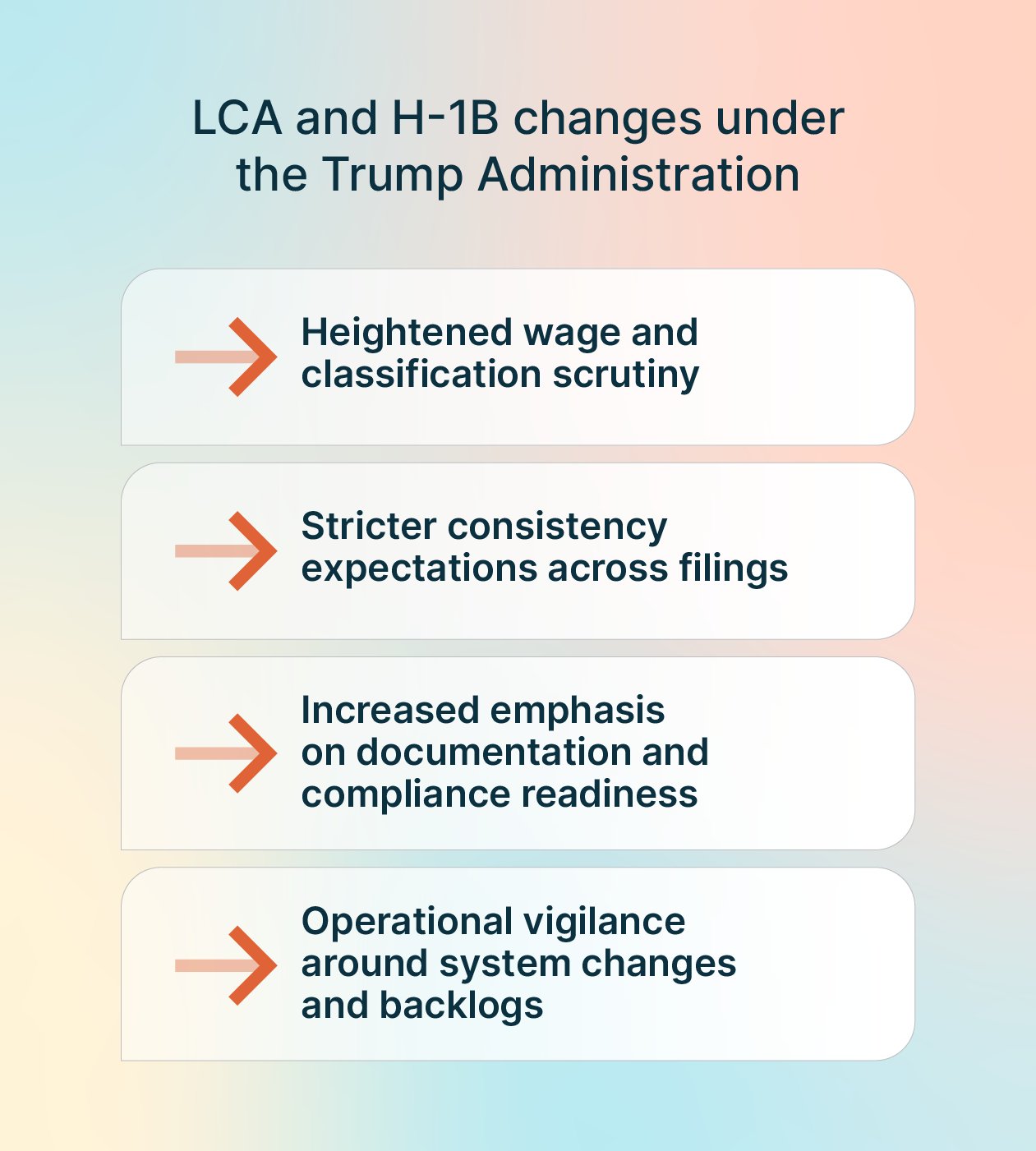
Heightened wage and classification scrutiny: Agencies increased scrutiny of prevailing wage levels and occupational classifications, reinforcing the need for accurate wage determinations that align LCA data with job duties and local labor market standards.
Stricter consistency expectations across filings: Agencies placed greater emphasis on alignment between the LCA and the H-1B petition—particularly job duties, worksite details, and wage information—with USCIS reporting from the period reflecting heightened scrutiny where inconsistencies appeared.
Increased emphasis on documentation and compliance readiness: Department of Labor regulations require employers to maintain a Public Access File for each LCA, containing the certified LCA and related wage and notice documentation, and to make it available upon request. Failure to properly maintain or produce a compliant Public Access File constitutes a violation.
Operational vigilance around system changes and backlogs: Recent disruptions and outage-linked backlogs in the Department of Labor’s Foreign Labor Application Gateway (FLAG) system—which temporarily halted LCA filings and status tracking for weeks—underscore the need for attorneys to plan for potential system downtime and slower processing as agencies work through accumulated cases.
Though specific policy initiatives may evolve, the practical lessons from this period, especially around accuracy, cross-filing consistency, and compliance discipline, remain central to effective LCA preparation and H-1B case management.
Common issues and delays in LCA filing that immigration lawyers face
Even seemingly minor errors in wage data, job classification, or documentation can delay approvals and trigger DOL scrutiny. To ensure faster filings, immigration lawyers should verify details, leverage case management tools, and maintain organized records.
Common mistakes to look for include:
Incorrect wage data: Using outdated or incorrect wage levels often results in denials or re-filings.
Mischaracterized job duties: Inaccurately describing position responsibilities or selecting the wrong occupational classification can trigger questions from the DOL.
Incomplete documents: Missing or insufficient evidence, such as a lack of proper notice posting, slows the process.
Technical errors during e-filing: System glitches or form-filling mistakes can result in rejection or delayed processing.
Tips for tracking the LCA filing status as an immigration attorney
Effective LCA tracking helps attorneys manage timelines, reduce surprises, and keep clients informed throughout the H-1B process.
Solutions to avoid delays:
Double-check all wage determinations, form inputs, and supporting evidence before submission.
Use reliable immigration case-tracking software: Centralizing LCA data in a single platform helps firms monitor status changes, deadlines, and related filings in one place, reducing manual follow-ups and missed steps.
Run an LCA status check through the DOL portal: Attorneys can check case status directly in the Department of Labor’s FLAG system using the LCA case number.
Know common status messages and timelines: Most LCAs are processed within about seven business days; extended “in process” statuses may signal review issues or system delays.
Plan for delays and follow-ups: Building buffer time into case planning helps protect downstream filings if additional review or corrections are required.
Maintain organized digital records, especially if you need to refile or provide additional documentation.
Keep clients updated: Clear, regular communication around LCA status and timing helps set expectations and maintain momentum.
Benefits of e-filing with case tracking software
With so many processes and documents to manage, it can be inefficient to handle document filing across platforms. That’s why immigration lawyers increasingly turn to e-filing tools to streamline LCA submissions and track LCA processing time.
Often, these solutions even let them submit immigration forms directly from the same software they use for case tracking and document management.
Here are some of the ways that e-filing inside of case management software helps immigration law firms:
Streamlined workflows: Automation can populate form fields, reducing manual errors and time spent on data entry.
Centralized tracking: All client documents, deadlines, and statuses are displayed in a single dashboard, simplifying follow-ups.
Fewer errors and delays: Built-in compliance checks can flag inconsistencies before submission—helping to avoid rejections.
Better client communication: Automated notifications keep clients informed, reducing the need for status inquiries.
Especially for immigration lawyers handling multiple LCAs, e-filing within case management software helps maintain consistent, high-quality work while reducing stress.
How 8am™ DocketWise enhances the LCA filing process
DocketWise supports immigration attorneys throughout the full LCA lifecycle by combining electronic filing, immigration case tracking, and compliance-focused integrations into a single platform.
Key capabilities include:
E-filing Form ETA-9035 through the DOL FLAG system: DocketWise supports electronic filing of Form ETA-9035/9035E, allowing attorneys to prepare and submit LCAs directly through the Department of Labor’s FLAG system.
Immigration case tracking for H-1B filings: Built-in immigration case tracking and workflows help firms monitor case status, certification dates, and next steps, reducing reliance on manual status checks and spreadsheets.
Smart Forms with consistent data reuse: Smart Forms auto-populate key employer, job, and wage information across forms, helping reduce discrepancies between the LCA and Form I-129 and minimizing avoidable follow-up issues.
Compliance visibility and deadline awareness: DocketWise helps firms stay on top of notice-posting requirements, prevailing wage documentation, and other compliance obligations tied to the LCA process.
Integration with LaborLess for LCA compliance: DocketWise integrates with LaborLess to support notice posting workflows and public access file requirements, helping firms manage LCA compliance more effectively.
By bringing e-filing, case tracking, and compliance tools into a single workflow, DocketWise helps immigration law firms reduce administrative friction and maintain better visibility across H-1B matters. To see how it fits into your LCA filing process, you can book a demo.