


Key takeaways
-
Small and medium-sized law firms are not seeing the same slowdown in collection rate reported among Big Law. 8am™ MyCase data shows 30-day collection rates improving over the last two years .
-
Firms - especially in the 4-10 attorney cohort - on average are billing more, expanding headcount, and taking on more cases.
-
However, more than $7 billion in bills sit overdue and uncollected across firms, presenting both a challenge and opportunity.
-
Payment enablement is the clearest dividing line between firms gaining and losing ground. Firms that enable online payments collect 4.5x faster than those without .
Bloomberg Law reported in April that Big Law is waiting longer to turn billable work into collected revenue. Q1 2026 data from the Wells Fargo Legal Specialty Group showed that while Big Law revenue climbed more than 13% in the first quarter, uncollected legal fees grew nearly 17%. Collections also slowed by 6.5 days, and realization declined nearly 3%—a sign that even the largest firms feel pressure when strong demand doesn’t translate into immediate cash flow.
But what does the picture look like for small and medium-sized firms?
At 8am, we see how tens of thousands of firms manage the business and financial side of legal work every day through 8am MyCase . We analyzed several million bills issued by these firms over the last two years to uncover how they’re billing, collecting, and enabling payments. What we found is a more nuanced view of law firm financial health: While small law firms aren’t insulated from broader economic pressure, they aren’t facing Big Law’s slowdown in the same way. Many are collecting more efficiently and taking on more work.
But, there’s a multi-billion dollar factor at play that could become a major opportunity or risk, depending on how firms modernize their financial infrastructure.
Are small law firms collecting payments faster?
Big Law’s collections pressure is largely tied to large corporate clients, major transactions, and longer payment cycles. Small law firms operate in a very different environment. Their clients are typically individuals, families, and small businesses rather than corporate legal departments with complex e-billing processes.
Our data shows that the share of firms with at least one overdue invoice has remained remarkably steady over the last two years: 51.9% in 2024, 52% in 2025, and 51.6% year to date. Looking at this further, across all invoices, only 22% are actually overdue at the 30-day maturation window.
Most importantly, collection rates are improving. The share of invoices collected within 30 days rose from 58% in 2024 to 63% this year. Average days to collection remained steady at five days, and the median collection time was within a day, meaning clients paid the same day they received the bill.
So what does this all tell us? Simply that many small firms are getting paid more reliably and efficiently. However, the data also shows a warning sign: overdue balances are growing, even as 30-day collection rates improve:
-
Average overdue balances: $2,800 (early 2024) to $3,400 (this year), a 21% increase
-
Total outstanding overdue receivables: $7.04 billion
-
Median overdue bill: 131 days past due
Breaking this down further, by practice area:
-
Divorce / separation: Highest average overdue balance ($3,077)
-
Immigration: Highest overdue invoice rate (42.5%)
-
Estate planning: Lowest average overdue balance ($720) and highest collection rate (75%)
-
Criminal defense: Lowest collection rate at 30 days (49%)
Overall, many small law firms are improving how they collect, but significant earned revenue is still sitting unpaid for months. That gap can limit hiring, investment, and planning for any business.
Are small law firms billing more work?
Collections tell us how much money is getting in the door. We also looked at billing to better understand these firms’ workloads and how they’re driving this cash flow.
Our data shows that on average, small law firms are billing more hours now compared to a year ago - 6.5 more hours per firm per month to be exact. Hours spent per case are also up 37%, attorney headcount is up 34%, and cases per attorney are up 36%. Billed dollars per hour rose 4.4% on average ($262 to $274) suggesting the growth reflects real billable work, not just more detailed time entries.
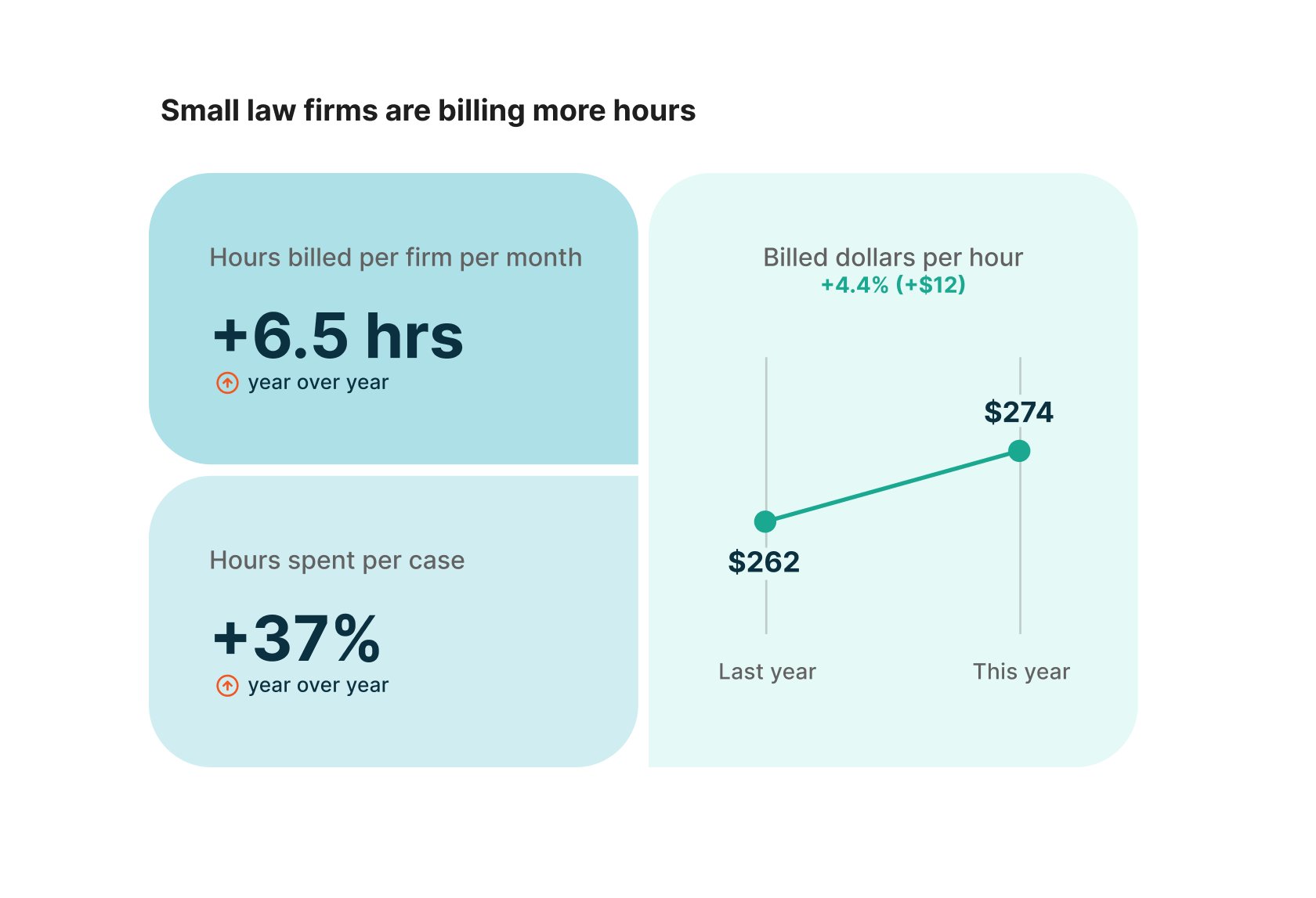
The strongest momentum is concentrated among firms with 4-10 attorneys, which are billing 15.5 more hours per firm per month on average (2-3 times faster than the rest of the market). Solos and very small firms (2-3 attorneys) are billing just over 5 more hours per firm per month on average. Larger firms with 11 or more attorneys have added just over 2 additional hours per firm per month. Overall, billable hours are up, but that growth is uneven.
The growth drivers also differ by firm size:
-
Solos and 2-3 attorney firms: 42% and 60%, respectively, of growth came from more attorneys per firm (adding capacity)
-
4-5 attorney firms: 81% of growth came from more hours per case (capturing time more intensively and/or handling cases of higher complexity)
-
6-10 attorney firms: 73% came from more cases per attorney (scaling client load)
Practice area trends also tell an important story. Bankruptcy work stood out, with case volume up 115% and hours per case up 32% year-over-year. A surge in bankruptcy legal work doesn’t define the economy, but can be an early indicator of financial stress, and it’s one worth watching closely.
Why are some law firms collecting more and faster?
The biggest divide we found isn't between large and small firms, but those that have modernized their payment infrastructure and those that haven't.
Our data shows that firms with online payments, Pay Later, and autopay options collect more of their billables, faster, and with less administrative work.
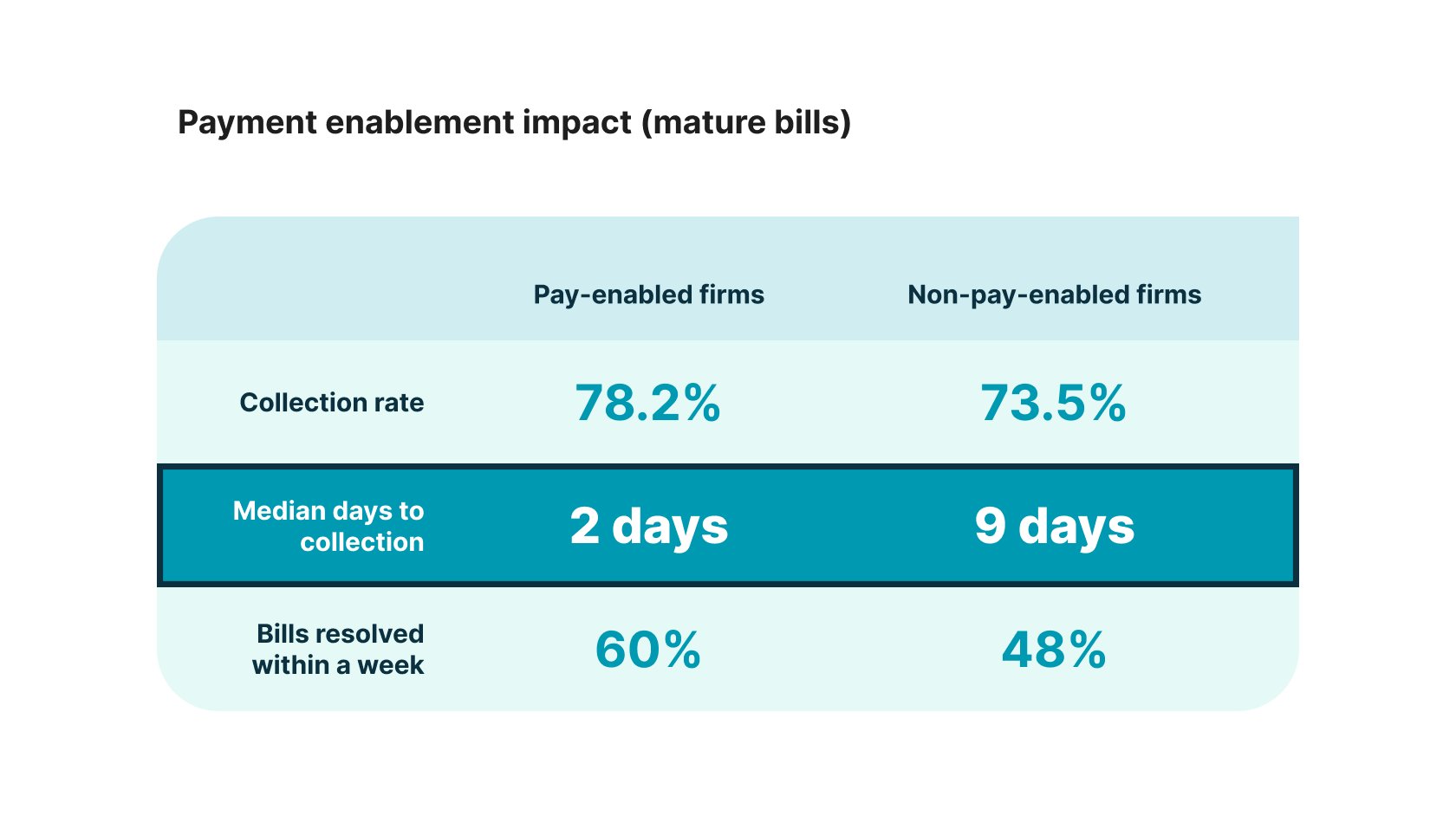
The effect is even clearer on larger bills. On invoices over $5,000, autopay plans - which break billing into more manageable chunks for clients - recover 79 cents on the dollar versus 38 cents for large bills without a payment plan. That difference matters because high-value bills are often the hardest for clients to pay in a single lump sum.
Payment terms and language are also an important lever. Net 30 had the highest collection rate of any term tested (78.8%), outperforming “due on receipt” (74.5%). This declines further if no payment term is set (68%). Ultimately, clear deadlines outperform urgency and ambiguity.
Law firm billing structure also matters. Our data shows that when firms make it easier for clients to pay, through accessible methods, clear terms, and structured billing, it can deliver real dividends:
-
78% of flat-rate invoices were collected within 30 days, compared to 68% of hourly invoices.
-
Flat-rate invoices had a lower firm overdue rate (34%) compared to hourly invoices (48%).
-
Invoices with no time entries performed worst, with only 49% collected within 30 days and the highest average outstanding balance, at $3,919.
-
Pay Later availability lifted collection by 5-10 percentage points on larger bills ($5,000 - $25,000).
Six steps to improve legal billing and collection
Small businesses broadly are under significant pressure, and law firms certainly aren’t immune to what’s happening in the broader economy. What this data reinforces is that operational discipline matters more than ever in a challenging macro environment. Every dollar of earned revenue counts more, and the $7 billion sitting unpaid across these small and medium-sized law firms represents earned work that hasn’t turned into usable cash.
For any firm, modernizing payment infrastructure is no longer just about efficiency. It’s also about ensuring the work they’ve already done actually hits the bottom line.
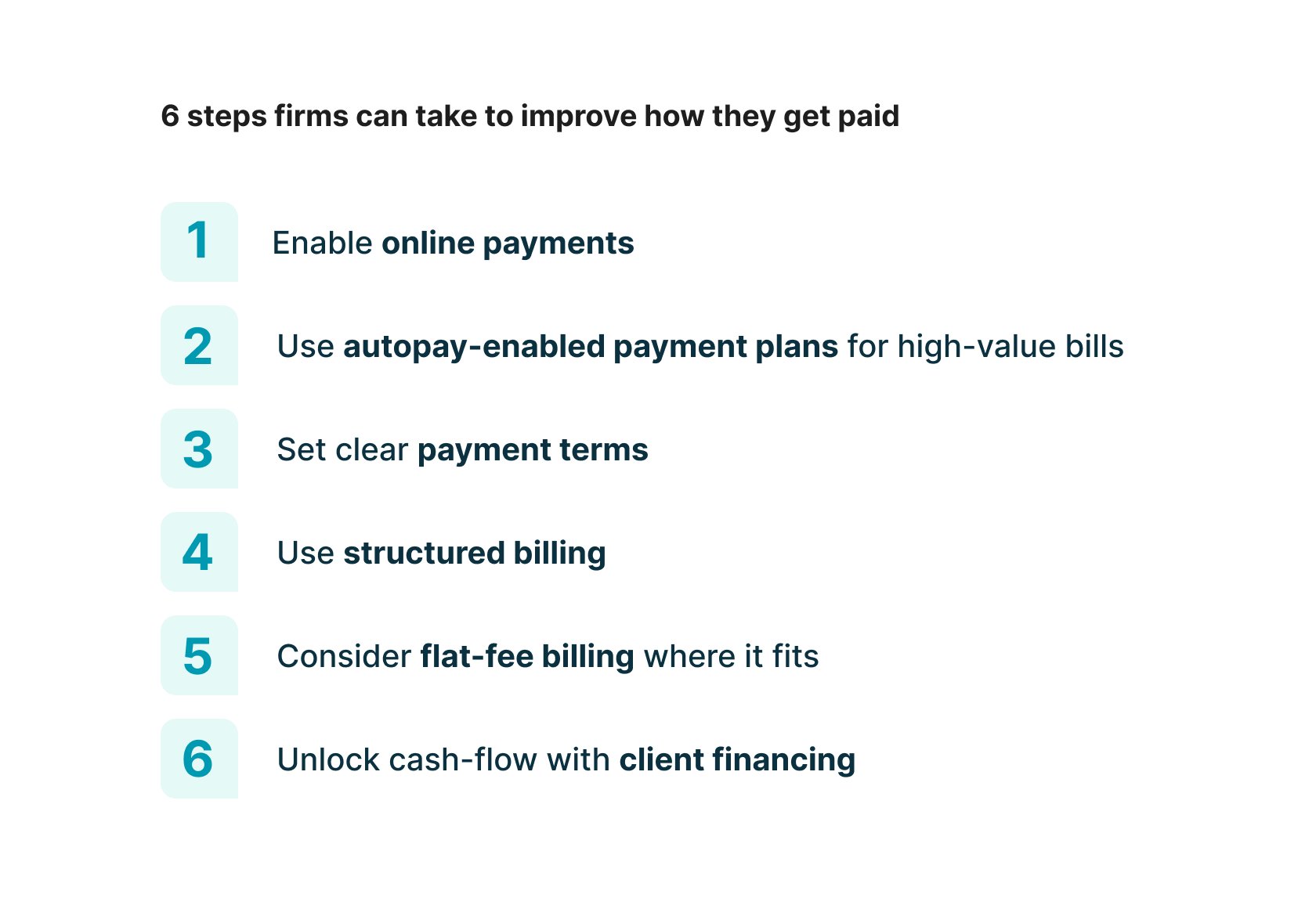
Here are six steps firms can take to improve how they get paid:
-
Enable online payments: The single clearest lever as pay-enabled firms collect 4.5x faster than those that rely on print billing.
-
Use autopay-enabled payment plans for high-value bills: Large lump-sum invoices are hard for many clients; autopay paired with an extended timeline provides a manageable path while accelerating recovery.
-
Set clear payment terms: Net 30 outperformed every other payment term tested as clients tend to pay more reliably when they know exactly what is expected.
-
Use structured billing : Bills should clearly connect amount owed to work performed; whether billing hourly or flat-fee, line items should match your commercial model and be easy for clients to verify.
-
Consider flat-fee billing where it fits: For predictable work, flat fees improve client understanding and reduce friction at the point of payment.
-
Unlock cash flow with client financing: Solutions like Pay Later put more choice in clients’ hands to pay over time while removing risk of collection and delivering revenue to the firm immediately - which is particularly effective on larger bills.
Turning billed work into collected revenue
The Wells Fargo Report and our 8am customer data highlight a key challenge: demand does not automatically create stronger cash flow. Many small law firms are collecting faster and more reliably, but $7 billion in overdue receivables indicates how much value is uncaptured - and how much opportunity exists.
For small firms, the path forward is about operational improvements, especially removing friction from the billing and payment experience. Modern payments help firms turn more of their billable hours into revenue they can use to hire, invest, serve clients, and expand with confidence.
To support small and medium-sized firms , 8am brings practice management and payments together through MyCase and LawPay . Firms can manage matters, track billable work, generate invoices, accept online payments, and monitor collections in one connected platform.
Study methodology:
Findings draw on three studies covering aggregate data from tens of thousands of active small and medium-sized law firms - predominantly with 10 or fewer attorneys - and several million bills issued between April 2024 and March 2026 across 8am MyCase. All analyses use standardized maturation windows and balanced firm panels to ensure comparability and exclude test accounts, draft invoices, and inactive firms. Data points reflect the activity of 8am's customer base and are not representative of every law firm in the US legal market.