

Key takeaways
Build a clear strategy first. Don't just post randomly; define your specific goals and audience before you begin to avoid wasting time.
Pick the right platforms for your clients. Focus your energy where your audience hangs out, such as using LinkedIn for business clients or Facebook for personal injury cases.
Stick to a consistent schedule. Use a simple content calendar to plan ahead, aiming for about one to three posts per week to stay visible.
Follow ethical rules strictly. Protect your license by never promising specific results (like "we will win") and always keeping client information private.
Many lawyers recognize the value of social media as a marketing tool, but they aren’t always sure how to use it effectively.
The challenge usually comes down to organization. Without a focused plan, a firm’s social presence can become inconsistent, ineffective, or neglected. But with defined goals and the right tools in place, social media marketing becomes easier to manage—and far more impactful in building visibility and trust.
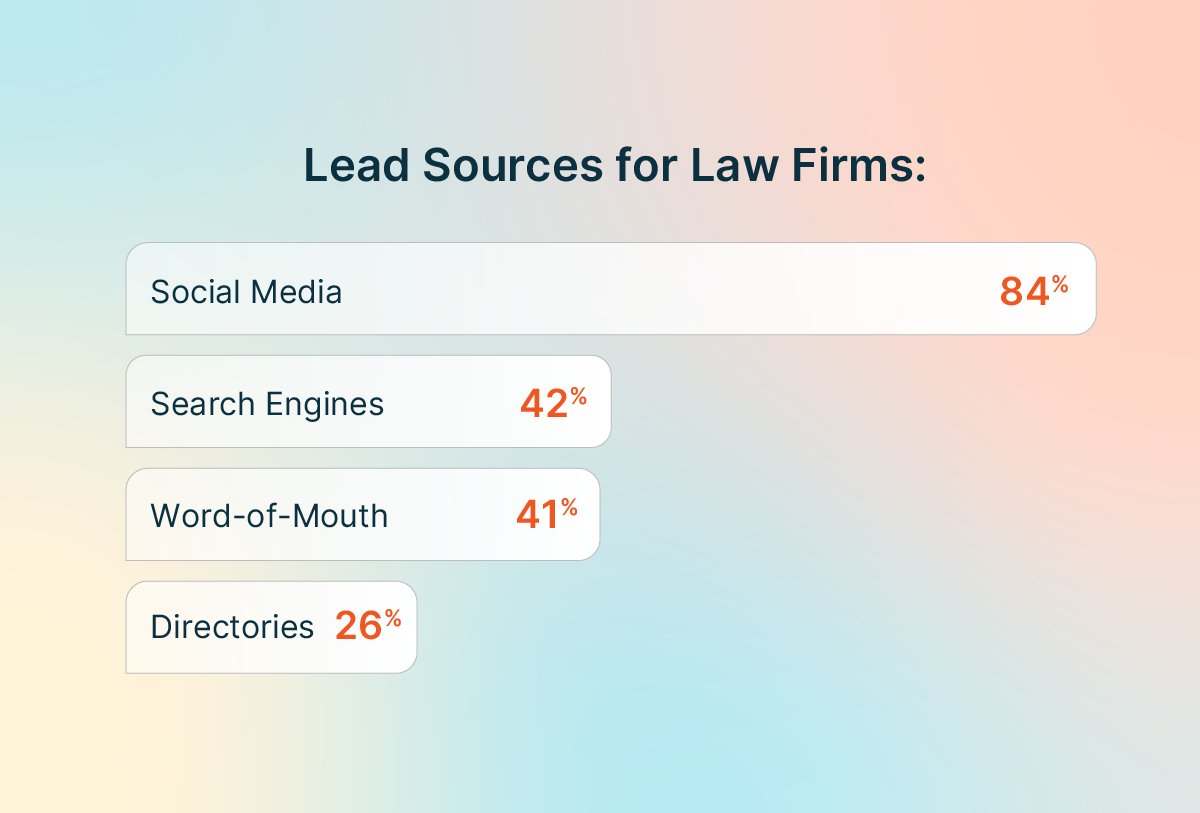
A recent report from Clearview Social illustrates the importance of social media in the legal profession: 84% of firms consider social platforms dependable sources for finding and cultivating new leads. The report also notes that many firms generate inquiries through search engines (42%), word-of-mouth recommendations (41%), and professional directories (26%), underscoring the importance of social media for lawyers relative to the broader legal marketing ecosystem.
At its core, social media marketing for lawyers is less about promotion and more about building familiarity and credibility over time. As Gyi Tsakalakis, founder of AttorneySync, puts it: “People hire lawyers whom they know, like (sometimes), and trust. The likelihood that social media will work for your law firm will depend heavily on your ability to create content that resonates with people likely to refer clients and hire you.”
This article offers a step-by-step guide to social media marketing for lawyers, focusing on practical actions you can take to build a consistent, professional presence.
Why social media still matters for lawyers
A well-executed social media strategy can play a significant role in reinforcing your credibility, keeping you connected to referral sources, and making potential clients feel more comfortable reaching out.
According to the American Bar Association’s 2024 Legal Technology Survey, 80% of law firms use social media for marketing. LinkedIn is the most popular platform (used by 76% of firms), followed by Facebook (53%). This level of adoption shows that social platforms have become core channels for staying top of mind with future clients.
Social media also gives lawyers a platform to showcase their human side. Sharing stories about your community involvement, firm milestones, and team culture can help foster better client relationships and distinguish your practice from others.
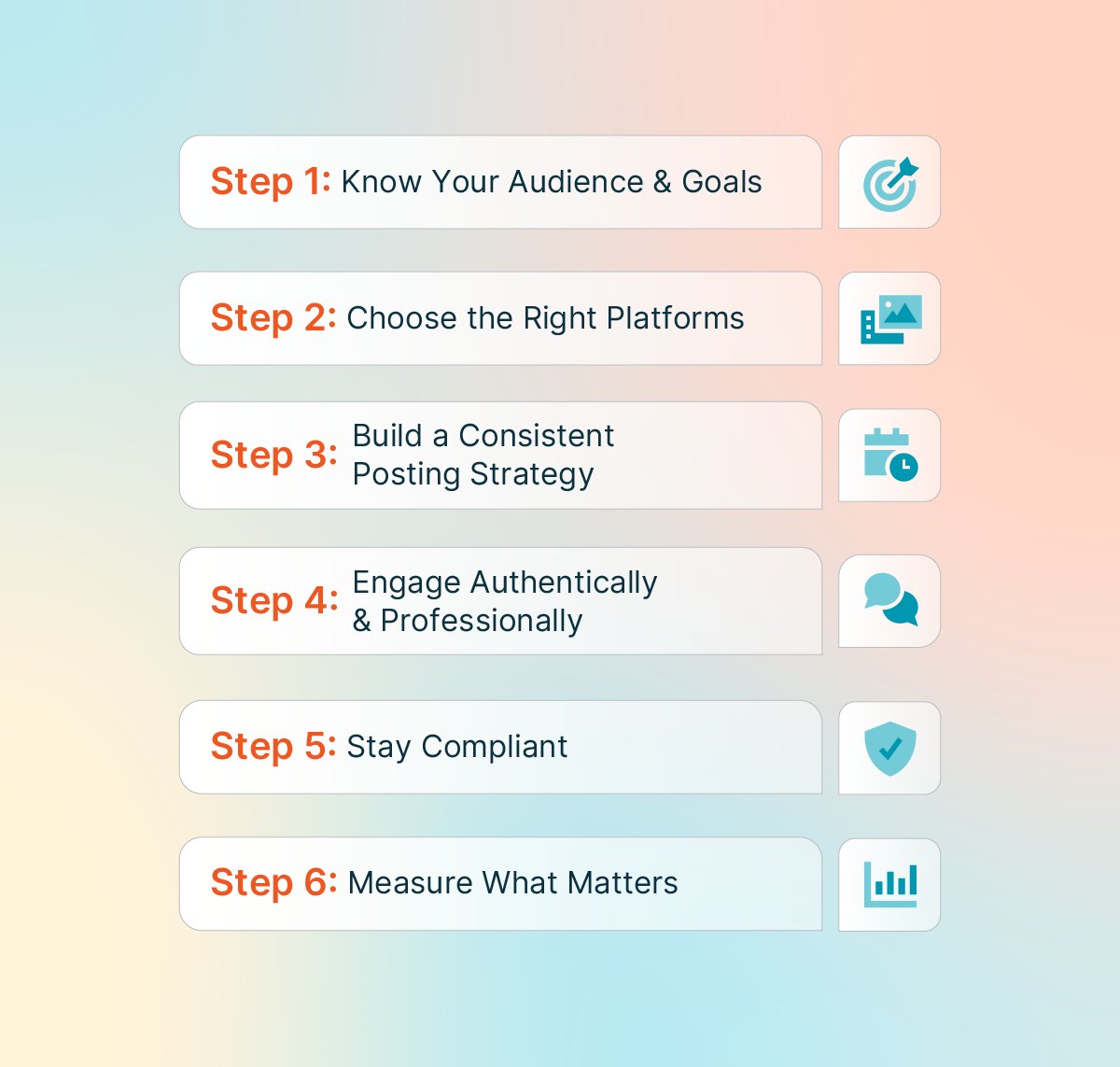
Step 1. Know your audience and goals
A strong social media strategy begins with getting a clear understanding of who you’re trying to reach and what your firm wants to accomplish. Without this foundation, you risk wasting time on content that doesn’t resonate or platforms that don’t support your goals.
Keep your target audience top of mind as you shape the tone, visuals, and format of your posts. For example, if you’re a criminal defense attorney, you might adopt a conversational and reassuring tone that resonates with individuals who need help with immediate legal issues. By contrast, a corporate or employment lawyer may benefit from a more polished, professional voice that speaks to business decision-makers.
It also helps to think about your firm’s structure and focus. A solo attorney with a local practice might use social media to stay visible in their community, while a multi-office firm with a national footprint might prioritize thought leadership and brand consistency.
Practice areas matter, too—consumer-focused (B2C) areas like family law or personal injury often perform well on platforms like Facebook or Instagram, while business-oriented (B2B) practices may find more value in LinkedIn.
Finally, it’s essential to define your goals up front. Whether you’re focused on visibility, lead generation, or improving client retention, setting clear objectives will guide your content strategy. It also helps you decide which metrics are worth tracking as you go.
Step 2. Choose the right platforms for your practice
Not every social media platform serves the same purpose or the same audience. To decide which channels are the best fit for your firm, think about who you’re trying to reach and what kinds of content you plan to share.
LinkedIn works well for professional updates, networking, and sharing legal insights. Instagram is ideal for visual content like infographics, short videos, and glimpses into your firm’s culture. X (formerly Twitter) is useful for real-time updates, quick legal commentary, or connecting with media and professional circles. TikTok offers a more casual format that some firms use to simplify legal topics and reach younger audiences.
Each social platform offers a different approach to engaging potential clients, so it’s worth considering where your audience already spends their time and where your firm can show up most authentically.
Best social media platforms for lawyers
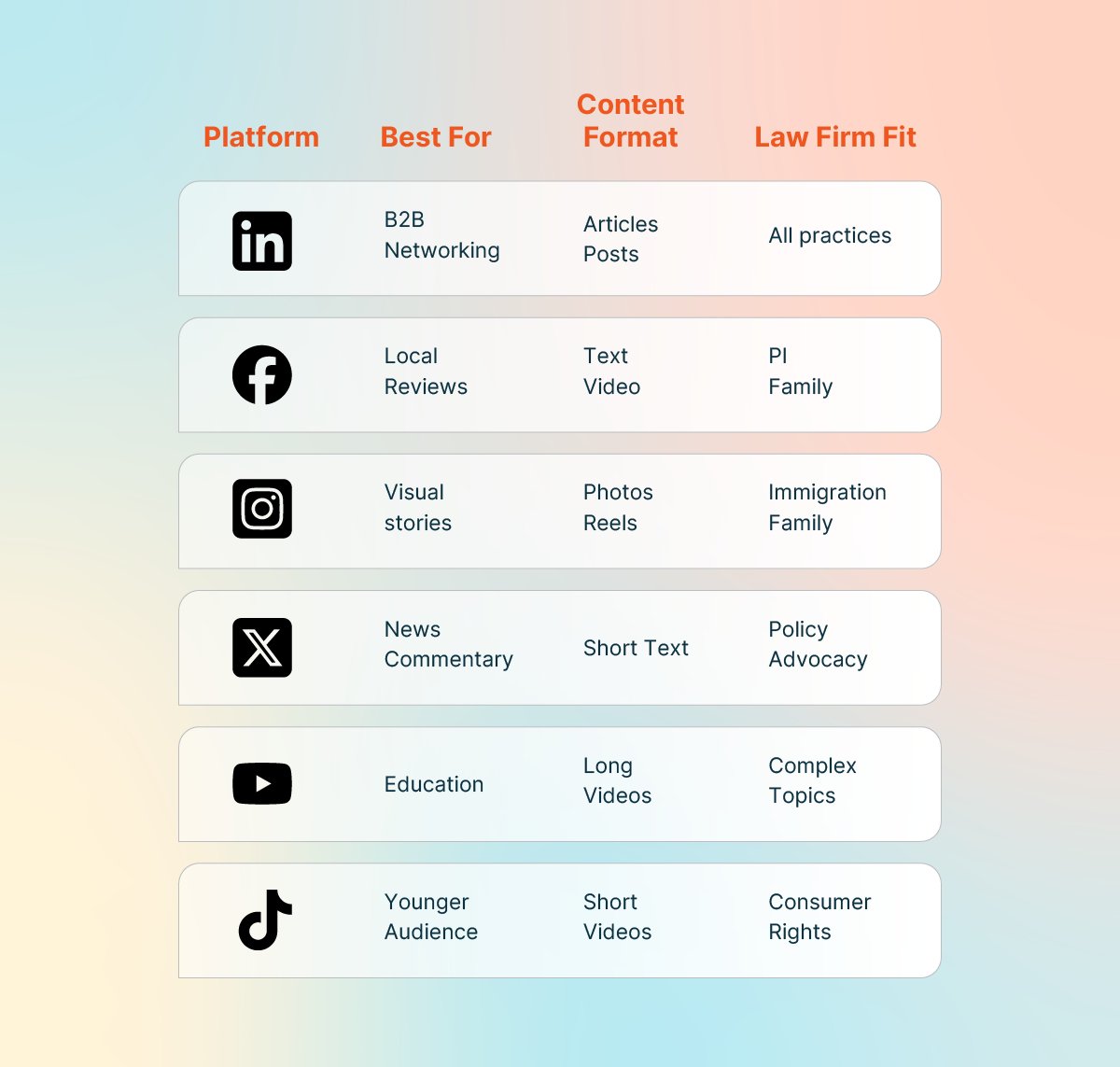
The most effective attorney social media marketing strategies are built around platforms that align with your audience, your goals, and the types of content you’re comfortable creating. Here’s a quick guide to the six platforms lawyers tend to use most effectively.
LinkedIn is a destination for professional networking, building B2B credibility, and sharing content that showcases your legal expertise. Employment, corporate, and estate planning attorneys are often active on the platform.
Facebook is still one of the most valuable platforms for lawyers, particularly in consumer-facing practice areas like personal injury, family law, and criminal defense. It’s useful for gathering client reviews, building a local presence, and connecting through community groups. The LawPay and MyCase 2023 Benchmark report found that Facebook is the top social platform for generating leads.
Instagram is a good channel for showcasing firm culture, breaking down legal concepts into bite-sized visuals, and highlighting events or milestones. Learning how to market a law firm on Instagram can help practices in areas like immigration or family law use visual storytelling to position themselves as approachable and trustworthy.
X is useful for sharing real-time legal news, quick updates, or commentary on current events. It’s especially relevant for firms that engage with journalists, public policy, or advocacy. Tone and professionalism are important considerations, given the conversational nature of engagement on the platform.
YouTube is great for firms that want to educate potential clients through video content. Short- and long-form videos such as legal explainers, FAQs, and attorney Q&As tend to build trust and generate higher engagement, particularly for complex or high-stakes legal topics.
TikTok is a more informal platform where lawyers can share short, relatable clips that simplify legal topics or answer common questions. While it might not be the right fit for every firm, it can be effective for reaching younger audiences in areas like consumer protection, tenant rights, or criminal defense.
No matter which platforms you choose, planning ahead is key. This is especially true for visual formats like YouTube and Instagram, as recording and editing videos can take some time. Maintaining a consistent content calendar can help you stay organized and show up reliably across the platforms that matter most to your practice.
Step 3. Build a consistent posting strategy
Once you’ve chosen the platforms you’d like to focus on, the next step is to post with consistency and purpose. Posting regularly and following a well-planned law firm social media strategy keeps your practice visible, reinforces your credibility, and helps you avoid scrambling for content ideas each week. It also creates a more cohesive experience for anyone following your firm online.
Define your content pillars
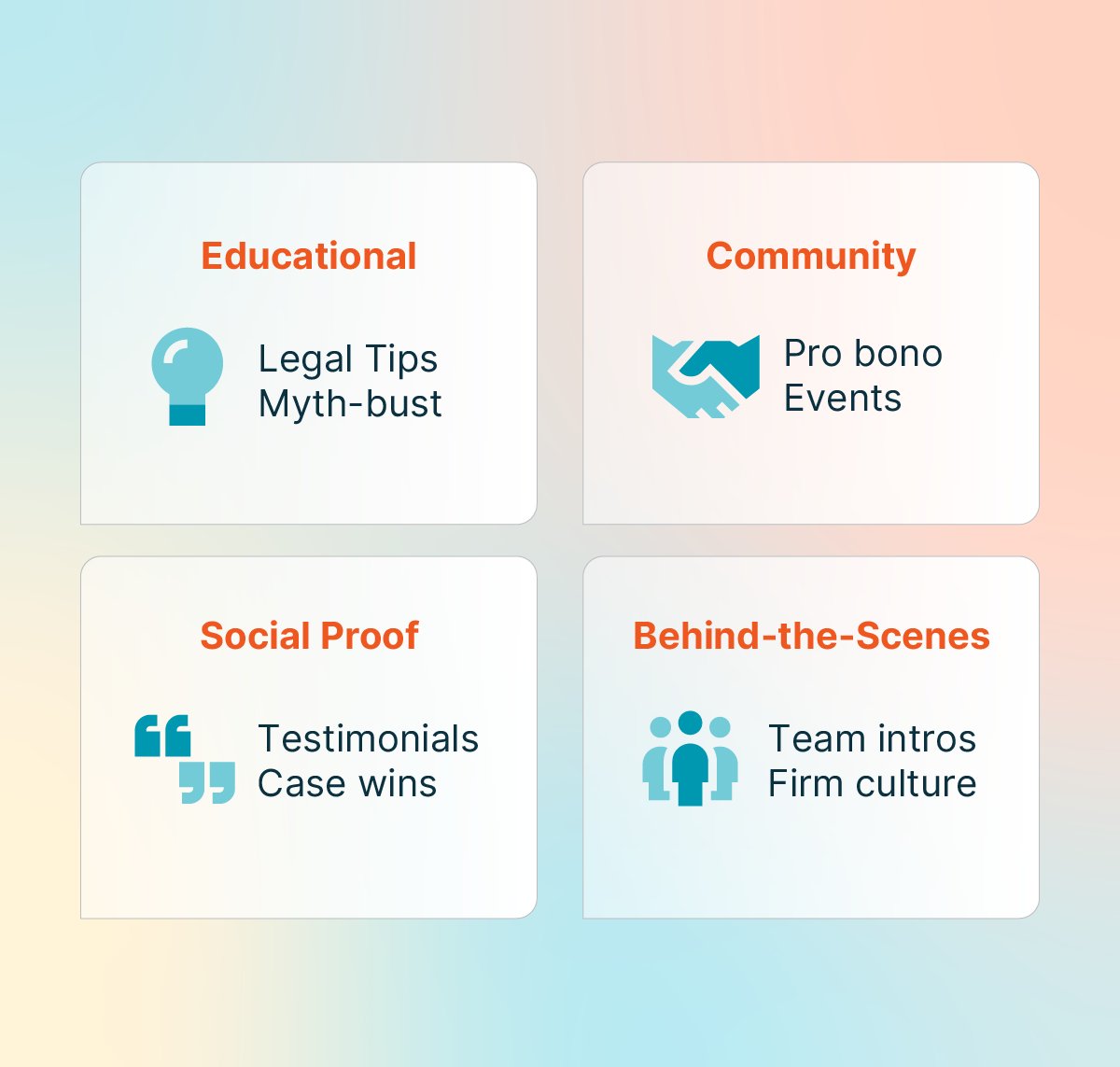
Content pillars are recurring themes that guide what you post. They give structure to your strategy and make it easier to keep your social content consistent without being repetitive.
Educational: Share legal tips, explain common misconceptions, and break down legal processes in simple terms.
Community: Highlight events you’ve participated in, pro bono work, and milestones that connect your firm to the local community.
Social proof: Post client testimonials, case outcomes, and media features (always with proper permission and ethical guidelines in mind).
Behind-the-scenes: Introduce your team, share office updates, or post moments that reflect your firm’s personality.
Aligning your posts to a few clear pillars helps build trust while keeping your content varied and relevant.
Create a content calendar
One of the easiest ways to maintain a steady rhythm is to plan your social media calendar ahead of time. A simple content calendar helps you avoid last-minute scrambles and makes it easier to stay on track, especially during busy stretches. For many small and mid-sized firms, scheduling one to three posts per week is a realistic starting point.
To stay organized, many firms use platforms like Hootsuite, which offers scheduling, analytics, and team collaboration tools; Buffer, a user-friendly option for managing and publishing posts across multiple platforms; or Sprout Social, a more advanced solution that includes detailed performance tracking and audience insights.
Law firm social media post ideas
If you’re not sure what to post, start with a few simple formats that provide value and show your firm in action. Here are a few ideas for law firm social posts with examples you can tailor to your practice:
Celebrate case milestones (without disclosing client details)
These types of posts can give your audience a reason to follow your firm and help build familiarity with your work and values.
Step 4. Engage authentically and professionally
Posting content is just one part of an effective strategy for social media marketing for lawyers. What truly builds visibility and trust is how your firm engages with others online. Interaction—not just information—is what keeps your audience coming back.
Once you've chosen your platforms and built a steady posting rhythm, the next step is building real connections. Whether you’re responding to comments, participating in conversations, or highlighting others in your community, active engagement strengthens relationships and reinforces your firm’s credibility.
Community engagement
Consistent interaction is what turns a passive follower into someone who sees your firm as a trusted resource. Even a few minutes a week spent engaging with your community can make your online presence feel more accessible and authentic.
Here are a few simple approaches to social media engagement for law firms:
Ask questions to start conversations. Try easy prompts like, “What’s one legal myth you hear all the time?” or “If you could ask a lawyer one question, what would it be?”
Highlight local causes or pro bono work. If your team volunteers, sponsors an event, or supports a legal aid clinic, share it with a short caption and photo.
Engage with other professionals or organizations. Comment on posts from local businesses, bar associations, or referral partners to stay visible in your network.
According to the Sprout Social Index, posts that encourage conversation or spotlight community involvement consistently receive higher engagement. A few thoughtful interactions can go a long way in turning followers into advocates.
Reputation and review management
Your online reputation plays a major role in how potential clients perceive your firm. Reviews, comments, and public feedback can shape first impressions long before someone visits your website or reaches out for a consultation. That’s why social media engagement for law firms should involve both posting content and responding to online reviews and social posts that mention your practice.
Whether a review is positive or critical, managing client feedback with professionalism reinforces your credibility and shows that your firm takes communication seriously.
Some tips for managing online reviews include:
Thank clients for positive reviews when it’s appropriate to respond publicly. A short, sincere reply goes a long way.
Handle negative feedback calmly. Never share client details or engage in arguments, even if the comment feels unfair.
Set internal guidelines for how your team should respond to online feedback so that tone and messaging stay consistent.
For more guidance on this topic, see our article on lawyer reputation management.
Every interaction—whether it’s a reply to a comment or a response to a review—is a chance to strengthen trust. A consistent, professional voice across platforms helps reinforce your firm’s values and build lasting confidence in your brand.
Step 5. Stay compliant: Social media ethics for lawyers
Engagement can help grow your reputation, but without the right safeguards, it can also put it at risk. Ethical compliance is a critical consideration in social media marketing for lawyers. A single post that crosses the line—intentionally or not—can undermine client trust or even trigger a bar complaint.
That’s why it’s essential to approach social media with the same level of care and professionalism that you bring to your legal work. The same ethical rules that govern advertising, confidentiality, and client communication apply online, too.
Advertising and disclosure rules
Bar associations treat social media content as a form of advertising, which means posts must follow specific guidelines around claims, testimonials, and disclosures. This includes avoiding statements that could be considered misleading or overpromising.
Avoid absolute language that seems to promise specific outcomes. For example, instead of posting statements such as, “We’ll get you the settlement you deserve,” use phrasing like: “We’ve successfully represented clients in similar matters.”
Be sure to review the official ABA advertising guidelines for more details on what’s allowed and what to avoid.
Ethics standards can vary depending on your jurisdiction, so it’s always smart to consult your state bar’s website or ethics committee for local guidance.
Privacy and client confidentiality
Protecting client privacy is just as important on social media as it is in the courtroom or your office. Even well-meaning posts can cross a line if they reveal too much or if the audience can piece together a client’s identity based on details you share. A strong reputation depends on showing discretion and professionalism at all times.
Keep these best practices in mind when sharing content online:
Never post case details, documents, or identifiable information unless you have clear, written consent from the client.
Avoid using screenshots of client communications, reviews, or outcomes, even in private forums.
Use anonymized examples when sharing case takeaways, wins, or legal insights. Focus on the principle, not the person.
The ABA Model Rules of Professional Conduct provide the foundation for these standards and apply to your digital presence as much as your day-to-day legal work. When in doubt, err on the side of protecting confidentiality.
AI and automation
AI tools and automation platforms can make it easier to plan, write, and schedule social media content—but efficiency should never come at the expense of compliance. Whether you're using generative AI to draft captions or relying on scheduling software to publish posts, it’s still your responsibility to ensure everything aligns with ethical standards.
Automation can save time, but every post should be reviewed by a person who understands your firm’s voice and bar rules. A quick review helps prevent errors, ensures accuracy, and maintains consistent and professional messaging.
Step 6. Measure what matters: Tracking ROI
To get meaningful results from social media marketing for lawyers, you need to look beyond likes and shares. Tracking performance helps you understand what’s working and what’s not, so you can spend time and resources more effectively.
By tracking your metrics consistently, you can get a reliable measure of your return on investment (ROI) and identify successful content that’s driving engagement and generating leads.
Quantitative metrics
The most useful metrics for measuring ROI for social media in your law firm are the ones tied to engagement and growth over time. Here are some key indicators to watch:
Engagement rate is the percentage of people who interacted with your post (likes, comments, shares, and saves) compared to the total number who viewed it. This can show how relevant or interesting your content is to your audience.
Reach is the number of unique users who saw your post.
Impressions refer to the number of times your content was displayed.
Clicks track how many people clicked on links to your website, intake forms, or blog posts from social media.
Follower growth indicates that your content is resonating with the right audience and expanding your reach.
Tracking these metrics consistently helps firms understand what’s working, where interest is growing, and how social media efforts support broader marketing goals over time. High-growth law firms are more than twice as likely to track and use marketing metrics with high proficiency compared to lower-growth firms, according to research by Hinge Marketing.
Qualitative metrics
Not every success can be measured numerically. Some of the most valuable outcomes from social media—like brand awareness, client trust, and word-of-mouth referrals—are harder to measure, but just as important.
To track these qualitative signals, try incorporating a few simple habits into your intake and review processes:
Ask new clients how they found your firm. Include a “How did you hear about us?” question on intake forms to connect online activity with real leads.
Pay attention to what people say about your posts. Social mentions, reviews, DMs, or comments may reference specific content or moments that made an impression.
Identify topics that spark offline conversations. If a certain post keeps coming up in client calls or networking events, it’s worth noting, even if the online metrics seem modest.
By tracking client engagement, it becomes easier to link your firm’s online presence to client acquisition.
Monthly performance review
For most small firms, reviewing your social media performance once a month is enough to stay on track without getting overwhelmed. Regular check-ins help you spot trends, fine-tune your strategy, and stay focused on what’s driving results.
You can create a simple key performance indicator (KPI) tracking sheet in Excel or Google Sheets with columns for engagement, reach, website clicks, and leads generated. Approach your analytics review like you would a client check-in: consistent, organized, and focused on results. Over time, you’ll see what’s gaining traction and where you might need to make adjustments.
Tracking KPIs related to marketing and billing helps paint a fuller picture of your ROI across the entire client journey.
Tools and templates to simplify social media for lawyers
With the right tools, managing social media marketing for lawyers doesn’t have to be time-consuming. From planning content to creating a regular posting schedule, having a reliable system in place helps you maintain an active online presence without derailing your workload.
Recommended social media management tools for lawyers
Below are a few tools that can simplify how your firm creates, schedules, and designs social media content.
Social media scheduling:
Hootsuite: A widely used platform that offers scheduling, analytics, and team collaboration tools
Buffer: A simple, user-friendly option for scheduling and publishing posts across multiple platforms
Sprout Social: A more advanced tool that combines scheduling with detailed performance reporting and audience insights
Social media design:
Canva: An easy-to-use design platform with customizable templates for social graphics, infographics, and video clips
Adobe Express: A flexible platform for creating branded visuals and short videos, with more advanced editing options than most free tools
Choose tools that match your workflow. Automation is helpful, but the best results come from consistent human review.
Plug-and-play templates
Templates and planning tools can make it easier to post consistently, especially for small firms without dedicated marketing teams. Here are a few helpful resources you can adapt to fit your firm’s voice and workflow:
Weekly post planner: Using a visual calendar to plan your social posts helps you stay consistent and see your upcoming content mix at a glance. The Social Media Strategies Summit blog provides a list of free social content calendar templates, including this template from HubSpot.
Social media captions: When writing captions for social posts, start with a hook, deliver value, and end with a clear call to action (CTA). Use this guide to write social media captions that effectively structure posts to capture attention and drive engagement.
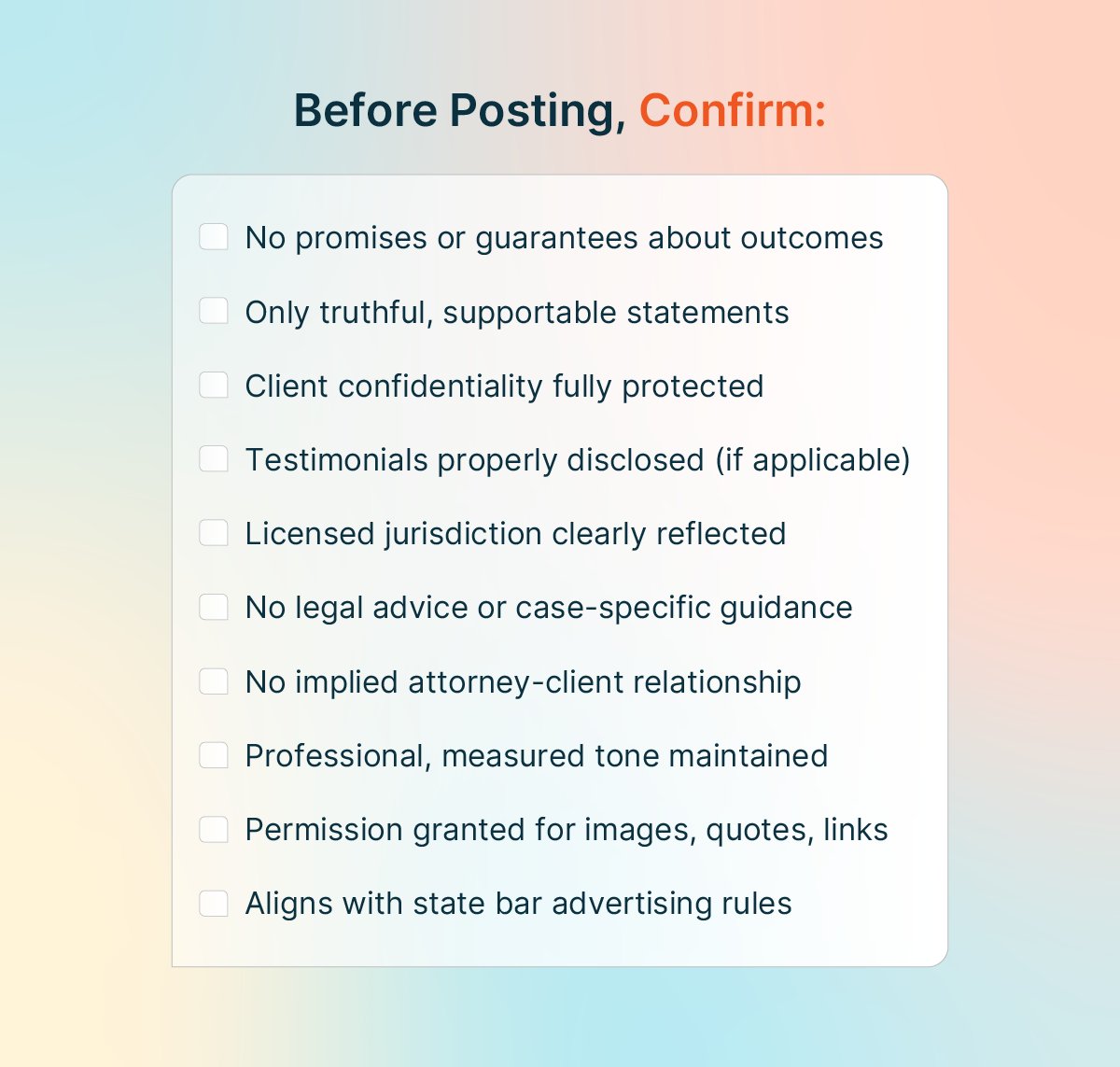
Social media ethics checklist: A basic ethics checklist can help ensure your posts stay compliant with professional standards. See the example below.
Before posting, confirm that your content:
Makes no promises or guarantees about outcomes
Includes only truthful, supportable statements
Protects client confidentiality in full
Uses testimonials only when permitted and properly disclosed
Clearly reflects your licensed jurisdiction
Avoids giving legal advice or case-specific guidance
Does not imply an attorney-client relationship
Maintains a professional, measured tone
Uses images, quotes, and links you have permission to share
Aligns with your state bar’s advertising and ethics rules
Lead management
No matter how strong your content is, social media marketing for lawyers won’t deliver tangible results unless you have a plan for capturing and following up with leads. Here are a few tools that streamline lead management and ensure no opportunity slips through the cracks:
Client intake tools: Collect inquiries through custom forms, organize contact details, and begin the intake process automatically.
CRM tools: Manage communications, track lead statuses, and stay organized as potential clients move through the pipeline.
Lead tracking tools: Monitor which platforms generate the most engagement and inquiries so you can build on your most successful channels.
When these tools are built into a practice management solution like 8am™ MyCase, it’s easier to turn interest into action and connect your marketing efforts with real business results.
Build momentum and manage your leads with 8am
Building a strong social media presence doesn’t have to be overwhelming. Start with a simple plan, focus on consistency, and let your strategy evolve as you learn what works. A steady approach is more effective than aiming for perfection, and far easier to maintain over time.
Here’s a quick checklist to help your firm stay organized and build momentum with your social media marketing efforts:
Choose one platform that fits your audience and practice area
Create a social content calendar with a realistic schedule, such as one post per week
Direct all client inquiries to a single intake form or inbox
Review incoming leads weekly using your practice management solution
Hold off on expanding to new platforms until your posting and lead follow-up routine is running smoothly
With built-in lead tracking and intake tools, MyCase and 8am CasePeer give your firm the structure needed to turn social media marketing into real results.
Ready to turn your social media efforts into real results? Explore how 8am practice management solutions can help you capture online leads, streamline intake, and grow your firm.