


Key takeaways
-
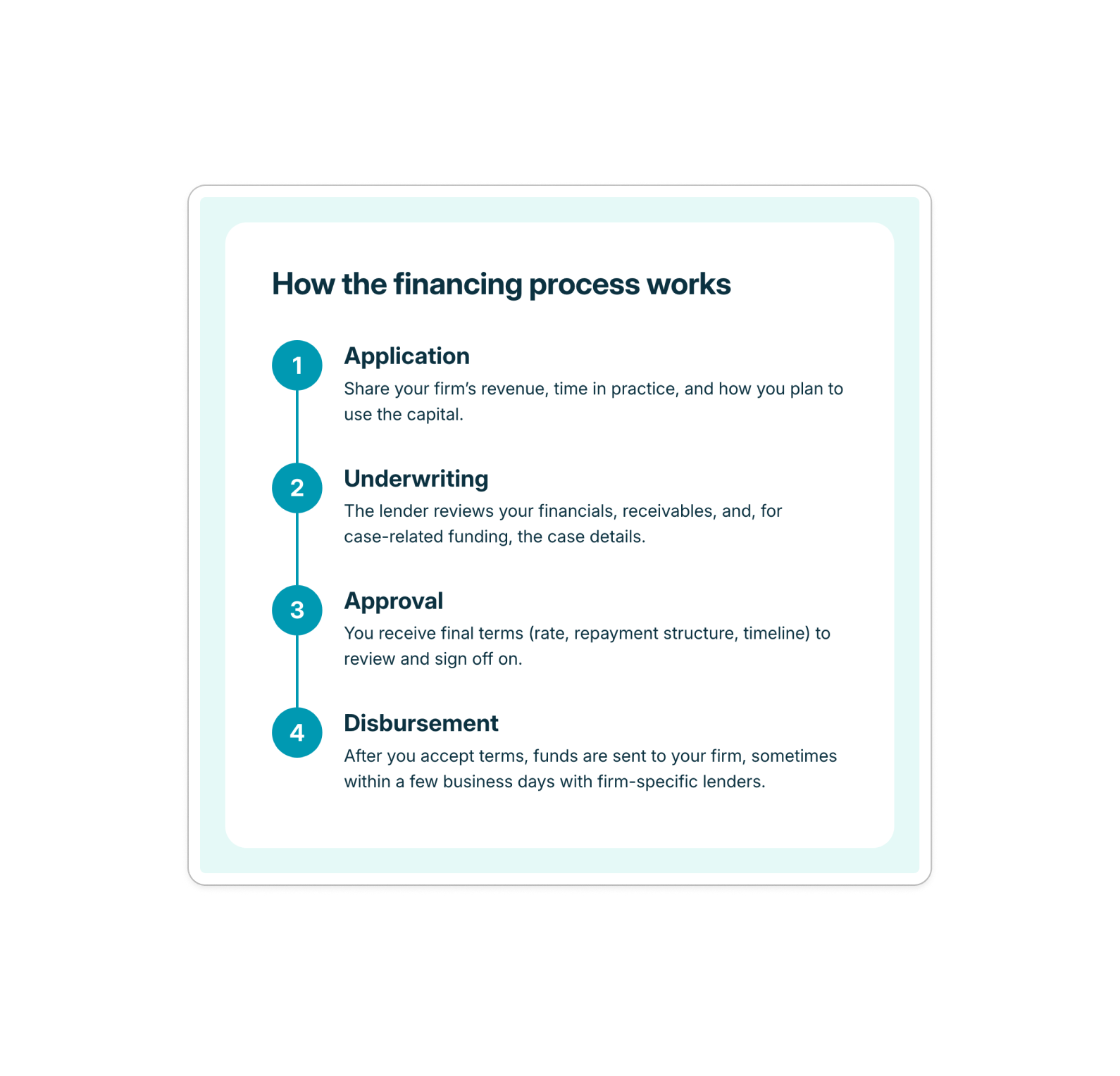
Financing bridges the gap between work done and cash collected, covering payroll and case costs while you wait on client payments or settlements.
-
Structures differ by risk. Recourse capital (lines of credit, loans) must be repaid regardless of outcome; non-recourse capital ties repayment to how a case resolves.
-
Firm-specific lenders underwrite differently from banks, weighing revenue and billing cycles rather than collateral and personal guarantees, which usually means faster decisions and better-fitting terms.
Cash flow rarely moves in a straight line at a law firm. Payroll is due on the first of the month, but client invoices might not be paid for 60 or 90 days after the work is done. A new associate could double your capacity, but only if you can cover their salary before the added billings show up. This gap between the work you've done and the cash you've collected is exactly what firm-specific financing can solve.
This guide walks through what this type of financing is, the types of capital available, how the process works, what lenders look for, and how to choose a partner you can trust.
What is law firm financing?
Law firm financing is capital raised specifically to support the operations, growth, or case-related costs of a legal practice. It covers everything from a working capital line that smooths out payroll to funding tied directly to a load of active cases. What sets it apart from a generic small-business loan is that it's structured around how firms bill, collect, and manage risk.
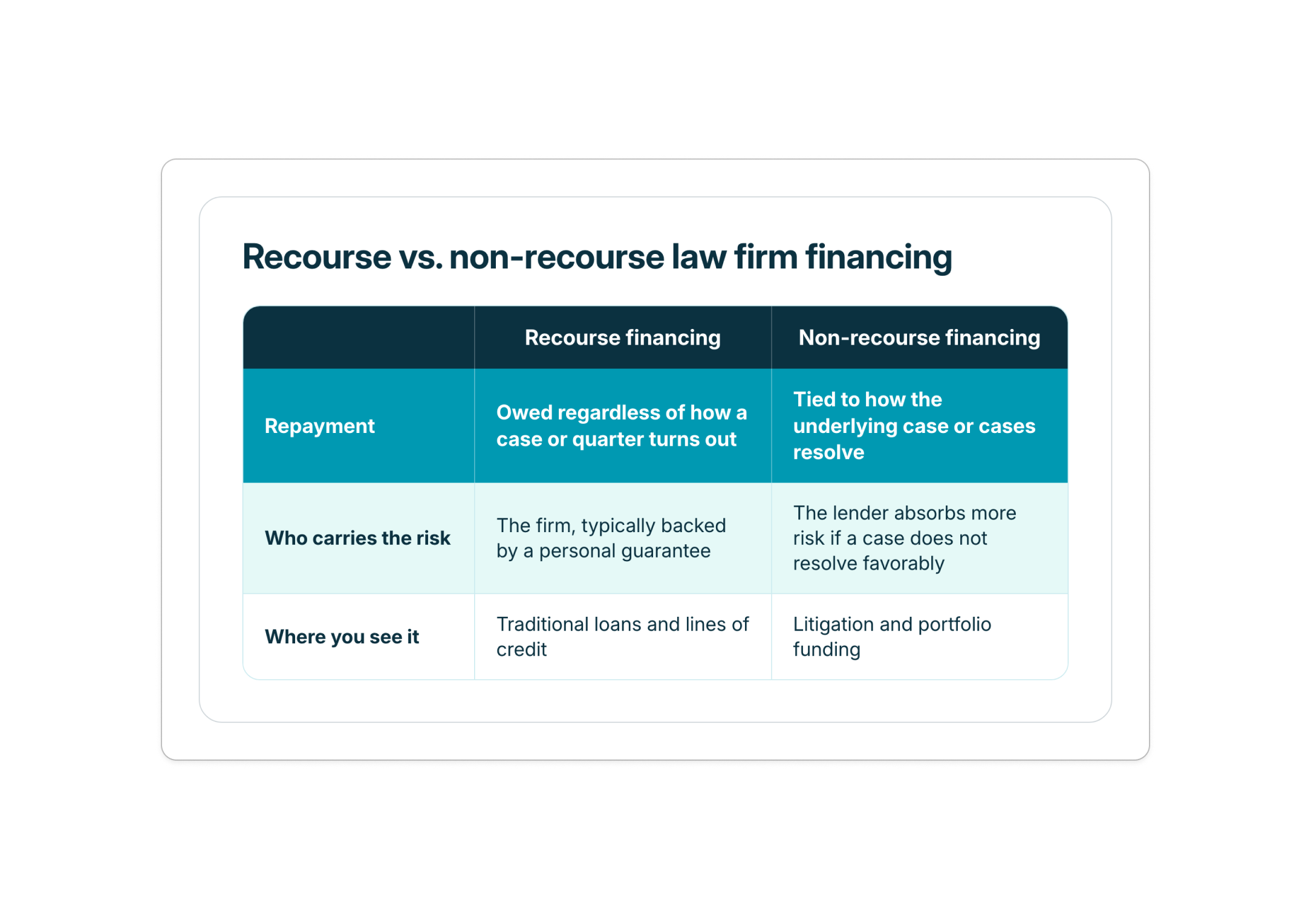
A key distinction within this category is between recourse and non-recourse capital.
-
Recourse financing behaves like a traditional loan—your firm is obligated to repay it regardless of how a case or quarter turns out, typically backed by a personal guarantee.
-
Non-recourse capital , more common in litigation and portfolio funding, ties repayment to the outcome of the underlying case or cases—if the case doesn't resolve favorably, the lender absorbs more of the risk.
This also puts law firm funding in contrast with a standard bank loan. Traditional bank lenders often require hard collateral, a personal guarantee from every partner, and a credit-underwriting process that doesn't account for how contingency or hourly billing actually flows. Financing built for law firms tends to weigh firm revenue, case pipeline, and receivables instead.
In this guide, we will focus primarily on firm- and business-level financing (working capital, growth capital, and business loans) rather than single-case litigation funding, though the two overlap in places.
Why law firms use financing
Financing gives firms more room to operate strategically instead of reactively. The most common reasons firms turn to it include:
-
Smoothing cash flow: Covering payroll, rent, and vendor invoices while you wait on billing, especially at firms working on contingency or with clients who pay net-60 or net-90. Maintaining steady law firm working capital means you're not scrambling every time a big invoice runs late.
-
Funding growth: Hiring an associate or paralegal, launching a marketing campaign, upgrading case management software, or opening a second office all require upfront capital before additional revenue materializes. Case-related costs—expert witnesses, filing fees, discovery, and depositions—are another common use, allowing firms to take on cases they'd otherwise have to pass on.
-
Offering more flexible billing: With capital to draw on, firms have more room to offer alternative fee arrangements, payment plans, or flat-fee packages without straining the practice's own cash position while waiting on client payments.
-
Reducing personal risk and building staying power: Non-recourse and firm-tailored structures can reduce personal risk compared with a loan backed by a partner's personal guarantee. For solo and small firms in particular, financing can substitute for the larger cash reserves that bigger firms rely on, giving newer or leaner practices more staying power.
Types of financing available to law firms
Not all capital is created equal, and the right type depends on what you're trying to solve. Here's a rundown of the most common options facing law firms today:
-
SBA loans and traditional business loans: SBA-backed loans and conventional law firm business loans from banks typically offer the lowest rates but require longer application processes, more documentation, and slower funding timelines—often weeks rather than days.
-
Working capital lines of credit: A law firm line of credit gives you revolving access to funds you draw on as needed and repay as cash comes in, making it one of the most flexible ways to manage law firm working capital without taking on a lump-sum loan you don't need yet.
-
Litigation and portfolio funding: This is non-recourse law-firm lending tied to the outcome of a specific case or a portfolio of cases, most relevant to contingency-based practices that incur high case costs. These providers often set their own minimum case value or portfolio size requirements, separate from the eligibility criteria used for general business financing.
-
Revenue-based financing: Repayment scales with your firm's revenue rather than a fixed monthly payment, which can make it easier to manage during slower months. It's one of several structures that fall under the broader umbrella of financing and loan financing for law firms.
-
Merchant cash advances: These offer fast access to cash, often within a day or two, but usually carry some of the highest effective costs of any option here—worth approaching cautiously rather than as a first choice.
-
Business acquisition and succession financing: Buying into a partnership, acquiring another practice, or funding a partner's exit are all forms of law firm business financing that require capital structured around the value of the practice itself, not just monthly cash flow.
-
Startup financing: Firms just getting off the ground have their own needs, such as office setup, initial staffing, and technology, and law firm startup financing options exist specifically for that early stage, alongside more general business loans for attorneys and other forms of law firm capital.
Most firms end up combining more than one type. For example, a working capital line for day-to-day flexibility alongside case-cost funding for a specific matter.
How the financing process works
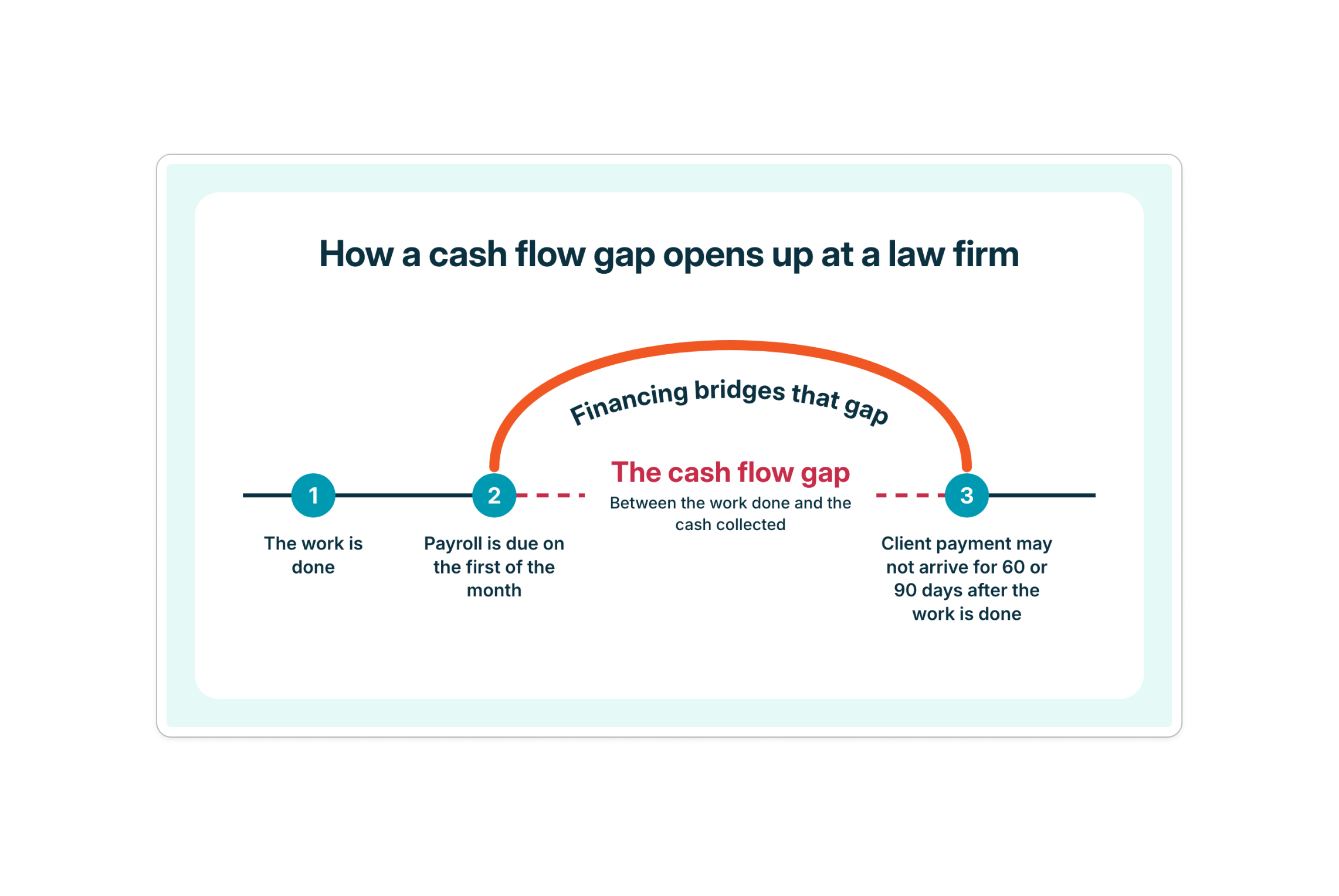
While every lender is a little different, most firm-focused financing follows a similar sequence.
-
Application: You submit basic information about your firm—revenue, time in practice, and what you plan to use the capital for.
-
Underwriting: The lender reviews your firm's financials, receivables, and, for case-related funding, the underlying case details, to assess risk and determine terms.
-
Approval: Once your application is reviewed, you receive final terms—rate, repayment structure, and timeline—for your review and sign-off.
-
Disbursement: After the terms are accepted, funds are sent to your firm, sometimes within a few business days with firm-specific lenders.
If you are exploring attorney loan options, the application process closely mirrors traditional small-business financing. However, the key distinction lies in underwriting that accounts for the unique billing and collection cycles of legal practices—enabling specialized law firm financing to deliver faster turnarounds than standard bank loans.
Eligibility requirements for law firm financing
Requirements vary significantly by financing type, but a few factors come up across the board. Time in practice and firm revenue are often the first filters—many lenders want to see at least a year or two of operating history, and some set a minimum annual revenue or minimum funding amount below which they won't lend. Personal and firm credit still matter for recourse financing, though less so for non-recourse, case-tied capital.
Documentation typically includes recent financial statements and, depending on the lender, information on trust accounting or case value. Eligibility can also vary by jurisdiction, since bar rules on fee arrangements and trust accounting differ by state—it's worth confirming a lender is set up to work with firms like yours. Law firm funding providers that specialize in the legal industry tend to ask more targeted questions here than a generalist small-business lender would, because they already understand how firms operate.
Keeping a handle on overhead makes qualifying easier across the board; this piece on legal spend management and this guide to setting a law firm budget are both good starting points if you want to tighten up your financials before you apply.
How to choose a financing partner for your law firm
Not every financing provider is a good fit for a law firm, and it's worth spending as much time vetting a lender as you would vetting a new client. Unclear or shifting fee structures are a red flag, as are aggressive daily or weekly repayment schedules that can strain cash flow rather than relieve it. So is a lender who doesn't understand—or ask about—how trust accounting and IOLTA rules affect your firm's finances.
What to prioritize can also shift with firm size. Solo and small firms typically benefit most from speed, simple underwriting, and lenders willing to work with thinner cash reserves, since a slow or document-heavy process can be a dealbreaker when you don't have a finance team to manage it. Larger firms, on the other hand, often weigh higher credit limits, multi-partner guarantee structures, and the extent to which a lender's process integrates with existing accounting or billing systems.
Before signing with any provider, it's worth asking:
-
What's the true total cost of capital, including all fees?
-
Are there prepayment penalties?
-
How quickly can funds actually be disbursed?
-
Do they have experience with law firm lending specifically, or are they a generalist small-business lender applying a one-size-fits-all process?
Firm-specific lenders tend to structure terms more sensibly for legal practices precisely because they've seen how firms operate day-to-day, from billing cycles to case timelines.
Why 8am™ Capital for firm financing
This is where a firm-specific approach to law firm capital makes the most difference. 8am Capital is a working capital solution built directly into 8am LawPay, so eligibility is based on your firm's actual payment history rather than a stack of paperwork or a hard credit pull.
To review pre-qualified offers, firms generally need an active LawPay account with at least 90 days of payment history, U.S.-based annual revenue of $30,000 or more, and a personal credit score of 600 or higher. From there, approved funds typically arrive within one to two business days by ACH, with no origination fees and no prepayment penalties.
Repayment is structured around how firms actually get paid: rather than a fixed monthly bill, payments are drawn automatically as a percentage of daily LawPay payment volume, so they rise and fall with revenue instead of hitting hardest during a slow month. A minimum weekly payment applies to keep repayment predictable, and trust account deposits are excluded from the calculation entirely, keeping the whole structure IOLTA-compliant by design.
Financing isn't a sign that something's wrong at your firm—it's a tool that lets you grow, smooth out cash flow, and take on the cases and clients you want without waiting on your own receivables to catch up. Start by identifying your actual use case, compare the types of capital that fit it, and vet any provider carefully before you sign.
If you're ready to see what firm-specific financing looks like in practice, 8am Capital is built to meet that need. Review eligibility and see current offers on the 8am Capital law firm funding page .