


Key takeaways
-
AI adoption among legal professionals has surged, with 69% now using AI tools regularly, but many firms still struggle to quantify firm-level ROI.
-
The highest-return AI use cases include document drafting, legal research, document summarization, document review, and automated timekeeping.
-
Effective ROI measurement starts with establishing a baseline, tracking time savings, evaluating quality improvements, monitoring firm-wide adoption, and assessing workflow integration.
-
Common barriers to ROI include lack of training, missing AI policies, trust concerns, and reliance on disconnected standalone tools.
-
Integrated legal AI solutions like 8am IQ can help firms turn AI adoption into measurable business outcomes by improving efficiency, capturing more billable time, and reducing administrative overhead.
Walk through almost any law firm right now, and you’ll find a strange paradox.
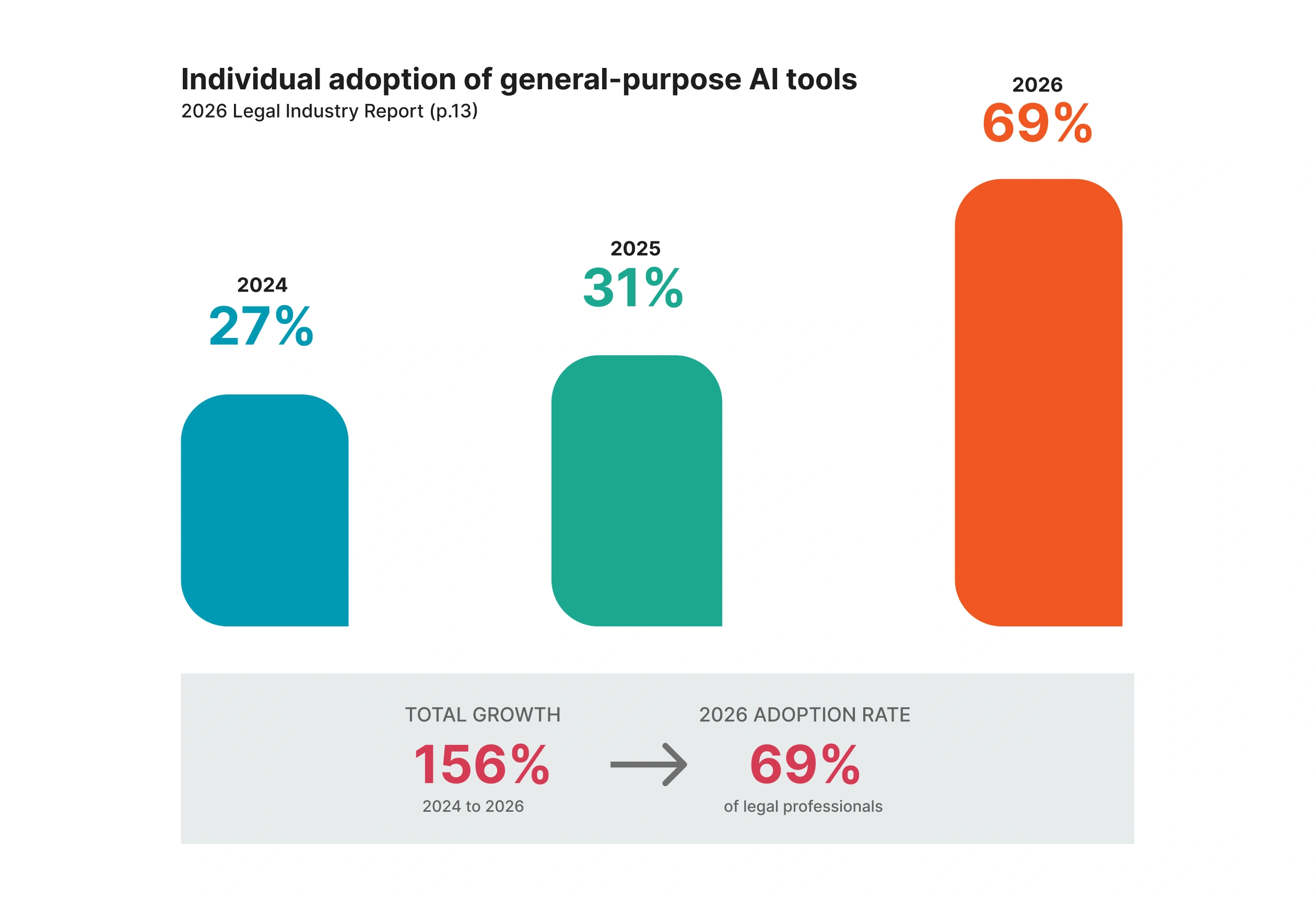
If you ask individual associates or paralegals, many of them will tell you they use AI tools every day to draft emails, clean up transcripts, and summarize documents. In fact, 69% of legal professionals now say they use general-purpose AI tools like ChatGPT regularly for work tasks, a massive leap from just 31% last year, according to the 8am TM 2026 Legal Industry Report .
But if you walk into the managing partner’s office and ask if those tools are actually paying off for the business, you’ll likely get a blank stare.
There’s a significant difference between individuals experimenting with AI tools and organizations being able to measure meaningful business impact. As personal AI adoption outpaces formal operational strategies, legal professionals are saving time on individual tasks, but many firms are still figuring out how to translate that productivity into consistent financial gains.
Closing this gap in 2026 requires a shift in perspective. Proving a measurable ROI in legal AI implementation requires moving past fragmented browser-based tools and shifting toward practical, secure, human-guided legal AI software integrated within the technology your firm already uses.
What does ROI actually mean for legal AI?
Some people view ROI as a simple math problem: time saved multiplied by hourly billable rates. But anyone who’s actually run a law firm knows it’s rarely that straightforward.
Sometimes, returns are hard to quantify in units of time. According to the Legal Industry Report, 33% of legal professionals say AI has significantly improved the quality of their work even when it didn’t save them measurable hours.
In a professional services environment, this lift in quality directly addresses a firm's exposure to liability. Quality control helps mitigate risk: If an AI assistant flags a conflicting statement in a dense medical record, or catches a missing case citation before a filing goes out, attorneys gain an added layer of accuracy and confidence before submitting important work.
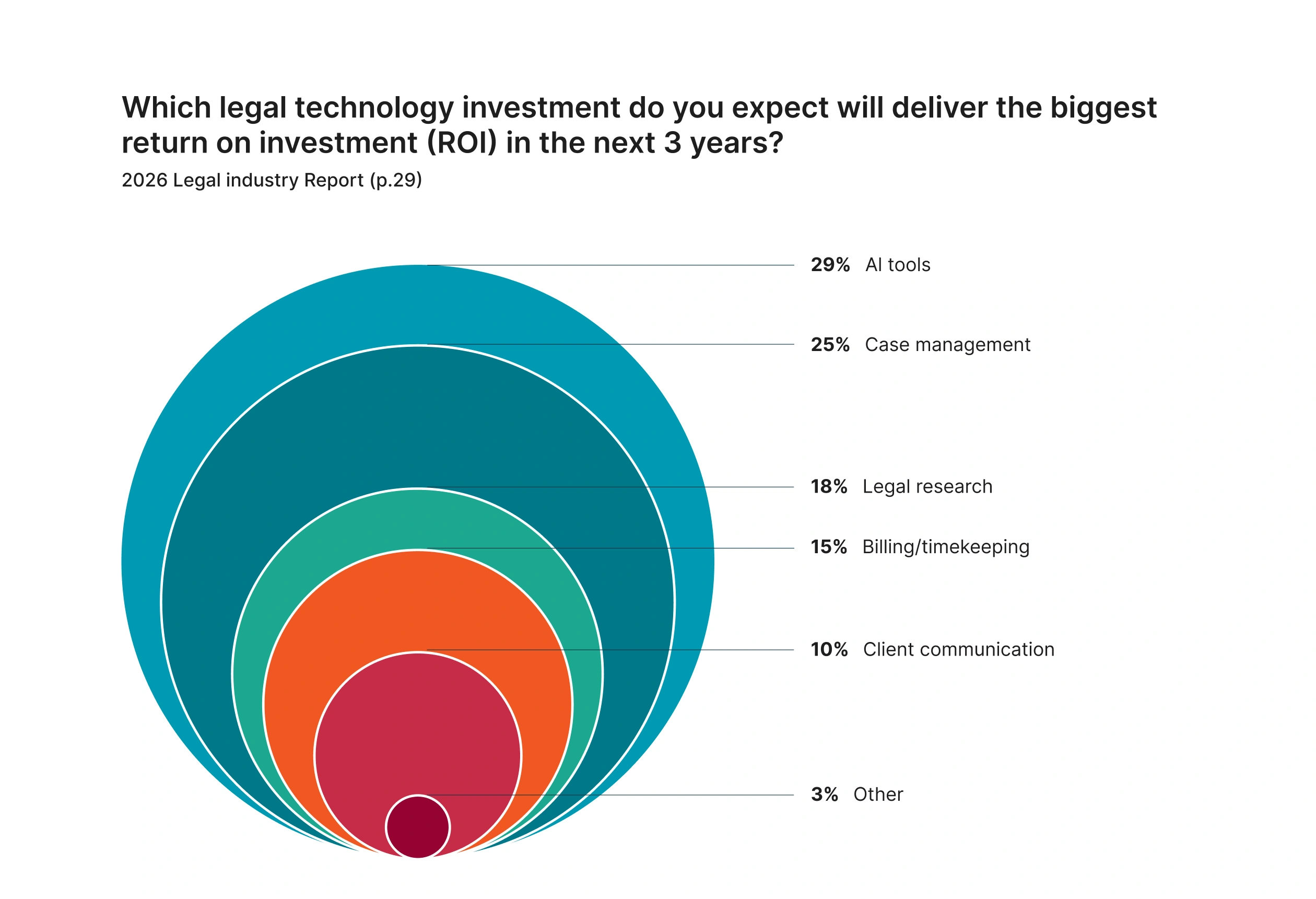
Yet, even with these subjective benefits, firm leaders are hungry for hard numbers. AI tools are currently ranked as the #1 expected ROI among all legal technology investments for the next 3 years.
Interestingly, this expectation shifts dramatically depending on who you ask:
-
Across the industry as a whole, 29% of respondents call AI their top ROI bet.
-
Among firms with 21 or more lawyers, that number skyrockets to 51% .
To see a real return, you have to connect the technology directly to specific firm goals. Are you trying to scale your case volume without increasing headcount? Capture more billable time? Spend less time reviewing and organizing documents? If you don't know what you’re aiming for, your software subscription is just an overhead expense. Our AI resources for law firms can help you identify and set these goals.
Where law firms are seeing legal AI ROI deliver results
Proof of ROI is easiest to see in tasks where AI helps reduce administrative work or speeds up time-consuming research and review processes. By integrating AI into the tools your team regularly uses, you can move beyond the limitations of basic legal AI tools and build a more connected, efficient workflow.
The following use cases highlight some of the clearest examples of legal AI ROI in 2026:
-
Document drafting and correspondence: It's the highest-volume bottleneck in almost every practice. In 2026, 58% of professionals use AI for routine correspondence, and 43% use it to draft documents. Utilizing AI tools for legal writing is less about replacing the attorney and more about clearing the "blank page" hurdle. By reducing the administrative load on associates, it allows lawyers to focus more attention on legal analysis, strategy, and client work.
-
Legal research: Speed matters, but accuracy matters more. According to the Legal Industry Report, 58% of practitioners use AI tools for legal research . When your research moves faster, you immediately create more billable capacity across your team. AI can also help attorneys work with greater confidence by surfacing relevant cases, citations, and supporting information more quickly during the research process.
-
Document summarization: 47% of professionals use AI to summarize documents, providing a direct time-saver on high-volume matters. This turns a 3-hour task of reading through medical records or discovery into a 15-minute verification process. For personal injury or workers' comp firms, this ability to quickly triage case files helps avoid delays during intake, investigation, and settlement preparation.
-
Document review: In complex, document-heavy litigation, AI has a significant operational impact. AI-powered summarization can reduce reviewer hours by up to 80% , allowing counsel to focus more time on high-level strategy. The ROI of AI in law firm document review is especially clear for smaller firms handling large volumes of litigation documents with limited staff resources.
-
Timekeeping and matter organization: Turning recovered time into captured revenue is an easy way to prove ROI in legal AI implementation. Firms using integrated tools like the 8am Smart Time Finder bill an average of 64 extra hours per year per user, simply by capturing the small, invisible tasks that lawyers often forget to log (like a quick email reply or an unscheduled client call). If your billable rate is $300, that’s nearly $20,000 in direct revenue per attorney, just by finding time that was already being spent but not recorded.
How law firms measure legal AI ROI
Measuring ROI at a solo or small firm doesn't require complicated tracking systems or enterprise-level reporting tools. Instead, how law firms measure legal AI ROI effectively involves a simple, five-step approach focused on outcomes.
Step 1: Set a baseline before you implement
You can’t measure what you haven't defined. Establish what "normal" looks like by documenting how long key tasks take before any AI tool enters the picture.
To build an accurate baseline, look at these three categories:
-
Administrative velocity: How long does it take to move a lead from intake to a signed retainer? If your intake process currently takes 48 hours because of manual data entry, use that as your benchmark.
-
Drafting cycles: Track the number of hours your team spends per motion. If a paralegal currently spends 4 hours on a first draft of a standard complaint, that’s your number to beat.
-
Client response times: How long do clients wait for a summary of their case status or a response to a standard inquiry? Faster communication helps improve client satisfaction and retention.
Establishing these operational metrics provides the baseline clarity needed to justify future technology investments. Interestingly, firm-level hesitation is rarely about budget or price: only 24% of those surveyed for the Legal Industry Report cited cost as a significant barrier. Instead, 46% pointed directly to data security concerns.
Because of these governance requirements, an accurate ROI framework can’t just account for recovered hours; it must factor in the structural peace of mind that comes from deploying tools embedded directly within a secure, professional environment.
Step 2: Track time savings and recovered capacity
Measuring time savings consistently across attorneys, staff, and recurring tasks provides a clearer picture of AI’s impact. It’s most effective for firms to translate these recovered hours into estimated dollar values using their own billing rates.
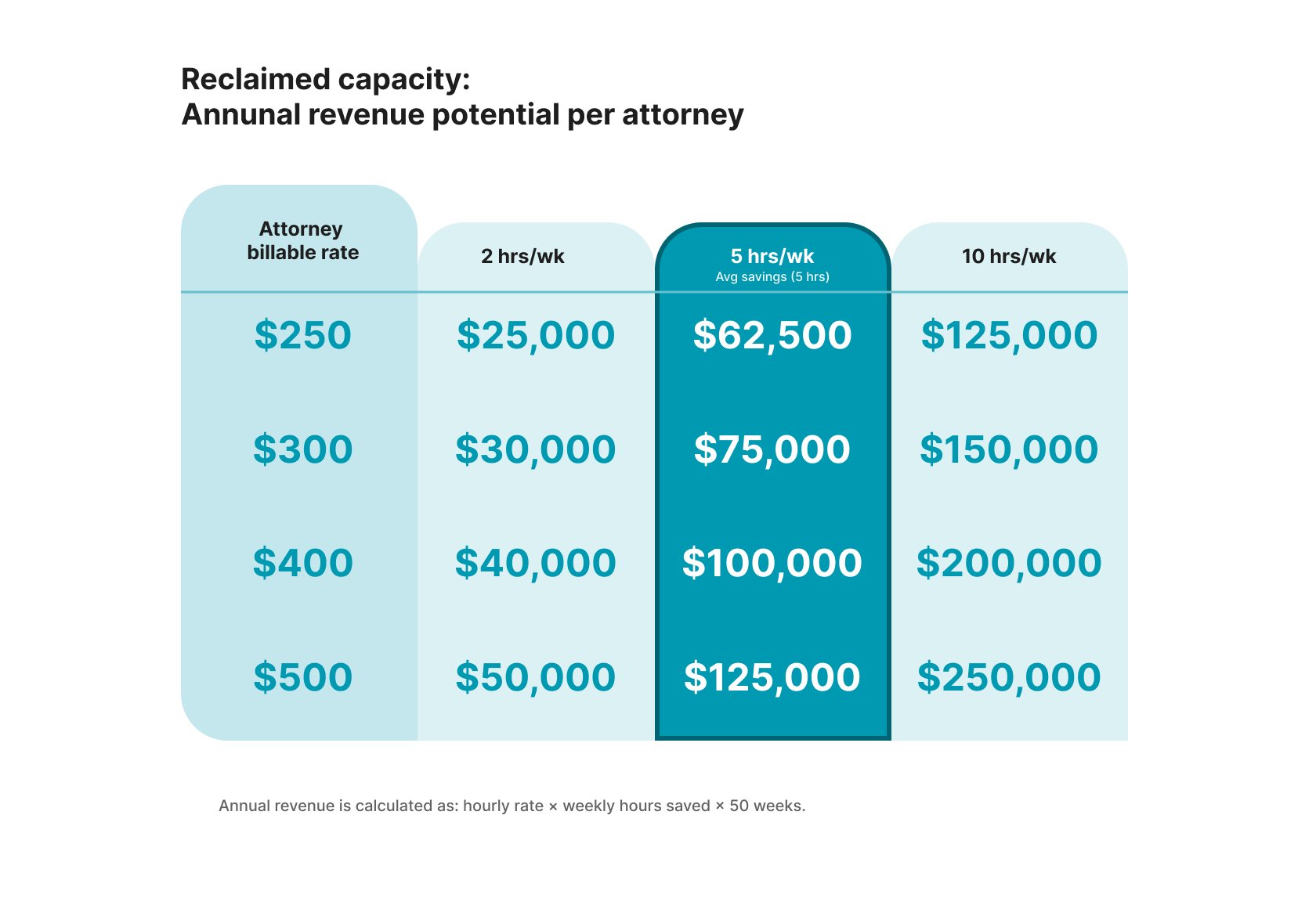
Let’s look at the math. The 2026 Legal Industry Report found that 38% of respondents save 1 to 5 hours per week with generative AI, while 14% save 6 to 10 hours. For a firm billing $300 an hour, saving 5 hours per week would result in $1,500 in recovered capacity per week, or roughly $75,000 annually per attorney.
This is more than just time saved. It's a major shift in your revenue potential. These gains support additional billable work, faster turnaround times, and more manageable workloads for attorneys and staff, which are all significant returns on your investment.
Step 3: Factor in quality improvements, not just speed
If a tool helps you work twice as fast but your drafts require twice as much editing, your ROI is zero. But if the tool helps you uncover a hidden detail in a deposition transcript that completely flips a case, the return is priceless.
Achieving this level of precision requires shifting away from standalone consumer apps toward deep workflow continuity. When practitioners look to integrate technology safely into their daily habits, they prioritize tools that protect their operational integrity. In fact, according to the Legal Industry Report, the most frequently cited reason for choosing legal-specific AI is its availability directly within the trusted legal software platforms a firm already utilizes
By embedding capabilities like 8am IQ directly into your core environment, your data remains unified, your workflows stay clean, and your team reclaims the cognitive capacity needed to focus entirely on the strategic judgment that technology can’t replace.
Step 4: Measure adoption rate across the firm
If only one tech-savvy associate in your office is using AI, your firm isn't scaling; you’ve just made one employee’s day a bit easier. Firm-wide adoption is what multiplies the time savings. You want to see practical AI becoming the standard operating procedure for everyone in the building.
Evaluate your team’s adoption rate by looking at how consistently attorneys, paralegals, and staff are using the same approved AI tools in their daily work. If different teams rely on different tools, it’s more difficult for firms to maintain visibility, control, and operational efficiency.
Utilization metrics can help track how often AI features are being used across the firm and indicate whether the investment in this technology is being fully realized.
Step 5: Evaluate integration, not just individual tools
If your team constantly has to move information between your case management solution and separate AI tools, you’re wasting time and losing focus. Copying text into browser-based chatbots, reformatting responses, and transferring information back into case files adds extra steps and interrupts workflow continuity and adds to the cost of busywork.
Integrated AI tools help reduce that friction by embedding AI capabilities directly into the systems your firm already uses for document management, communication, billing, and case management. Evaluating how much administrative overhead and app switching your team has eliminated with these integrations is an effective way to gauge ROI. When your system is unified, your data remains secure, your workflows stay clean, and your team stays focused on practicing law.
To learn more, see how this philosophy of purpose-built AI works across the entire 8am practice management ecosystem.
What limits the ROI of legal AI tools?
When law firms struggle to see a meaningful return from AI, the issue is often tied less to the technology itself and more to how it’s implemented and supported internally. Several common operational gaps can limit the ROI of implementing AI in legal operations :
-
Training gaps: According to the 2026 Legal Industry Report, 54% of firms provide no AI training to their staff, and only 11% require it. Without guidance on how to use AI tools effectively and verify outputs, many legal professionals fall back on slower manual processes. Firms that invest in building AI skills for lawyers and support staff early will be better positioned to realize the full efficiency gains these tools are designed to deliver.
-
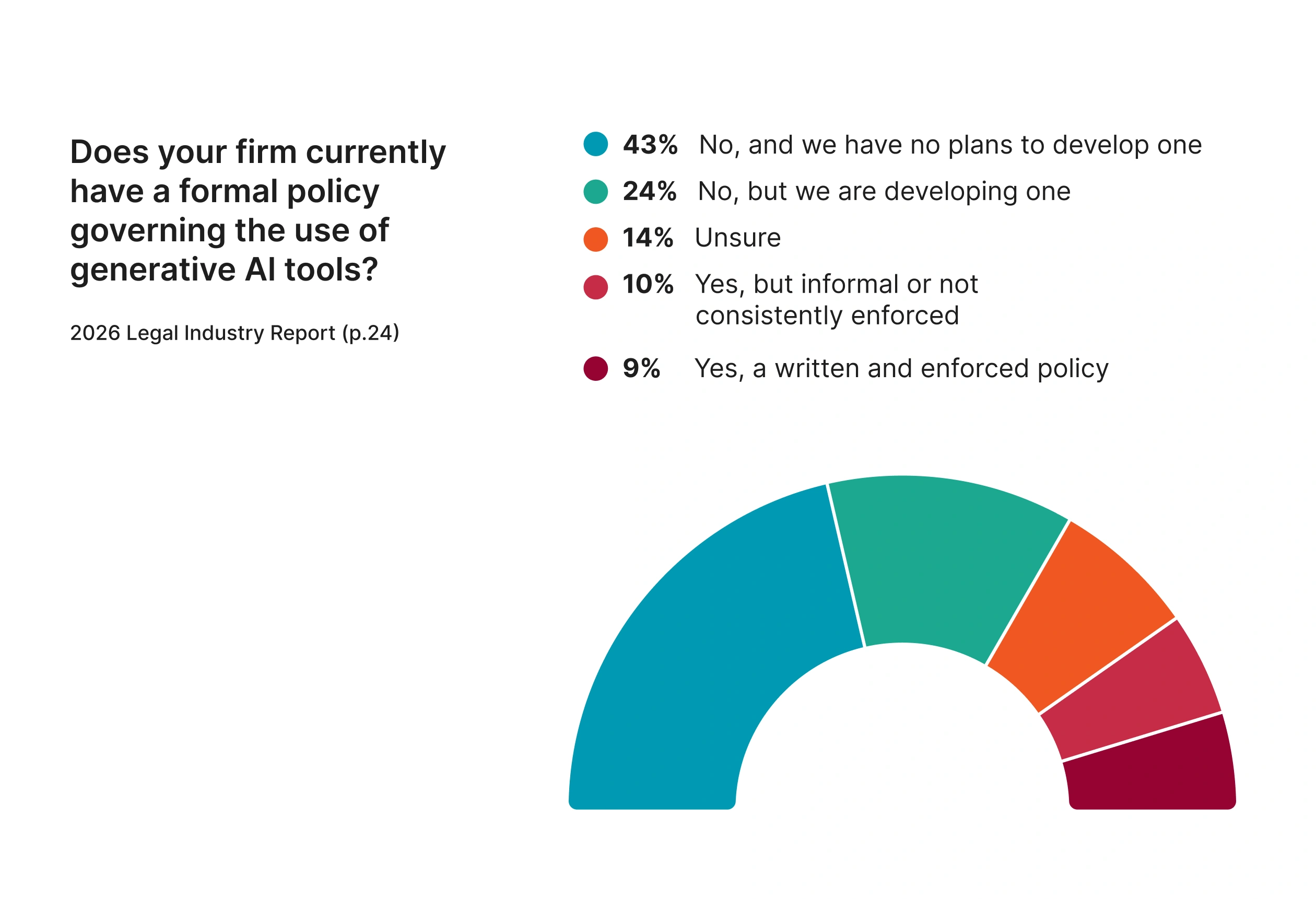
Policy gaps: The Legal Industry Report also found that 43% of firms have no formal AI policy in place. Without clear guidelines around approved use, data handling, and review procedures, adoption can become inconsistent across teams and create unnecessary risk.
-
Lack of trust: 39% of legal professionals say a lack of trust in AI results is actively slowing down their firm's adoption. Building trust often depends on using AI within secure environments that draw from verified case data, rather than risking the hallucinations and data exposure that can occur with consumer AI chatbots.
-
Standalone tools: AI tools that operate outside a firm’s core workflows can create additional administrative work instead of reducing it. Managing separate systems, moving data manually between tools, and maintaining multiple vendors can offset many of the efficiency gains firms hope to achieve.
How 8am IQ turns AI adoption into measurable firm ROI
To provide a meaningful return on investment, legal AI needs to be integrated into the systems firms rely on every day. 8am IQ provides AI tools built specifically for how solo and small firms actually work. It’s designed to provide clarity in your data, confidence in your results, and control over your firm's security.
By embedding AI directly into 8am MyCase , lawyers can draft documents, summarize matters, and surface insights without switching tools. This integrated approach helps preserve important context that general-purpose tools often miss, such as matter history, client details, and firm-specific templates. Features like Case Assistant make it easier to organize case information and plan next steps, reducing administrative overhead that eats into billable time.
AI can support a wide range of operational tasks across law firms beyond drafting assistance. Explore 10 more AI use cases for lawyers to see how firms are using AI to improve efficiency, manage workloads, and support day-to-day legal operations. Firms that adopt AI strategically can build a stronger foundation for long-term growth, translating innovation into measurable financial gains.
Learn more about practical AI tools from 8am that help legal professionals simplify operations and save time.
The statistics cited throughout this article come from an 8am survey of more than 1,300 legal professionals. Download the full 8am 2026 Legal Industry Report for additional insights into AI adoption, law firm operations, billing trends, and the future of legal work.