


Key takeaways
AI skills for lawyers include prompt writing, output review, workflow integration, and ensuring responsible use of AI tools within legal practice.
Legal professionals are adopting AI rapidly, while many firms are moving more slowly to develop formal policies, training programs, and implementation strategies.
Human-centered skills such as legal judgment, client communication, negotiation, and strategic thinking continue to grow in value alongside AI adoption.
Firms often see stronger results when AI tools are integrated into existing case management workflows and mesh well with the daily routines of attorneys and staff.
Attorneys are increasingly using AI tools to summarize documents, organize research, draft communications, and handle time-consuming administrative tasks more efficiently. As this technology gains traction, AI skills for lawyers are becoming more valuable for improving firm productivity, organization, and client service.
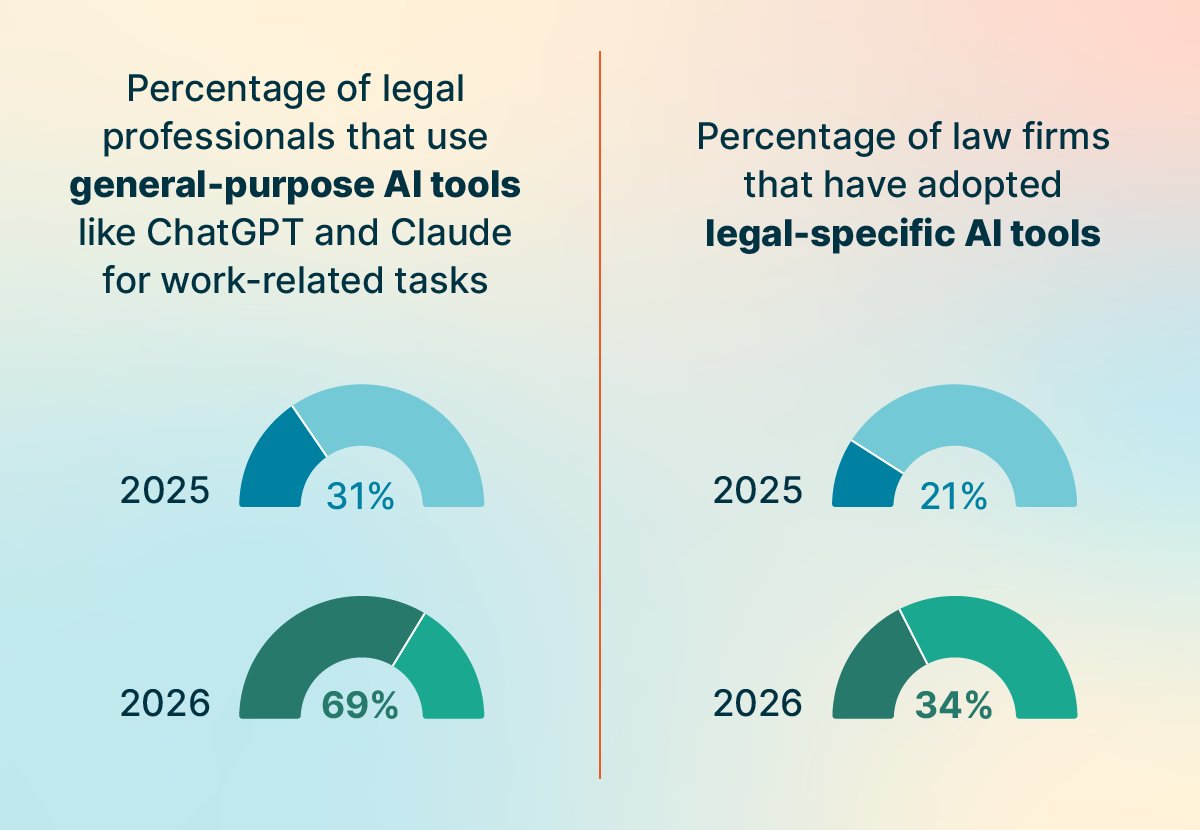
According to the 8amTM 2026 Legal Industry Report, 69% of legal professionals now use general-purpose AI tools for work-related tasks, up from 31% the previous year. That sharp increase highlights how many lawyers are moving from curiosity about AI to routine experimentation, creating a stronger need for informed, thoughtful use.
At the same time, many firms are still figuring out how AI fits into their operations. Formal training remains limited, firmwide policies are still developing, and many attorneys are learning through trial and error as adoption accelerates.
As these tools become more common, attorneys who understand their strengths, limitations, and risks will be better positioned to use them effectively. This is the first step toward building practical, career-relevant AI skills.
Why AI skills are now a core legal competency
Legal AI skills are the practical abilities attorneys need to evaluate AI tools, write effective prompts, review outputs critically, protect sensitive information, and apply AI responsibly within legal workflows. These are operational and professional competencies tied directly to day-to-day legal responsibilities, rather than highly technical disciplines like coding, machine learning engineering, or software development.
Below are several reasons these abilities are becoming increasingly valuable across the legal profession.
Legal AI is here to stay
Legal technology adoption has traditionally moved at a measured pace. Tools like digital billing systems, cloud-based case management, and electronic document storage took years to gain broad acceptance across the profession. Generative AI has followed a very different trajectory.
Within just a few years, general-purpose AI tools such as ChatGPT, Claude, and Gemini are already widely used for drafting, summarization, brainstorming, and research support. Legal-specific AI solutions built around firm workflows, matter data, and legal research are gaining momentum as well: According to the 2026 Legal Industry Report, 34% of law firms now use legal AI tools, up from 21% in 2025.
AI can boost efficiency and work quality
The benefits of legal AI extend beyond speed. Legal professionals who use AI tools report saving between one and 10 hours per week, according to the 8am survey. Another 33% say AI improves the quality of their work, even when it doesn’t reduce the time spent on a task.
AI literacy is becoming a self-directed responsibility
Many lawyers are developing AI skills independently as their firms move more gradually to create formal policies and training programs. The Legal Industry Report found that 54% of firms still provide no AI training at all, leaving attorneys to experiment and establish best practices through hands-on use.
5 essential AI skills lawyers need right now
Lawyers are increasingly expected to understand how AI tools function, where they fit into legal workflows, and how to use them responsibly in client work. The skills below provide a practical starting point for attorneys looking to build that foundation.
1. Technical fluency with AI tools
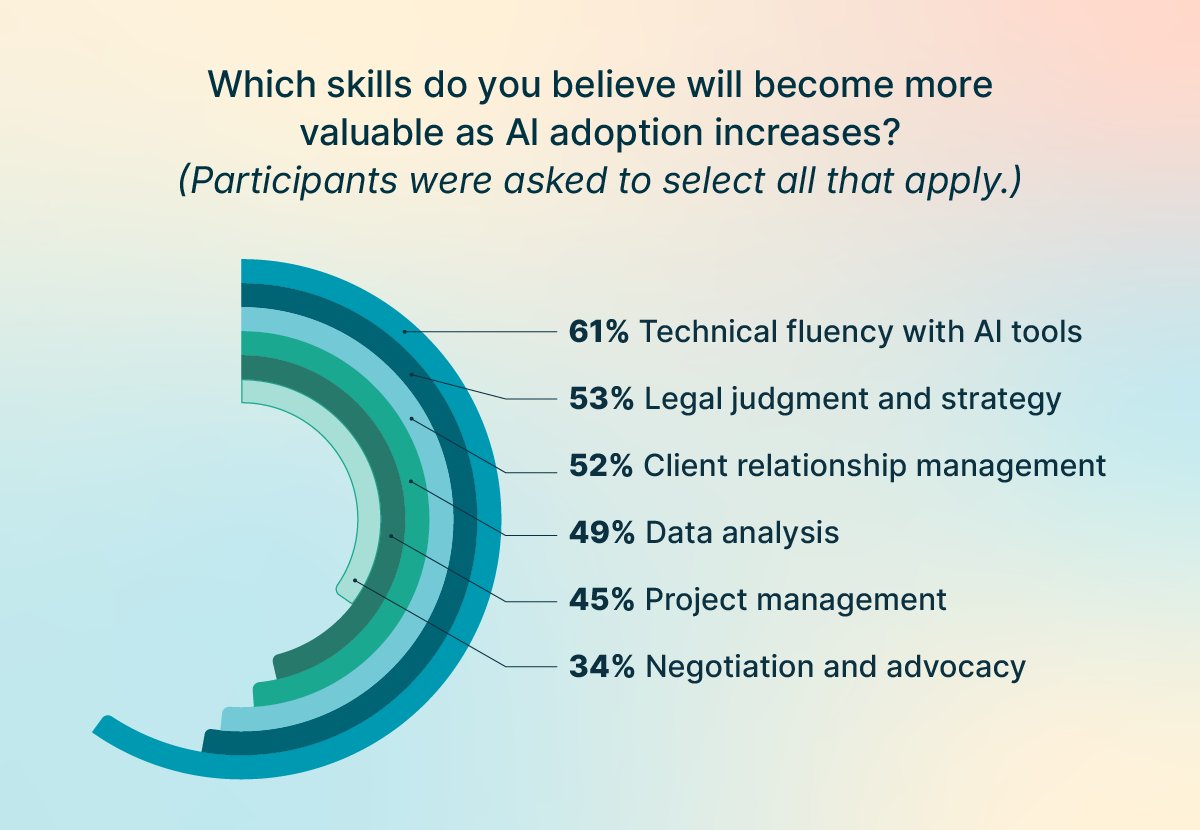
The Legal Industry Report found that 61% of legal professionals believe technical AI fluency will become increasingly valuable as adoption grows across the profession. Lawyers should develop working knowledge in several key areas:
Data privacy and confidentiality: Understand what types of client and case information can safely be entered into an AI tool, and how vendors handle data storage and retention.
Model limitations: Recognize that AI systems can generate inaccurate citations, incomplete summaries, or fabricated information.
Legal-specific vs. general-purpose AI: Learn when a legal-focused tool may provide better context, workflow integration, or safeguards than a general chatbot.
Source transparency: Prioritize tools that show citations, supporting text, or traceable sources behind AI-generated answers.
Workflow compatibility: Evaluate whether an AI tool fits naturally into daily legal work instead of creating additional administrative overhead.
Security and compliance standards: Review vendor policies around encryption, permissions, and professional responsibility obligations.
Having a good understanding of the technical aspects of legal AI can help lawyers evaluate tools for accuracy, security, and appropriateness for legal work—a foundational skill in itself.
2. Prompt engineering for legal work
Prompt engineering is the ability to write targeted instructions that guide AI tools toward accurate, relevant, and ethically sound outputs. Because legal work depends heavily on precision, structure, and careful language, attorneys have a solid head start in this area.
Small changes in wording can significantly affect the quality of an AI-generated result. A vague prompt such as “summarize this contract” may lead to a surface-level overview that fails to capture important legal details. A stronger legal AI prompt provides clear direction and context: “Summarize the key obligations, termination clauses, and liability limitations in this contract, flagging any unusual or non-standard terms.”
Lawyers can strengthen this skill by practicing how they frame instructions, define scope, request citations, and identify the intended audience or purpose of the output.
3. Output verification and critical review
Trust remains one of the biggest obstacles slowing AI adoption within law firms. According to the Legal Industry Report, 39% of respondents said a lack of trust in AI-generated results were a major barrier to implementation, while 43% of firms reported greater trust in legal-specific AI tools than in general-purpose platforms.
AI hallucinations occur because language models predict likely text patterns rather than truly “understanding” legal authority or case history. For legal professionals, output verification means carefully reviewing AI-generated content for accuracy, completeness, citation quality, factual support, and ethical compliance before using it in legal work. This includes checking all citations, validating summaries against source documents, confirming jurisdictional relevance, and looking for missing details.
4. Data literacy and legal analytics
As AI tools become more common across legal practice, lawyers are increasingly expected to interpret data alongside legal text. Data literacy includes understanding how AI-generated outputs are produced, evaluating statistical or predictive claims, recognizing potential bias, and applying data insights to areas including legal strategy, financial management, and client guidance.
5. Workflow integration and change leadership
Barriers to legal AI adoption often relate to issues with implementation, communication, and day-to-day processes inside the firm. Legal professionals who understand AI-powered workflows can play an important role in helping their firms implement new tools, improve operational consistency, and support long-term growth.
Workflow integration involves identifying repetitive or time-intensive tasks that can be streamlined with AI, creating consistent processes for these tasks, and making it easier for attorneys and staff to work efficiently without constantly switching between multiple platforms.
When introducing new AI workflows, it’s generally best to start small. For example, a firm might begin by using AI to summarize intake notes or organize discovery documents, and then gradually expand into additional workflows once these processes are tested and refined.
What skills do lawyers need beyond technical AI fluency?
Legal professionals expect several human-centered skills to grow in value as AI adoption increases. Alongside technical fluency, the Legal Industry Report identified several other skills lawyers need for the AI era, including legal judgment and strategy (53%); client relationship management (52%); data analysis (49%); project management (45%); and negotiation and advocacy (34%).
Legal judgment and strategy
As AI takes over more administrative and process-driven tasks, attorneys will have more time to evaluate risk, shape legal strategy, and apply professional judgment to complex situations. AI can organize information quickly, but lawyers are still responsible for weighing nuance, interpreting context, and making informed legal decisions that align with client goals.
Client relationship management
Strong client relationships depend on trust, responsiveness, empathy, and clear communication. Those qualities remain deeply human and are difficult to replicate through automation. Lawyers who can explain legal issues clearly, build confidence during stressful situations, and maintain strong client rapport will continue to stand out as legal workflows evolve.
Data analysis
In day-to-day legal practice, data literacy increasingly involves knowing how to interpret AI-generated recommendations, recognize patterns across matters, identify potential bias or weak assumptions, and translate analytical findings into practical client guidance.
Project management
Firms need legal assistants, paralegals, and other staff who can organize timelines, manage responsibilities, and keep matters moving efficiently. As legal workflows become more technology-assisted, strong project management skills will help ensure work stays accurate, organized, and aligned across teams.
Negotiation and advocacy
Negotiation, persuasion, courtroom advocacy, and relationship-based problem-solving are aspects of legal practice that rely heavily on human judgment and interpersonal skill. While AI may support preparation and research, attorneys still need to read people, adapt in real time, and advocate effectively.
Legal AI resources: How lawyers can start building AI skills today
AI education is beginning earlier in the professional pipeline, with most students now getting hands-on experience with legal AI technology in law school. As lawyers continue developing professionally, building these skills is a gradual process that involves ongoing experimentation.
For legal professionals, the goal is not to become an AI engineer overnight, but rather to build familiarity with the tools, understand where they fit into legal work, and use good judgment when deciding how they should be used.
Here are a few helpful resources about AI for lawyers who are looking to strengthen these skills:
MyCase AI Resource Center: Articles, guides, and other resources focused on AI use in law firms
American Bar Association: Law and Artificial Intelligence Resources: Guidance on AI ethics, professional responsibility, and legal technology trend
ABA Law Technology Today, Legaltech News, and Artificial Lawyer: News, discussions, and real-world examples of how firms are using AI in legal practice
8am IQ for MyCase: AI that works with you
Law firms often have an easier time adopting and managing AI when the technology meshes with the tools and workflows they already have in place. The firms that integrate AI agents into real workflows are most likely to see meaningful ROI from legal AI implementation.
8am IQ for MyCase is designed to support that kind of day-to-day usability. Built into 8am MyCase, it helps firms work more efficiently with documents, communication, and case information while keeping attorneys at the forefront of legal judgment and decision-making.
8am IQ includes several AI assistants tailored to support legal workflows:
Document Assistant: Summarizes legal documents, identifies key clauses and deadlines, and creates structured takeaways tied to each matter.
Case Assistant: Searches across case files, notes, filings, and messages to surface relevant facts, timelines, and citations.
Writing Assistant: Helps refine emails, summaries, and other written communications with faster editing and clearer language.
Discovery Assistant: Uses optical character recognition (OCR) to convert scanned and image-based documents into searchable, machine-readable text.
To see how 8am IQ works in action, schedule a demo of MyCase today.
Not ready for the demo? Keep exploring practical AI use cases and products from 8am.