

Key takeaways
-
According to the 2026 Legal Industry Report, 69% of legal professionals at solo and small firms now use AI at work, with more than half using it every day or several times a week.
-
General-purpose AI and legal-specific AI each play distinct roles in supporting legal work.
-
Trust, security, and governance continue to shape how firms adopt AI.
-
Starting with low-risk tasks, choosing legal-specific tools, and establishing clear policies can help firms adopt AI more effectively.
AI adoption for solo and small law firms is accelerating, with a growing number of attorneys and staff using the technology for research, drafting, client communication, and other administrative tasks.
New data from the 8am™ 2026 Legal Industry Report shows that 69% of legal professionals at solo practices and small law firms with two to five attorneys use AI tools for work. That matches the AI adoption rate across the legal profession overall, though usage remains lower than at larger firms, according to the survey.
This guide explores trends in how smaller firms are using AI tools, common barriers to adoption, and practical strategies for implementing AI across your practice.
How widespread is AI usage among solo and small firms?
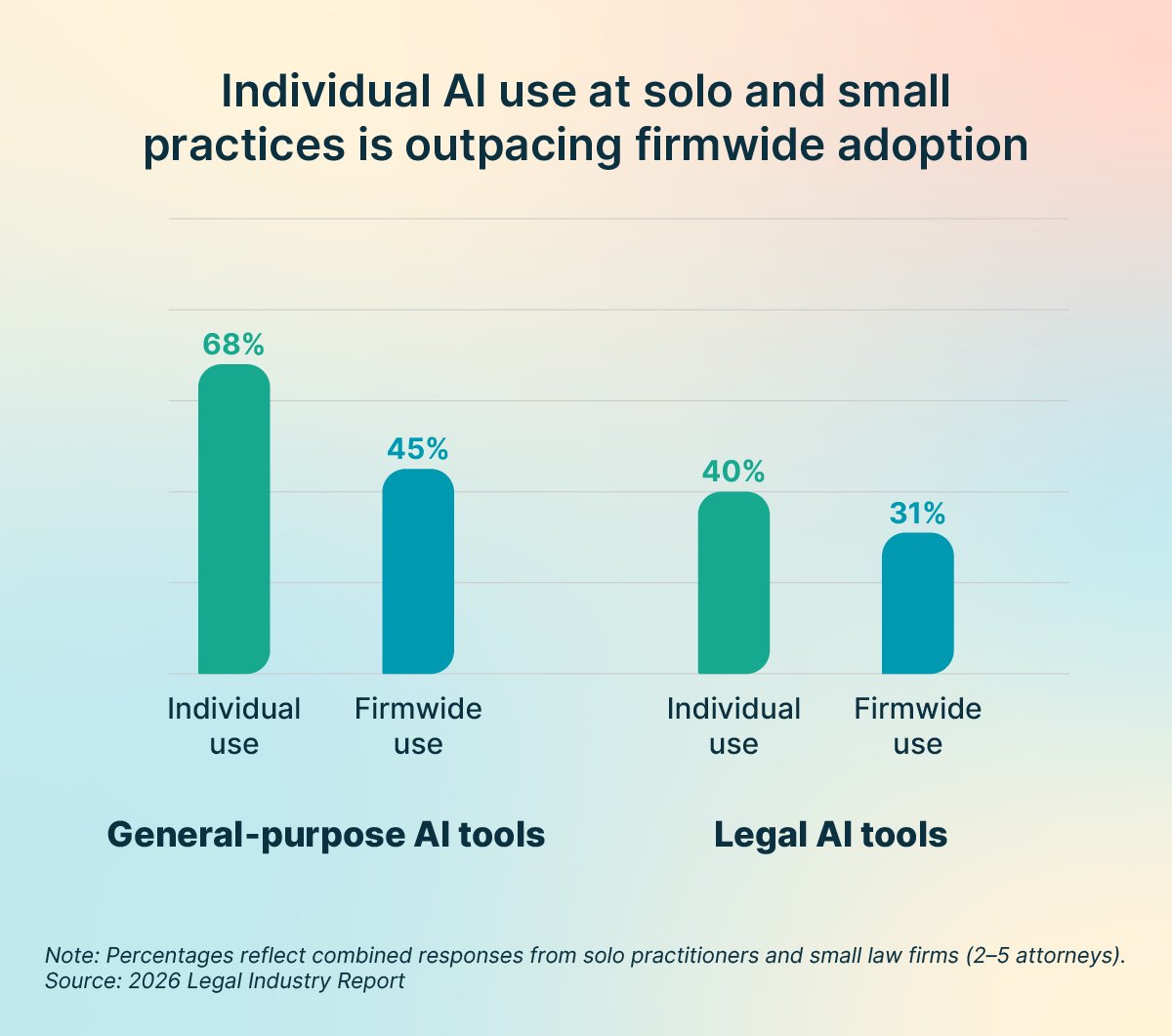
The Legal Industry Report found that individual AI use at smaller practices is outpacing firmwide adoption, suggesting that many attorneys and legal staff start incorporating AI into their own work before their firms establish official guidelines.
Here's how AI adoption breaks down among the surveyed legal professionals at small and solo firms:
General-purpose AI tools (such as ChatGPT, Claude, or Gemini):
-
Individual use: 68%
-
Firmwide use: 45%
Legal-specific AI tools :
-
Individual use: 40%
-
Firmwide use: 31%
While AI usage is increasing across firms of all sizes , larger firms continue to lead the way. Individual use of general AI platforms rises from 68% for small and solo practices to 78% at firms with more than 50 lawyers. The gap is even bigger for individual use of legal-specific AI, with adoption reaching 61% at the largest firms compared to 40% at small and solo firms.
Organization-wide adoption follows a similar pattern, suggesting larger firms are moving more quickly to establish standard AI tools and practices.
Frequency of AI use
Not everyone who uses AI relies on it to the same extent. The report found a wide range of usage patterns among respondents who work at solo and small firms:
-
27% use AI every day
-
31% use it several times per week
-
12% use it once per week
-
11% use it once a month or less
-
19% report never using AI
These findings suggest that AI has become a routine part of workflows for many professionals at smaller practices, with 58% using it multiple times every week.
Time savings and quality improvements
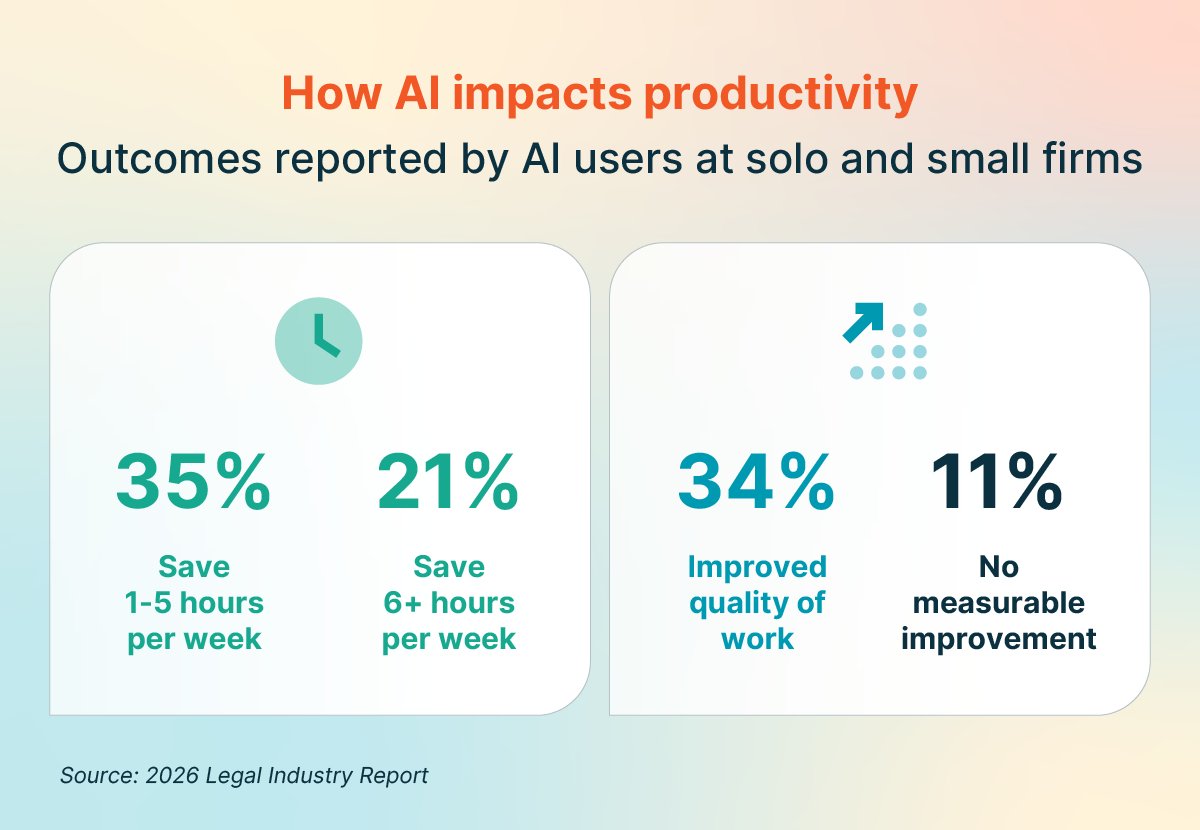
Among solo and small-firm respondents, more than half reported that AI has helped them reclaim time during the workweek:
-
35% save 1–5 hours per week
-
12% save 6–10 hours per week
-
5% save 11–15 hours per week
-
4% save 16 or more hours per week
-
34% report no measurable time savings but improved quality of work
-
11% say AI has not improved efficiency
The results suggest AI's value isn’t limited to time savings. One-third of respondents reported improved work quality despite not seeing measurable efficiency improvements, indicating that firms may see benefits beyond faster task completion.
Interested in a specific practice area? Learn how immigration , personal injury , criminal defense , and family law firms are using AI in their day-to-day work.
What are solo and small firms using AI for?
AI is supporting a wide range of work at solo and small firms, from early-stage research and drafting to legal research and document preparation. The Legal Industry Report shows that general-purpose and legal-specific AI tools have many similar use cases, with a few notable differences in how firms apply them.
Uses for general-purpose AI tools
Legal professionals at solo and small firms are using general-purpose AI platforms such as ChatGPT and Claude to complete administrative and knowledge-based tasks, particularly those that don't require legal-specific functionality.
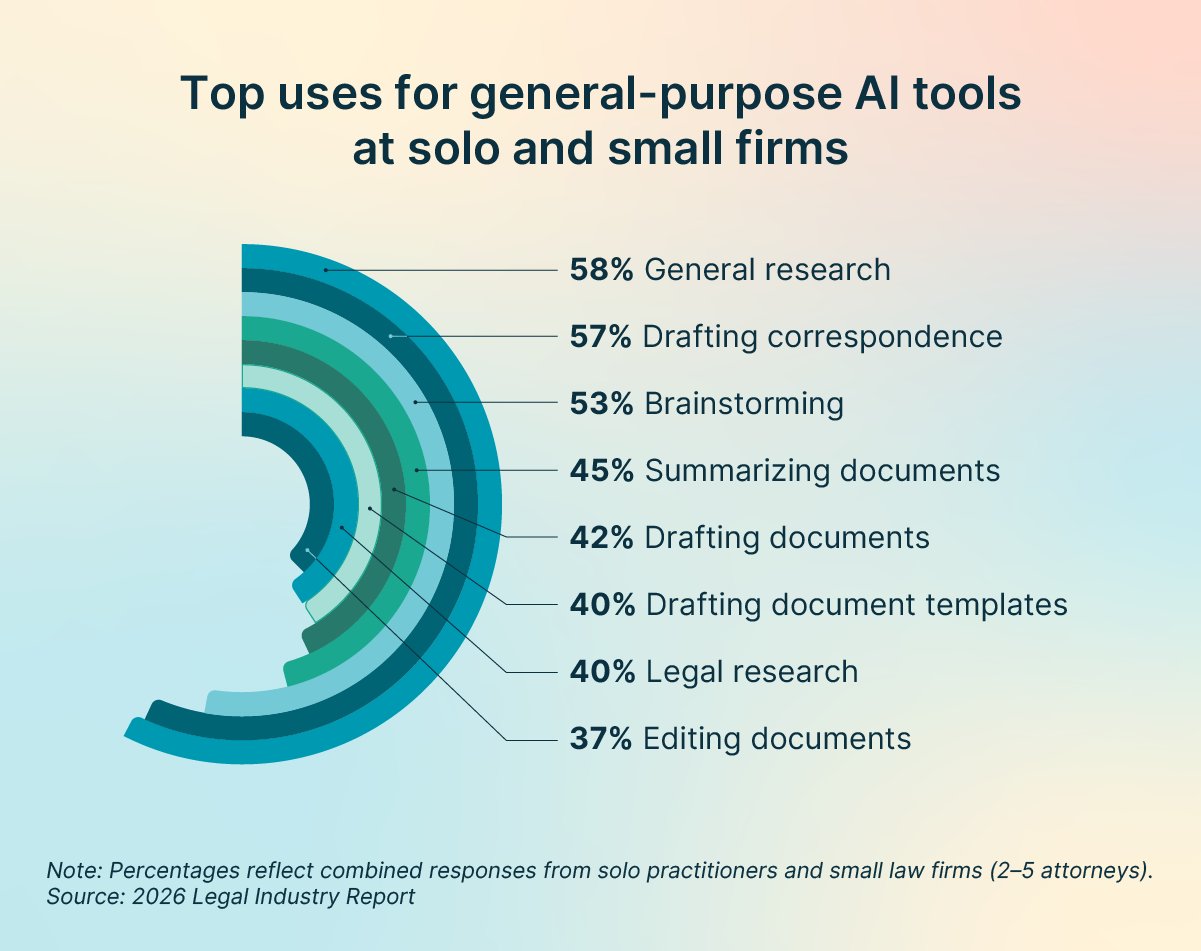
The report found that the most common uses for general-purpose AI at solo and small firms are:
-
General research (58%)
-
Drafting correspondence (57%)
-
Brainstorming (53%)
-
Summarizing documents (45%)
-
Drafting documents (42%)
These findings suggest many professionals use general AI platforms to gather information, develop ideas, and produce first drafts before moving into more specialized legal work.
Uses for legal AI tools
Among respondents using legal-specific AI, the most common use cases closely mirrored those of general-purpose AI platforms:
-
Legal research (57%)
-
Drafting documents (49%)
-
Summarizing documents (46%)
-
Drafting correspondence (42%)
-
General research (41%)
The biggest differences were in how each type of tool was used. Brainstorming and drafting correspondence were more common among users of general-purpose AI, while legal research and document drafting ranked higher among users of legal AI.
This pattern suggests many firms rely on general AI for open-ended writing and idea generation, while turning to legal-specific tools for work that requires legal context and practice-specific features.
Comparing AI usage habits between small firms and solo practices
Solo practices and small firms use AI in similar ways, but there are a few notable differences between the two groups. For example, solo-practice attorneys and staff were more likely than small-firm professionals to use AI for brainstorming (57% versus 49%), drafting documents (44% versus 40%), creating marketing materials (26% versus 19%), and knowledge management (21% versus 12%).
These differences suggest AI for solo lawyers may support a broader range of business and administrative work that’s typically shared across multiple roles at larger firms.
What's holding solo and small firms back from AI adoption?
While AI adoption is growing at solo and small firms, there’s some hesitation around expanding its role in their practices. According to the Legal Industry Report, among the solo and small-firm respondents who gave input about their concerns related to AI adoption, the three most common concerns were:
-
Lack of trust in AI-generated results (83%)
-
Data security concerns (80%)
-
Ethical issues (78%)
Training and policy
A majority of smaller practices have not yet implemented official AI policies or training programs. Among survey respondents, 62% of solo practices and 53% of small firms said they haven’t provided AI training and have no plans to do so.
Small firms were somewhat more likely to be working on formal plans for AI governance: 20% said they expect to develop an AI policy within the next year, compared with 13% of solo practices.
These findings suggest AI governance is still taking shape at solo and small firms. As these practices grow and AI adoption in small law firms increases, formal policies and training may become more important for establishing consistent expectations around approved tools, confidentiality, and review of AI-generated work.
How to implement legal AI for small law firms and solo practices
The following strategies can help your firm move from experimenting with AI toward a more structured, secure approach to adoption.
Start with low-risk tasks
Begin training your team on familiar, lower-risk tasks such as summarizing documents, drafting emails, or brainstorming ideas. This will give them an opportunity to get comfortable with the technology and build stronger review habits before using AI for more substantive legal work.
Establish an official AI policy
Even a basic AI policy can help clarify which tools are approved, how client information should be handled, and when AI-generated content must be reviewed before use. Short training sessions on prompting, fact-checking, and appropriate use cases can help attorneys and staff apply AI more consistently.
Consider legal-specific AI tools
General-purpose AI platforms can be a good option for early-stage work, but solutions designed for legal work are typically better equipped for tasks that involve firm data, client information, and specialized workflows. They’re also built with the security, privacy, and compliance requirements of legal practice in mind.
Use AI built into existing solutions
AI that’s integrated into your practice management solution reduces the need to move information between systems or upload data into separate tools. It also allows AI tools to draw on your firm's documents and matter information, allowing you to quickly locate key details, summarize files, and answer questions about specific cases.
Measure results
Track AI's impact using metrics that align with the work you're trying to improve. Depending on the use case, that might include hours saved, document turnaround times, drafting or research time, matter completion times, or the number of tasks completed. Comparing these metrics before and after introducing AI can help identify where it's delivering measurable value and where additional training or investment may be needed.
How 8am IQ helps solo and small law firms succeed with AI
The Legal Industry Report findings suggest that solo and small law firms are looking for AI tools they can trust, with security, legal context, and practical workflows built in. 8am IQ brings those capabilities directly into MyCase, allowing attorneys to use AI without leaving the solution where they already manage matters, documents, and client information.
Available in MyCase Advanced plans, 8am IQ includes a suite of AI assistants designed to help solo and small firms review documents, find information, and draft communications more efficiently:
-
Document Assistant summarizes key facts, dates, and other important details from documents such as bank statements, tax returns, medical records, and supporting case files, helping attorneys review large volumes of information more quickly.
-
Writing Assistant improves the quality and tone of client messages, case notes, invoices, requests for funds, and other written communications while keeping attorneys in control of the final content.
-
Discovery Assistant uses optical character recognition (OCR) to automatically convert scanned and image-based files into searchable text, making discovery materials easier to organize and review.
-
Case Assistant answers questions using information already stored in MyCase, helping attorneys quickly find notes, filings, court orders, timelines, and other matter details without manually searching through case files.
Book a demo today and see how MyCase can help your firm build a more efficient, connected legal practice.
Download the 2026 Legal Industry Report to learn more about AI adoption across the profession, and explore more legal AI trends at the 8am Practical AI for Law Firms Hub .